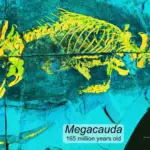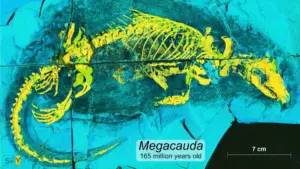









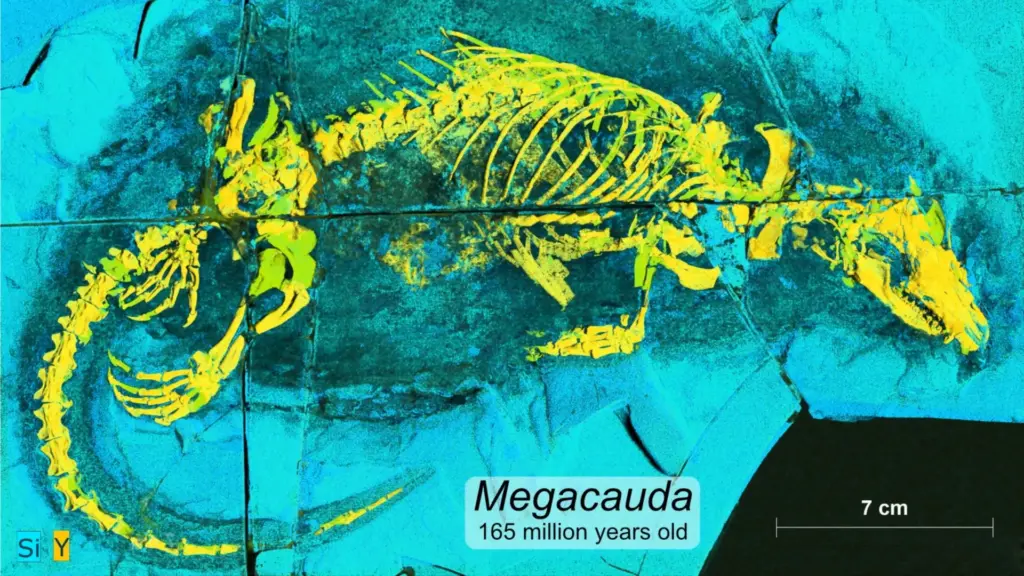
In the shadow of the gargantuan dinosaurs that dominated the Jurassic period, a small but formidable creature was quietly perfecting biological innovations that would one day define the mammalian lineage. Scientists have identified a 165-million-year-old fossil, Megacauda sungei, a furry, semi-aquatic predator that provides an unprecedented look at how early mammal relatives navigated their environments and developed the complex anatomical features necessary for the survival of their young.
Measuring approximately half a meter—roughly 20 inches—from nose to tail, Megacauda sungei was a heavyweight among its contemporaries. While modern mammals, from the blue whale to the African elephant, have scaled to massive proportions, their Jurassic ancestors were typically diminutive, often weighing only a few grams. Against this backdrop, the two-kilogram (4.4-pound) Megacauda was a true giant, a "top predator" in a world where most mammalian ancestors were relegated to the margins of ecological niches.
The discovery, recently published in the journal Nature, is the result of a multi-year collaborative effort by an international team of paleontologists, including Prof. Dr. Chang-Fu Zhou of Shandong University, Prof. Dr. Zhe-Xi Luo of the University of Chicago, and Prof. Dr. Thomas Martin of the University of Bonn. The fossil, unearthed in Xiayingzi, Inner Mongolia, and held by the Paleontological Museum of Liaoning in Shenyang, was subject to years of meticulous analysis, computed tomography (CT) scanning, and anatomical modeling before its true significance was fully understood.
A Breakthrough in Anatomy: The Soft Palate
While the size and aquatic lifestyle of Megacauda sungei are remarkable, the most profound discovery lies hidden within its throat. Researchers identified evidence of a sophisticated soft palate—a muscular structure that separates the mouth from the pharynx. This anatomical development is a cornerstone of mammalian evolution, fundamentally changing how these animals interacted with their environment.
In many non-mammalian vertebrates, the breathing and swallowing pathways are less distinct. Crocodilians, for instance, rely on a simpler arrangement of hyoid bones in the throat. Because they lack a soft palate, they are forced to employ "gravity-fed" mechanics to ingest food. As Prof. Dr. Thomas Martin of the University of Bonn explains, these reptiles must often lift their heads and perform sudden, jerking motions to force unchewed prey down their throats.
In contrast, the mammalian throat is a marvel of evolutionary engineering. The presence of a soft palate, combined with an elaborate hyoid structure, allows mammals to separate the act of breathing from the act of swallowing. This capability is not merely a convenience; it is a critical physiological requirement for nursing. The ability to suckle and swallow nutrient-rich milk without the risk of liquid entering the nasal passages or airway provided a significant survival advantage for early mammals.
"It was this adaptation that made brain development, eventually leading to humans, possible," Martin notes. "The soft palate and the shaping of the oral cavity and pharynx are directly linked to the evolution of mammals." Finding evidence of this structure in Megacauda sungei—a creature that lived millions of years before the rise of modern mammals—suggests that the physiological foundations for nursing were established far earlier than previously documented.
An Aquatic Specialist in the Age of Dinosaurs
With its short, dense fur and a broad, flattened tail, Megacauda sungei would have resembled a prehistoric otter, beaver, or platypus. Through advanced CT scanning, the research team created detailed three-dimensional reconstructions that allowed them to visualize how the animal moved through its environment. The models indicate a highly specialized locomotion: the animal likely paddled through the water using its front legs, while its tail provided propulsion through an undulating, side-to-side motion. Its hind legs were likely utilized for steering and maneuvering in the water.
"It is the earliest evidence of an aquatic lifestyle in mammals," says Martin. This discovery challenges the perception that early mammaliaforms were limited to terrestrial or arboreal habitats. Megacauda proves that the ancestors of modern mammals were already experimenting with diverse ecological niches as early as the Jurassic period.
This specialization was further reflected in the animal’s dentition. The creature possessed teeth with backward-curving cusps, an ideal design for gripping slippery, aquatic prey. Perhaps most surprising to the researchers were the specialized canine teeth, which featured three roots—a distinctive and complex anatomical feature that further underscores the rapid evolutionary diversification of the group to which Megacauda belonged: the docodonts.
The Docodont Legacy
Megacauda sungei has been classified as a member of the docodonts, an extinct group of early mammal relatives—or mammaliaforms—that were widespread across the Northern Hemisphere during the Jurassic. The name Megacauda itself is a nod to the animal’s physical characteristics, translating to "large tail," while the species designation sungei honors Prof. Sun Ge, the Honorary Director of the Paleontological Museum of Liaoning, who facilitated the research.
The study of Megacauda serves as a lens through which scientists can view the rapid evolutionary experimentation occurring in the shadows of the Mesozoic Era. Other fossils within the docodont group have shown that these animals were incredibly adaptable; while some docodonts were adapted for life in the trees or burrowing through soil like modern moles, Megacauda represents the branch that mastered the water.
"This shows how widespread docodonts were in the Northern Hemisphere and that this diverse group of animals developed very different lifestyles at an incredibly early stage," summarizes Martin.
The journey from the fossil’s discovery in the collection of the Paleontological Museum of Liaoning to its formal classification in Nature was a long, complex process. The researchers spent years comparing the specimen with other prehistoric fossils and living analogs, ensuring the accuracy of their reconstruction and the validity of their claims.
Ultimately, Megacauda sungei stands as a testament to the resilience and ingenuity of the earliest ancestors of mammals. By developing specialized aquatic movement, complex dental structures, and the vital, life-sustaining mechanism of a soft palate, these small creatures were carving out a future that would eventually lead to the rise of modern mammalian life. The discovery reminds us that the "Age of Dinosaurs" was not just a time of giant reptiles, but a period of profound biological innovation that continues to shape the anatomy of every mammal alive today.