




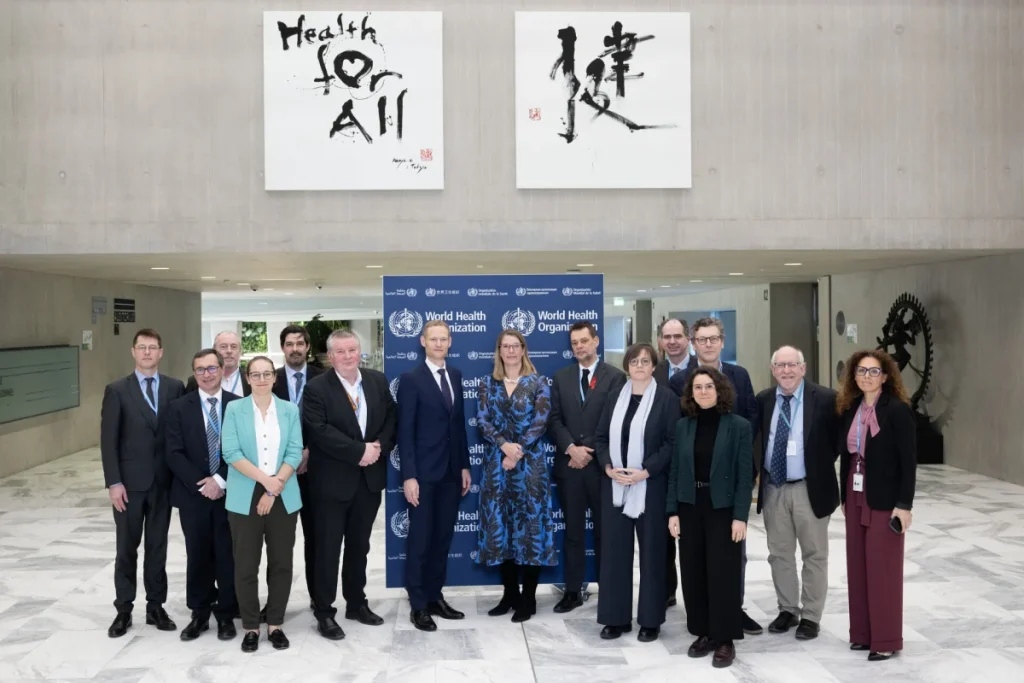
In a significant move to bolster international health security, Belgium and the World Health Organization (WHO) have concluded a comprehensive three-day strategic dialogue, reinforcing a longstanding partnership dedicated to advancing the global health agenda. The sessions, held in early March 2025, served as a critical forum for both parties to review historical progress and harmonize future objectives, particularly in the realms of universal health coverage (UHC), the strengthening of national health systems, and ensuring equitable access to life-saving medical countermeasures.
The Belgian delegation, led by H.E. Christophe Payot, Ambassador of Belgium to the United Nations and other international organizations in Geneva, represented a broad cross-section of the Belgian government. The mission included high-level participants from the federal government as well as the Flemish and Walloon regional governments, underscoring the nation’s holistic commitment to global health. During the three-day summit, the delegation engaged with WHO leadership and technical experts from the organization’s headquarters, as well as the Regional Offices for Africa and Europe.
The dialogue was designed not only to assess the efficacy of existing programs but also to ensure that WHO’s strategic direction remains fluid and responsive to an increasingly complex global landscape. For Belgium, the meeting served as an opportunity to build upon the momentum generated during its presidency of the Council of the European Union in 2024, where global health was a centerpiece of the policy agenda.

"After listening to the leaders and experts of WHO, we now better understand how they are navigating these challenging times," remarked Mr. Koen Van Acoleyen, Minister Counselor at the Permanent Representation of Belgium to the UN. "We are honored that we can walk this road together."
Accelerating Equitable Access to Vaccines, Medicines, and Health Technologies
A primary pillar of the discussions focused on the Access to Medicines program, an initiative heavily supported by Belgian funding. The program is designed to bridge the gap between innovation and patient delivery, particularly in low- and middle-income countries. WHO representatives presented a granular overview of the program’s current status, highlighting both the successes achieved and the systemic challenges that persist in the global pharmaceutical supply chain.
To illustrate the practical application of these policies, the teams examined a case study from Senegal. This country-level implementation provided a clear view of how international policy translates into local, tangible results—and where bottlenecks in distribution, regulatory approval, or infrastructure continue to impede progress. The conversation highlighted the critical role of local production, with both parties acknowledging that the long-term sustainability of the Access to Medicines initiative depends on “market shaping.” By creating predictable, stable environments for medical technologies, the partners aim to ensure that essential medicines remain available and affordable long after specific grant cycles conclude.
Health Emergencies and Pandemic Prevention
The dialogue shifted to the evolving global architecture for health emergency prevention, preparedness, and response (PPR). Central to this discussion was the ongoing negotiation of the international pandemic agreement—a landmark effort to ensure that the world is better equipped to handle future biological threats. The participants also explored the "One Health" approach, which recognizes the interconnectedness of human, animal, and environmental health as a vital strategy for preventing zoonotic disease spillover.
The urgency of these discussions was underscored by a presentation on WHO’s field operations in Gaza. By detailing the difficulties of delivering health services in active conflict zones, the WHO provided the Belgian delegation with a stark reminder of why emergency resilience is non-negotiable. Furthermore, the experts addressed the rising threats posed by the acceleration of biological risks. As technology advances and the risk of zoonoses increases, the focus remains on robust risk mitigation strategies that prioritize early detection and rapid, coordinated response.
Universal Health Coverage and Systemic Strengthening
A substantial portion of the three-day meeting was dedicated to the UHC-Partnership, an initiative that has seen significant progress between 2021 and 2024. This segment of the dialogue reviewed the results of interventions in Belgium’s partner countries, with the Democratic Republic of Congo serving as a primary case study for the challenges of implementing health reforms in complex, fragile settings.

The participants explored ways to move beyond simple project funding toward a model of enhanced, integrated collaboration at the country level. This includes the potential for tighter alignment between WHO country office programs and Belgium’s own bilateral development cooperation strategies. By synchronizing these efforts, both parties aim to reduce fragmentation and maximize the impact of every euro invested.
Furthermore, the discussion touched upon the integration of mental health into primary health care. Recognizing that mental health is an essential component of universal coverage, the partners reviewed WHO’s latest policy frameworks to ensure that this often-overlooked sector receives the necessary attention and funding to be effectively woven into national health systems.
The scope of the dialogue extended to other vital areas of cooperation, including the fight against neglected tropical diseases (NTDs) and the advancement of sexual and reproductive health and rights (SRHR). In these areas, the dialogue served to reinforce the necessity of an evidence-based approach, ensuring that resource allocation is driven by data rather than conjecture.
Dr. Catharina Boehme, WHO Assistant Director-General for External Relations and Governing Bodies, expressed the organization’s deep appreciation for the multifaceted support provided by Belgium. "We thank you for your support, honesty, and strong engagement for global health," Dr. Boehme said. "Your efforts in supporting our work in Mozambique and Senegal are clear examples of the crucial work we accomplish together."
Looking into the Future: The 14th General Programme of Work
As the dialogue concluded, the partners turned their attention to the future, discussing the evolution of the Belgium-WHO collaboration framework. A key focus was the progress toward a renewed WHO-Belgium Country Cooperation Strategy, which will serve as the roadmap for the next phase of their alliance.
The shared vision for this future is anchored in the WHO’s 14th General Programme of Work (GPW14). Both parties agreed that universal health coverage and the strengthening of health systems must remain the foundational elements of the GPW14 agenda. By placing these goals at the heart of their prioritization work, Belgium and the WHO aim to ensure that the global health system is not only capable of responding to the next crisis but is also capable of providing for the daily health needs of populations worldwide.
For the Belgian government, the partnership represents more than just a financial contribution; it is a commitment to the principles of multilateralism in an era where global cooperation is frequently tested.
"We recognize WHO as a trustworthy partner in global health," concluded Mr. Dirk Brems, Director of Thematic and Multilateral Cooperation at the Directorate-General for Development Cooperation and Humanitarian Aid. "We felt proud hearing how crucial our support is to the organization and how it is having a positive impact at country, regional, and global levels. It is important we continue these discussions as we tread uncharted territories, and we look forward to working together for strong and sustained multilateralism."
The successful conclusion of this strategic dialogue marks a renewed mandate for the Belgium-WHO partnership, setting a clear course for collaboration that prioritizes long-term resilience, equity, and the unwavering pursuit of health for all.