








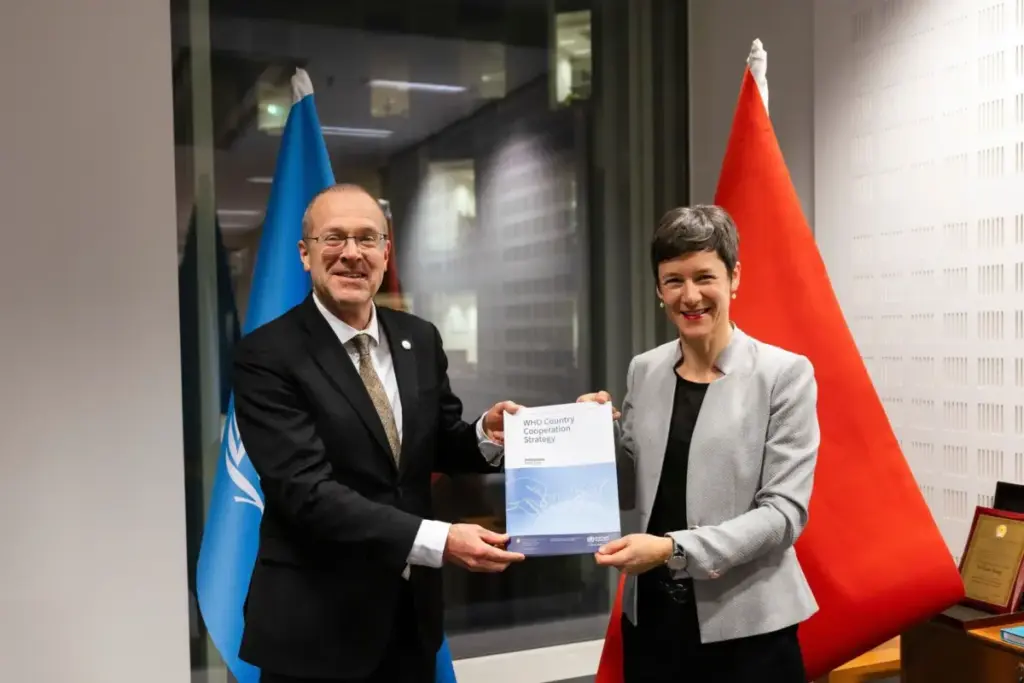
The World Health Organization (WHO) and the Swiss Confederation have officially renewed their commitment to collaborative public health governance, formalizing a new cooperation strategy for the period spanning 2024 to 2028. This milestone, finalized on March 4, 2025, at the WHO Regional Office for Europe in Copenhagen, Denmark, solidifies a long-standing partnership that has consistently served as a benchmark for how international health organizations and high-income nations can align their priorities to address both regional and global health challenges.
The signing ceremony, attended by key representatives including Barbara Schedler, Ambassador for Global Health at the Swiss Federal Office of Public Health, and Dr. Hans Henri P. Kluge, WHO Regional Director for Europe, marks a significant progression in a diplomatic and technical relationship that has evolved considerably over the last decade. By cementing this agreement, both parties have signaled a unified approach to navigating the complexities of modern public health, ranging from pandemic preparedness and health security to the strengthening of sustainable, equitable health systems.
A Pioneering Framework for Cooperation
The history of this unique collaboration dates back to 2013, a pivotal year that saw Switzerland distinguish itself as the first high-income country within the WHO European Region to adopt a structured country cooperation strategy. At the time, the concept of a "cooperation strategy" was primarily utilized by the WHO to engage with low- and middle-income nations to align international assistance with local needs. Switzerland’s decision to pilot this model was a bold departure from traditional donor-recipient dynamics, instead framing the relationship as a peer-to-peer technical partnership.

The rationale behind this initiative was to leverage the unique strengths of both entities. Switzerland, as a global hub for life sciences, pharmaceutical innovation, and international diplomacy, possesses vast technical expertise. The WHO, conversely, provides the normative leadership, global reach, and the convening power necessary to turn technical solutions into policy realities. By formalizing this relationship through a strategic document, Switzerland and the WHO ensured that their collaboration was not merely ad-hoc but guided by long-term, measurable objectives.
Over the years, this strategy has facilitated a more cohesive integration of Swiss health policy priorities with the broader European and global health agenda. It has allowed for the exchange of expertise on critical issues such as health system resilience, digital health, and the management of non-communicable diseases. The success of the initial strategy led to the realization that, in an increasingly interconnected world, such a framework remains essential for navigating the evolving health landscape.
Renewing the Vision for 2024–2028
The decision to update and renew the cooperation strategy was reached in 2022, following a comprehensive review of the previous years’ achievements and an assessment of the current global health climate. The finalized document, which covers the 2024–2028 period, is the product of intensive dialogue between the Swiss Federal Office of Public Health and the WHO European Region.
This new iteration of the strategy is designed to be agile and responsive. It reflects a shared understanding that the post-pandemic era requires a different approach to health governance—one that prioritizes proactive surveillance, equitable access to medical countermeasures, and the strengthening of multilateral institutions. The 2024–2028 strategy focuses on enhancing technical cooperation, fostering innovation in health policy, and continuing the robust advocacy for universal health coverage that has defined the relationship for years.
During the signing event in Copenhagen, the atmosphere was one of mutual respect and shared purpose. Dr. Hans Henri P. Kluge noted that the partnership remains a cornerstone of the WHO’s efforts to improve health outcomes across the continent. By working closely with a partner as dedicated to public health as Switzerland, the WHO can more effectively implement its European Programme of Work, ensuring that health policies are not only evidence-based but also practically implementable in diverse settings.

For Switzerland, the strategy represents an opportunity to amplify its influence in global health. As a nation that hosts numerous international organizations and remains at the forefront of the global health discourse, Switzerland’s alignment with the WHO ensures that its domestic health priorities—such as mental health, aging populations, and pharmaceutical regulation—are consistent with the international norms set forth by the World Health Organization.
The Broader Context of Global Health Security
The renewal of this strategy does not exist in a vacuum; it is part of a broader suite of collaborative initiatives between the two entities. A prominent example of this deep-seated cooperation is the partnership surrounding the global BioHub system. This initiative, which was strengthened significantly in mid-2024, serves as a testament to the practical, operational outcomes that arise from the WHO-Switzerland alliance.
The BioHub system is designed to facilitate the rapid sharing of pathogens and clinical samples between countries. In an era where the speed of response determines the scale of a potential pandemic, the ability to share information and biological materials in a secure, transparent, and timely manner is non-negotiable. Switzerland’s role in supporting this infrastructure—by providing the legal, technical, and logistical support necessary for such a delicate international endeavor—highlights the depth of the trust built between the two parties.
The 2024–2028 cooperation strategy is expected to act as an umbrella for these specialized projects. It ensures that the various strands of collaboration—from diplomatic policy to technical logistics—are woven into a coherent strategy that maximizes the impact of resources and expertise. By maintaining this structured dialogue, both the WHO and Switzerland can better anticipate emerging health threats and coordinate their responses without the delays often associated with international bureaucratic processes.
Looking Ahead: Implementation and Impact
As the implementation of the 2024–2028 strategy begins, the focus will shift toward translating the high-level commitments into tangible actions. This includes continued collaboration on health systems strengthening, where Switzerland’s expertise in health insurance models and clinical quality can provide valuable insights for other WHO member states. Furthermore, the partnership will continue to emphasize the importance of digital transformation in health, recognizing that data-driven policy is the future of resilient health systems.
The partnership also serves as a model for other high-income nations. By demonstrating that even the most developed countries benefit from a structured, collaborative relationship with the WHO, the strategy encourages a shift away from a "donor-only" mentality. It invites other nations to engage with the WHO as strategic partners, fostering a culture of mutual learning that is essential for tackling cross-border health issues like antimicrobial resistance, climate-related health risks, and the equitable distribution of vaccines.
The WHO Media Team, in coordination with the Swiss Federal Office of Public Health, has emphasized that the full details of the 2024–2028 agreement are publicly available for those interested in the specific technical objectives of the partnership. Through the official WHO/Europe website, stakeholders, researchers, and the general public can access the full text of the country cooperation strategy, providing transparency into how these two entities plan to contribute to the global health agenda over the next four years.
Ultimately, the renewal of this partnership is more than just a bureaucratic formality. It is a reaffirmation of the belief that international health security is a collective responsibility. By aligning their efforts through a well-defined, multi-year strategy, the WHO and Switzerland are ensuring that they remain well-positioned to face the inevitable challenges of the future, guided by a foundation of trust, shared values, and a commitment to the health of all people. As the world continues to recover from the shocks of recent years, the stability provided by such alliances remains a vital component of the global health architecture.