






In an era defined by deep ideological divides, the political landscape across many Western democracies often feels split into two unyielding camps. In the United States, citizens increasingly align themselves with the platform of a single political party while harboring a profound distaste for the ideology, policies, and rhetoric of the opposition. On virtually every major legislative or cultural question—ranging from healthcare and taxation to judicial appointments and social norms—the space for cross-partisan consensus appears to be shrinking by the day.
Yet, this stark polarization does not mean that every individual holds extreme or uncompromised views on hot-button public policy issues. Consider a deeply contentious and emotionally charged topic such as abortion. On one end of the spectrum, some individuals staunchly defend a woman’s fundamental right to choose whether to terminate a pregnancy under any circumstances. On the opposite end, others vehemently oppose abortion rights in all cases, even when the life of the pregnant mother is in danger.
Between these ideological extremes, however, exist numerous individuals who hold more moderate, nuanced positions. A moderate might support abortion access only during the earliest stages of gestation—such as through the first eight weeks of pregnancy—or believe that procedures should be permissible solely under specific circumstances like medical emergencies, severe fetal abnormalities, or cases involving sexual assault.

This raises a compelling psychological question: How do committed partisans—those with strong, unbending political loyalties—perceive these moderates who occupy the middle ground?
One intuitive possibility is that moderate voices might be welcomed and embraced by both sides of the political aisle. Because a moderate’s platform contains elements that partially align with the core values of both liberals and conservatives, each major party might theoretically find something to appreciate or respect.
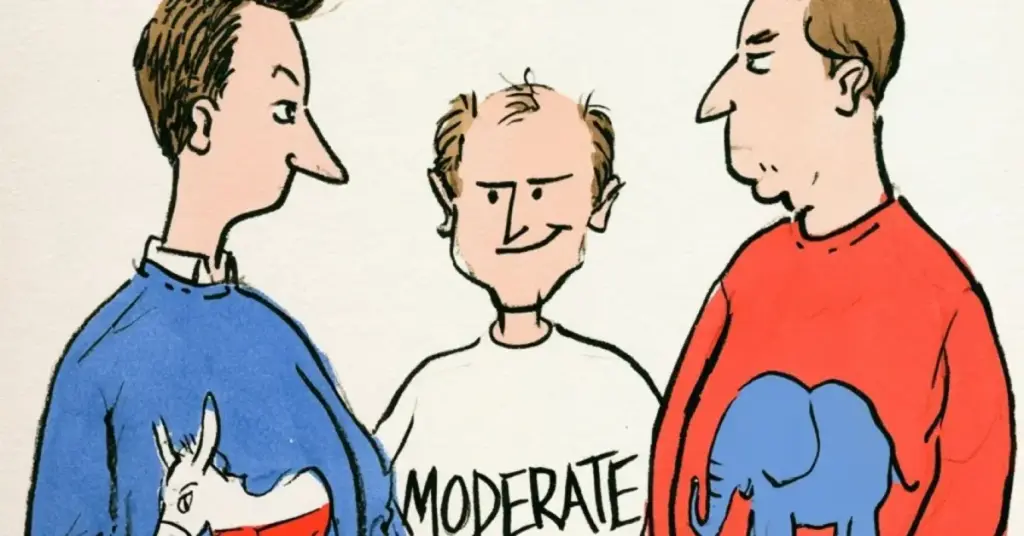
However, a darker and more cynical psychological reality often takes hold. Rather than being viewed as reasonable mediators or bridge-builders, moderates frequently face intense hostility from members of both political factions. From the perspective of strongly polarized individuals, attention is rarely directed toward the ways a moderate agrees with them. Instead, hardline partisans hyper-focus on the ways a moderate’s views diverge from their own orthodox creed. Consequently, these centrist individuals are frequently cast out, viewed not as potential allies or sensible insiders, but as untrustworthy outsiders who belong to the opposing camp.
This paradoxical and troubling phenomenon was recently explored in depth through a series of empirical studies conducted by researchers Giulia Maimone and Craig McKenzie. Their findings were published in the Journal of Experimental Psychology: General.
To investigate how partisans evaluate ideological compromise, Maimone and McKenzie focused their initial study on the abortion debate in the United States—a domain well-known for eliciting intensely polarized reactions. The researchers recruited participants who held strong, unwavering stances on the issue, either firmly pro-choice or firmly pro-life. These participants were then asked to evaluate the political and moral views of a diverse group of hypothetical targets.
Some of these targets held strong, predictable views on one side of the abortion debate or the other. Other targets held explicitly moderate positions, such as favoring legal abortion access only within the first eight weeks of pregnancy and opposing it at any point thereafter.
When analyzing the evaluation data, the researchers discovered a striking pattern. Participants with strong partisan views generally agreed with one another when rating other hardline individuals. However, their assessments diverged dramatically and predictably when they were asked to evaluate the moderates.
Specifically, individuals who identified as strongly pro-choice rated the moderate targets as being fundamentally pro-life. Conversely, participants who were strongly pro-life rated those exact same moderate targets as being moderately pro-choice. In short, rather than recognizing moderates as occupying a middle position between the two extremes, both groups of partisans perceived the moderates as being significantly more aligned with their ideological enemies than with their own allies.
Subsequent studies in the same research series—some of which examined other high-profile, emotionally charged public controversies—expanded upon these initial findings by identifying two critical psychological mechanisms driving the phenomenon.
First, the researchers found that this tendency for partisans to categorize moderates as members of the opposing group was most pronounced when the political issue carried a strong moral dimension or provoked a deep sense of threat. For an issue to trigger this "moderate as out-group" effect, it had to be a topic that elicited a powerful emotional reaction from the evaluator, transforming a policy disagreement into an existential battle of good versus evil.
Second, the studies revealed that this misclassification of moderates was heavily driven by a specific underlying perception: partisans believed that the moderates simply did not share their hatred of the opposition. To test this hypothesis, one of the later studies utilized the complex and deeply polarizing geopolitical conflict surrounding Israel and Palestine.
During this study, participants were asked to evaluate two distinct types of moderates. The first type was described as a moderate who could see and appreciate the valid points of view held by both sides of the conflict. The second type was described as a moderate who actively opposed both sides of the conflict.
The results provided a revealing glimpse into the psychology of political animosity. Pro-Israel and pro-Palestinian participants alike rated the moderates who showed understanding for both sides as being members of the opposing faction. Pro-Israel participants viewed these empathetic moderates as leaning toward the Palestinian cause, while pro-Palestinian participants viewed them as leaning toward the Israeli cause.
In stark contrast, both groups of participants rated the moderates who disliked both sides as being genuinely and fairly moderate. This crucial distinction suggests that partisans are not merely looking for ideological agreement when evaluating others; they are actively scanning for evidence of mutual animosity. To be considered compatible with a political group, an individual must demonstrate a shared distaste for the enemy. If a moderate fails to express the requisite hostility toward the opposing side, they are immediately relegated to the out-group.
These empirical findings carry profound implications for the health of public discourse and the future of democratic governance. They suggest that individuals who attempt to look for the positive aspects of opposing arguments, or who advocate for compromise on contentious issues, will inevitably face immense difficulty connecting with hardline partisans. This psychological barrier can severely hamper any genuine societal attempts to find a stable middle ground on hot-button topics.
Furthermore, these insights shed light on why deeply committed partisans so frequently view balanced, objective news coverage as being systematically biased against their worldview. Professional journalism strives to present information in a neutral, dispassionate manner, giving fair consideration to multiple perspectives. However, if a partisan viewer is actively searching for validation of their belief that the opposing side is entirely wrong and malevolent, they will not find that validation in neutral reporting. Consequently, the absence of partisan alignment in the news is frequently misinterpreted as active hostility, leading audiences to condemn independent media outlets as biased against them.
As Maimone and McKenzie acknowledge in their published work, the scope of their investigations was limited to participants residing within the United States. As a result, social scientists do not yet know whether similar cognitive patterns would emerge among populations living in other, less politically polarized societies, or whether identical studies conducted in the United States during a different historical and political era would have yielded parallel results.
Nevertheless, the research provides a sobering reminder of the psychological forces currently shaping public life. In an environment where political identity is increasingly tied to moral conviction and shared animosity, the middle ground is left desolate—viewed by the extremes not as a place for reconciliation, but as enemy territory.