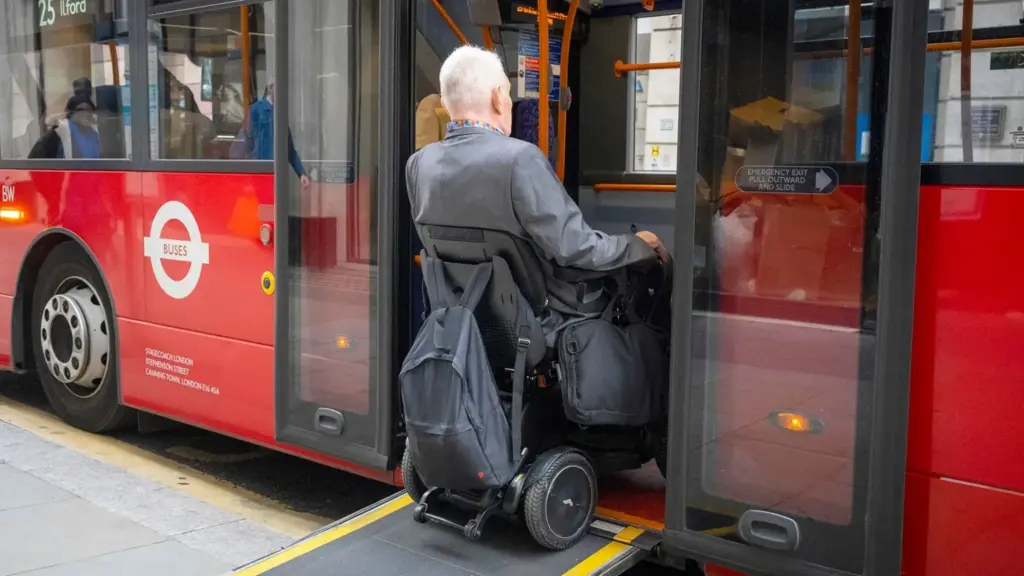
Starting April 1, disabled people across England will be able to travel by bus for free at any time of day, marking a monumental shift in national transport policy. Previously, free bus passes were restricted to off-peak hours on weekdays—specifically between 09:30 and 23:00. These historical time limits created severe barriers for pass holders attempting to commute to standard morning jobs, secure early appointments, or attend late-night cultural, social, and professional events. The removal of these time constraints will directly benefit an estimated one million people nationwide, effectively transforming local bus networks into a true full-time lifeline for disabled citizens seeking greater independence and integration into the workforce.
The landmark policy follows a highly successful trial conducted within Greater Manchester’s integrated “Bee Network.” The regional pilot demonstrated that removing time-based restrictions on concessionary travel did not destabilize local transit operations, but instead provided essential flexibility for passengers with diverse scheduling needs. Furthermore, the nationwide expansion responds to years of persistent campaigning by prominent disability rights organizations, including Scope and Transport for All. Advocates have widely celebrated the government’s decision for eliminating an unfair “postcode lottery,” a fragmented system where the validity of a concessionary pass previously depended heavily on arbitrary local rules and municipal boundaries.
Despite the widespread praise, disability organizations emphasize that this reform represents only one vital step toward true transit equity. Campaigners have noted that eligibility requirements across various regions still require broader standardization to ensure that disabled individuals receive equitable treatment regardless of where they live. To make the program permanent and economically viable for local authorities, the £60 million scheme is being funded jointly through the Department for Transport and the Department for Work and Pensions. Government officials are framing the reform as an essential workforce and cost-of-living initiative, aligning seamlessly with existing transit measures such as the nationwide £2 single-fare cap. This crucial update also brings England in line with similar 24/7 concessionary transit programs that have successfully operated in Scotland and Wales for years.

Global Takeaways: How Other Countries Can Make Accessible Commuting Possible
Making daily commuting accessible and affordable for disabled citizens requires a careful combination of deliberate policy design, advanced digital systems, and targeted public investment. As nations around the world look for effective models to improve urban and regional mobility, the UK’s recent policy adjustment offers significant insight into the mechanics of concessionary transit reform.
Why Was the UK Able to Do It?
The ability to implement a nationwide 24/7 free bus travel policy stems from a combination of centralized funding, existing legal frameworks, and sustained political pressure from organized advocacy groups. By utilizing joint investments from the Department for Transport and the Department for Work and Pensions, the central government absorbed financial responsibilities that might otherwise have strained local municipal budgets. This centralized backing was paired with the foundational framework of the pre-existing English National Concessionary Travel Scheme, allowing policymakers to build upon established infrastructure rather than designing a brand-new system from scratch. Furthermore, the groundwork laid by Greater Manchester’s "Bee Network" trial provided empirical evidence that all-day travel was operationally feasible, giving national policymakers the confidence to roll out the scheme across the entire country.
Does It Depend on Existing Infrastructure?
Yes, heavily. Free transit passes only work if the public transport network is physically and technologically accessible to begin with. Concessionary policies cannot succeed in isolation; they rely intrinsically on the physical and digital readiness of the transit ecosystem. This includes the widespread deployment of low-floor, wheelchair-accessible buses equipped with ramps and designated priority seating areas. Additionally, reliable real-time passenger information systems, audio-visual stop announcements, and well-maintained bus stops and interchange stations are critical components that enable disabled passengers to navigate their journeys safely and independently. Without these foundational infrastructural investments, removing financial barriers through free passes remains an incomplete solution.
What Is Needed to Make Commuting Affordable for People with Disabilities?
Making public transportation genuinely affordable and accessible for people with disabilities requires a comprehensive approach that extends far beyond simply waiving fares. Governments must secure stable, long-term public funding models that insulate transit networks from local government budget cuts and economic downturns. Policymakers also need to streamline and standardize eligibility criteria across all administrative regions to eradicate regional disparities and administrative hurdles for applicants. Integrating concessionary travel schemes across different transport modes—such as buses, trains, and light rail networks—ensures that passengers can complete multi-leg journeys without facing fragmented ticketing systems. Finally, ongoing consultation with disability advocacy groups and direct users remains essential to identifying operational bottlenecks, guiding future investments, and ensuring that public transit systems continue to evolve in step with the needs of the communities they serve.