








At the Monroe Carell Jr. Children’s Hospital in Nashville, the newest piece of mobility equipment is a 3D-printed wheelchair—built layer by layer by a gaming and technology specialist who had never set out to design a wheelchair at all.
That detail matters. It is a small sign of a much bigger shift happening in pediatric care: hospitals, schools, and even individual families are starting to manufacture the assistive technology that the traditional medical supply chain has struggled to deliver affordably, quickly, or in a way that feels like it was made for an actual child instead of a generic patient.
What Is Actually Happening at Monroe Carell
The story centers on Graden Knapp, whose day job is making hospital stays more bearable for kids through toys, video games, and other interactive tools. While working at Monroe Carell, Knapp noticed something more fundamental than entertainment was missing: the hospital did not have enough wheelchairs suited to its young patients’ specific needs.

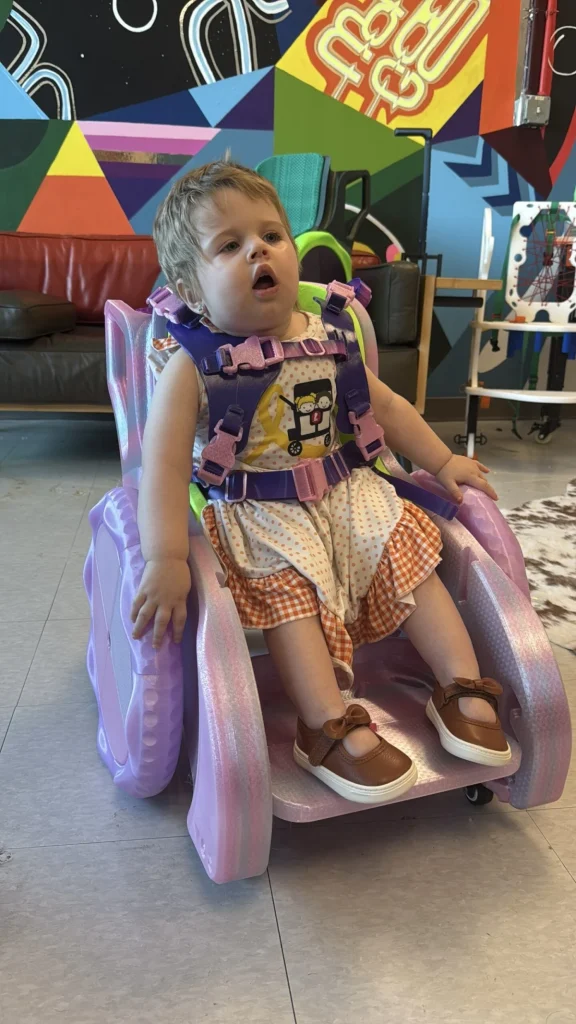
So he taught himself a new skill. According to reporting from WTVF/NewsChannel 5, Knapp came across “Made Good,” a New Orleans-based disability design nonprofit, and used a design the group provided to spend two to three months printing the components and assembling what is now the hospital’s first nearly complete 3D-printed wheelchair.
The plan is not just to park the chair in a hospital closet. Knapp’s intent is for patients to take the wheelchair home with them after discharge, turning a piece of hospital equipment into something a child keeps, customizes, and grows into. It is a small, grassroots project that points to where pediatric assistive technology may be headed: produced on-site, tailored to the individual child, and built around the idea that a wheelchair can be both functional and something a kid is excited to use.
The Likely Design Behind the Wheelchair: MakeGood’s Toddler Mobility Trainer
While local news reports did not name the specific model Knapp built, public documentation points toward MakeGood’s flagship mobility device, the Toddler Mobility Trainer (TMT). The design matches the description of a printed children’s mobility device sourced from a nonprofit network of disability designers.
Developed in collaboration with the industrial design firm LINK PBC and the nonprofit TOM Global, the TMT was announced to expand access to early childhood mobility devices. Nearly every part of the device—including the frame, wheels, tires, seat, and straps—is printed on a consumer-grade machine, such as the Bambu Lab A1. The pieces are engineered to snap together without specialized tools, screws, or glue, in a jigsaw-style assembly. If a component breaks, caregivers can reprint that single piece rather than replacing the entire chair.
MakeGood released the TMT as a free, open-source design on MakerWorld so that anyone with a 3D printer and standard filament—whether a parent, a school technologist, or a hospital specialist like Knapp—can produce one independently. Since its founding in 2021, MakeGood has delivered thousands of free assistive devices of various kinds to families in need.
The Real Story: Cost and the Medical Supply Chain
This is where the project stops being a feel-good local news segment and becomes a genuine accessibility story.
A traditional pediatric wheelchair in the United States typically costs anywhere from $1,200 to $5,000, while custom or powered pediatric models can run well past $12,000 once specialized seating, materials, and electronics are factored in, according to pricing breakdowns from medical equipment retailers like Nurture Mobility and BetterCare. That financial burden is compounded by the fact that growing children outgrow standard wheelchairs every couple of years, multiplying the lifetime cost, while insurance companies frequently deny or only partially cover these claims.

By contrast, MakeGood states that a complete Toddler Mobility Trainer can be produced for about $150 in materials. Industry breakdowns itemize the cost as roughly eight to ten spools of PETG filament, two to three spools of TPU, and a small amount of hardware, including six bolts, two nuts, two washers, and standard casters. While it cannot be independently verified whether Knapp’s specific build matched this exact formulation, the hospital specialist estimated that his creation came out roughly ten times cheaper than a typical commercial wheelchair.
The reason the savings are so dramatic is not merely cheaper raw materials; it is the elimination of an entire layer of manufacturing, distribution, and retail markup that conventional durable medical equipment carries. A traditional wheelchair must be designed, tooled for mass production, manufactured in a central factory, shipped internationally, stocked by a regional supplier, and marked up at each commercial step. A 3D-printed version skips nearly all of that infrastructure, moving from digital file to finished product right where it is needed.
How Accessible Is This Approach in Practice?
While the promise of inexpensive mobility equipment is compelling, accessibility involves more than just a low price tag. Producing a device like the TMT requires access to a reliable mid-sized 3D printer, a stable source of electricity, appropriate printing filaments, and an individual willing to spend time monitoring prints and assembling the components.
However, that combination—a low one-time equipment cost, cheap consumable materials, an open-source design, and no specialized medical manufacturing expertise required—is what makes this model fundamentally different from earlier eras of do-it-yourself medical equipment. It is not just cheaper; it is replicable by schools, community organizations, and individual families almost anywhere a printer and an internet connection exist.
Why This Matters Even More in the Global South
The Nashville story highlights a single hospital with one printer and one motivated employee, but the underlying technology has implications that extend far beyond Tennessee, particularly for low- and middle-income countries where access to mobility devices is severely restricted.
Data from the World Health Organization and UNICEF’s Global Report on Assistive Technology found that more than 2.5 billion people worldwide need at least one assistive product, yet nearly one billion of them are denied access. An analysis of 35 countries showed access rates as low as 3 percent in poorer nations, compared to roughly 90 percent in wealthy countries. Separate research on wheelchair service provision, citing WHO population estimates, indicates that roughly 77 million people worldwide need a wheelchair, of whom only 17 to 37 percent have access to one in less-resourced settings. This leaves an estimated 33 to 65 million people without the mobility devices they require, compounded by the fact that roughly 80 percent of people with disabilities live in developing regions where commercial supply chains are thinnest and import costs are highest.
Low-cost, open-source 3D-printed designs are uniquely positioned to bridge this gap. Because the manufacturing is decentralized, devices can be produced locally using readily available desktop printers, bypassing expensive import tariffs, international shipping delays, and the centralized distribution bottlenecks that plague traditional medical supply chains in the developing world.
Why Hospitals and Institutions Are Taking Notice
The growing interest among hospitals, schools, and disability-focused nonprofits in on-site manufacturing comes down to practical utility. By producing assistive technology locally, institutions can drastically cut costs, eliminate months-long waiting periods for custom equipment, and customize devices directly to the anatomical and psychological preferences of the child.
None of this suggests that 3D-printed devices are ready to fully replace clinically prescribed, insurance-covered wheelchairs for every patient with complex medical needs. Questions surrounding long-term durability, strict weight limits, and formal clinical validation remain active areas of research and development.
Yet for the specific use case demonstrated at Monroe Carell—getting a functional, well-fitted mobility device into a young child’s hands quickly and affordably—the technology is already working today in a clinical setting. For other hospitals, schools, and global health institutions, the central question is no longer whether on-site manufacturing is viable, but who will adopt the model next.