








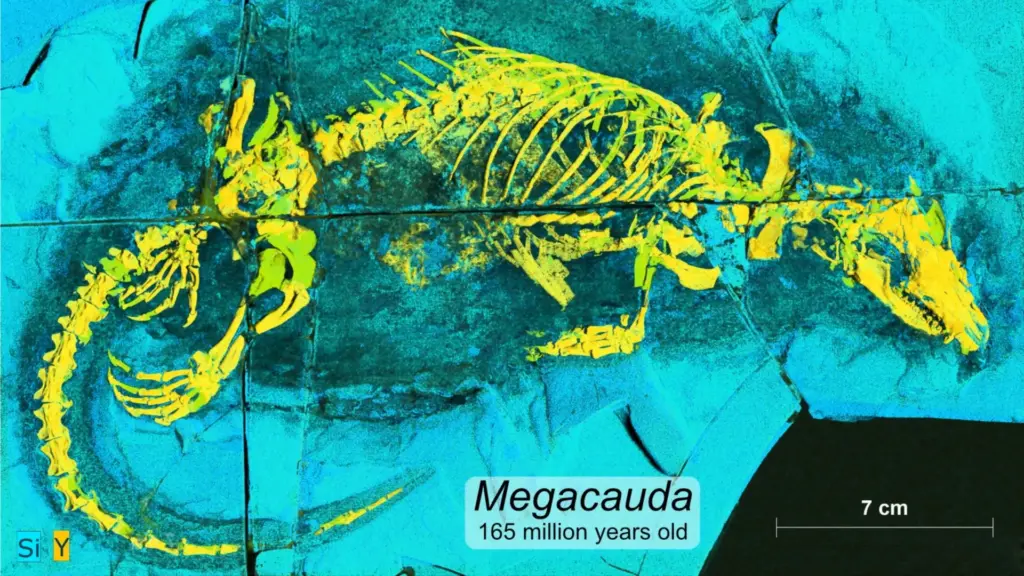
A remarkable fossil discovery from Inner Mongolia has provided scientists with an unprecedented window into the deep history of mammalian evolution. The creature, a furry, water-dwelling predator known as Megacauda sungei, lived approximately 165 million years ago during the Jurassic Period. Measuring about half a meter (20 inches) from its nose to the tip of its tail, this animal was a "giant" among its contemporaries, offering researchers a rare look at how early mammal relatives—known as mammaliaforms—began to diversify and adapt to specialized environments long before the rise of modern mammals.
The findings, published in the journal Nature, are the result of an extensive international collaboration between researchers at the Paleontological Museum of Liaoning in Shenyang, the University of Chicago, and the University of Bonn. By analyzing the fossil’s unique anatomy, the team has not only identified a new species but has also uncovered evidence of a critical physiological transition that would eventually pave the way for the complex biology of modern mammals.
How an Ancient Predator Reveals the Evolution of Swallowing
While the size of Megacauda sungei is noteworthy, its most profound contribution to science lies in the internal structure of its head. Researchers discovered that this ancient predator possessed a sophisticated soft palate. In mammalian anatomy, the soft palate acts as a muscular partition that separates the mouth from the pharynx, the passage connecting the oral cavity to the throat. This seemingly minor anatomical feature is, in fact, a pivotal evolutionary milestone.

In most non-mammalian vertebrates, the lack of a soft palate means that breathing and swallowing are often mutually exclusive, or at least highly restricted. Many animals, such as crocodiles, rely on a simpler arrangement of hyoid bones in the throat. Because they lack the complex mechanics of a mammalian throat, crocodiles must often lift their heads and engage in sudden, jerking motions to move food down their gullets. "This is achieved with the aid of gravity," explains paleontologist Prof. Dr. Thomas Martin of the University of Bonn.
In contrast, mammals possess a highly elaborate hyoid structure that allows for the separation of air and food pathways. This development permits mammals to swallow even when gravity is working against them—a capability that allows humans to drink through a straw while upside down without choking.
This evolutionary shift was essential for the survival of early mammals. The soft palate allows young mammals to consume nutrient-rich milk safely by preventing liquid from entering the nasal passages during the nursing process. Prof. Martin emphasizes the gravity of this discovery: "It was this adaptation that made brain development, eventually leading to humans, possible. The soft palate and the shaping of the oral cavity and pharynx are directly linked to the evolution of mammals." Finding evidence of this structure in Megacauda sungei—a creature that lived millions of years before the modern era—demonstrates that these vital adaptations were already well-established early in the lineage of our ancient ancestors.
A 165-Million-Year-Old Predator Built for Swimming
Physically, Megacauda sungei would have been an intriguing sight. With its short, dense fur and a broad, flattened tail, the creature likely resembled a modern otter, beaver, or platypus. Its entire physiology was optimized for life in the water, a habitat that was far from common for the mammaliaforms of the Jurassic era.
To understand how the animal navigated its environment, the research team utilized high-resolution computed tomography (CT) scans to create detailed three-dimensional reconstructions of the fossil. These digital models suggest a specialized form of locomotion: the animal likely propelled itself through the water by paddling with its forelimbs, while its broad tail provided powerful, undulating movements. Its hind legs, meanwhile, were positioned to function as rudders, allowing for agile changes in direction as it hunted for prey.
"It is the earliest evidence of an aquatic lifestyle in mammals," says Prof. Martin. This aquatic specialization was further supported by the animal’s dentition. Beyond the backward-curving cusps that allowed it to grip slippery, aquatic prey, the creature featured specialized canine teeth with three roots—a distinct and surprising anatomical feature that set it apart from other known species of its time.
Through rigorous comparison with other prehistoric specimens and living animals, the researchers confirmed that Megacauda sungei belonged to the docodonts. This extinct group of mammaliaforms was remarkably successful and widespread during the Jurassic Period. The discovery of the fossil in Xiayingzi, Inner Mongolia, serves as a testament to the geographic reach and ecological versatility of the group.
A Tiny Giant in the Age of Dinosaurs
In the shadow of the colossal dinosaurs that dominated the Mesozoic Era, early mammal relatives are often perceived as small, timid creatures that occupied the margins of the ecosystem. Many of these ancestors weighed only a few grams, keeping low profiles to avoid the reptilian titans that ruled the planet.
Megacauda sungei challenges this narrative. Weighing approximately two kilograms (4.4 pounds) and measuring half a meter in length, it stands out as the largest of the known mammaliaforms from the Jurassic. While it would be dwarfed by modern elephants or whales, within the context of its time, it was a formidable, top-tier predator.
"The new species Megacauda sungei is the largest of the mammaliaforms from the Jurassic," says Prof. Martin. This size, while modest by modern standards, was a clear "heavyweight" advantage in a world where most mammal relatives were small, insect-eating organisms. This discovery underscores that the early history of mammals was not merely a story of hiding in the undergrowth; rather, it was a period of aggressive experimentation and occupation of diverse ecological niches.
An Extraordinary Fossil Discovery in Inner Mongolia
The journey of Megacauda sungei from the rocks of Inner Mongolia to the pages of Nature was a long and complex process. The fossil was originally acquired by the Paleontological Museum of Liaoning in Shenyang as part of a general collection of specimens. It was only after a collaborative examination by Prof. Dr. Chang-Fu Zhou of Shandong University, Prof. Dr. Zhe-Xi Luo of the University of Chicago, and Prof. Dr. Thomas Martin of the University of Bonn that the specimen’s true significance began to emerge.
Recognizing that they were looking at an entirely new species, the team sought to honor Prof. Sun Ge, the Honorary Director of the Paleontological Museum of Liaoning. They combined the Latin for "large tail" (Megacauda) with the species name sungei to create the scientific designation Megacauda sungei.
The process of classifying the animal and documenting its anatomical secrets took years of meticulous analysis. "It is the result of a long period of teamwork," notes Prof. Martin. The effort has been well worth it, as the research provides new insights into the speed and efficiency with which early mammal ancestors developed specialized bodies and lifestyles.
Other fossils of docodonts have shown that the group was incredibly diverse, with some species evolving to live in trees, others burrowing underground like moles, and species like Megacauda sungei mastering the aquatic realm. "This shows how widespread docodonts were in the Northern Hemisphere and that this diverse group of animals developed very different lifestyles at an incredibly early stage," summarizes Martin.
Ultimately, the discovery of Megacauda sungei serves as a powerful reminder that long before the extinction of the dinosaurs paved the way for the dominance of modern mammals, their ancestors were already carving out sophisticated, varied, and successful existences across the globe.