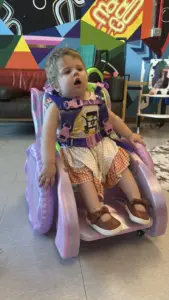









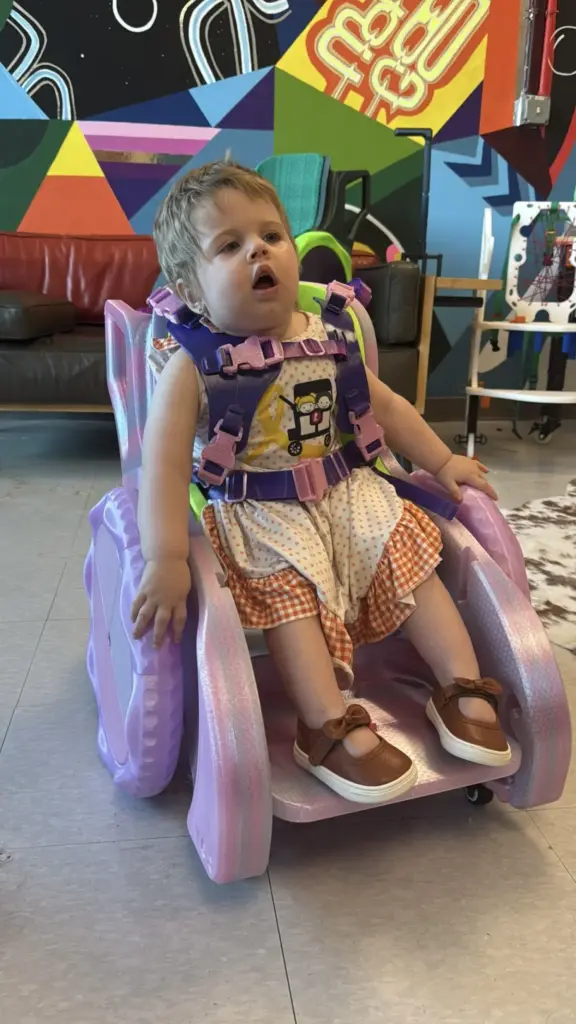
At Monroe Carell Jr. Children’s Hospital in Nashville, the newest piece of mobility equipment is a 3D-printed wheelchair—built layer by layer by a gaming and technology specialist who had never set out to design a wheelchair at all. That detail matters immensely, serving as a small sign of a much bigger shift happening across contemporary pediatric care. Hospitals, schools, and individual families are increasingly starting to manufacture the assistive technology that the traditional medical supply chain has long struggled to deliver affordably, quickly, or in a way that feels genuinely tailored to an actual child rather than a generic patient.
The story centers on Graden Knapp, whose day job involves making hospital stays more bearable for children through toys, video games, and other interactive entertainment tools. While working at Monroe Carell, Knapp noticed something more fundamental than entertainment was missing from the clinical environment: the hospital simply did not have enough wheelchairs suitably scaled and designed to meet its youngest patients’ developmental and physical needs.
Faced with this persistent gap in resources, Knapp took the initiative to teach himself an entirely new skill set. According to local reporting from WTVF/NewsChannel 5, Knapp came across "Made Good"—almost certainly a reference to MakeGood, a New Orleans-based disability design nonprofit given the matching name and mission. Using an open-source design provided by the organization, Knapp spent two to three months printing the various plastic components and assembling what has become the hospital’s first nearly complete 3D-printed wheelchair.

The ambition behind this project extends far beyond keeping the chair parked in a hospital storage closet. Knapp’s clear intent is for young patients to take the custom wheelchair home with them after discharge. This approach transforms a cold piece of institutional medical equipment into something personal that a child can keep, customize, and physically grow into over time. It is a small, grassroots project in its current iteration, but it points toward a potential paradigm shift in where and how pediatric assistive technology is produced: manufactured on-site, tailored to the individual child, and built around the core idea that a mobility device can be both deeply functional and genuinely exciting for a kid to use.
While the local news reports did not explicitly name the specific model Knapp fabricated, public records and technical descriptions point directly to MakeGood’s flagship mobility project. The Toddler Mobility Trainer, developed in collaboration with the industrial design firm LINK PBC and the nonprofit TOM Global, represents the organization’s primary 3D-printable wheelchair design. Released as an open-source project, the device is explicitly engineered for children roughly ages one to eight. Nearly every component—including the structural frame, wheels, tires, seating surface, and even the safety straps—can be produced on consumer-grade printing hardware, specifically optimized for machines like the Bambu Lab A1.
The design philosophy relies on a modular, snap-together assembly that avoids complex tools, screws, or chemical adhesives, functioning much like a 3D jigsaw puzzle. This modularity offers a practical maintenance advantage: if a single component breaks during daily use, caregivers can simply reprint that individual part rather than discarding or replacing the entire chassis. MakeGood has published the design files on open platforms so that parents, school librarians, and hospital technologists can produce the device independently. Since its founding in 2021, the nonprofit network has delivered thousands of various assistive devices globally, aiming to democratize access to essential mobility tools.
This decentralized manufacturing model directly addresses the profound economic barriers inherent in traditional pediatric healthcare. A standard pediatric wheelchair in the United States typically carries a retail price ranging from $1,200 to $5,000. Specialized, custom, or power-assisted pediatric models frequently run well past $12,000 once advanced seating systems, specialized materials, and electronic components are factored into the total cost. These steep figures are compounded by the reality that young, growing children inevitably outgrow standard equipment every couple of years, drastically multiplying the lifetime cost of care for families, while health insurance providers frequently delay, reduce, or outright deny coverage claims for necessary mobility upgrades.

In stark contrast, organizations like MakeGood estimate that a complete Toddler Mobility Trainer can be produced for roughly $150 in raw materials. Itemized breakdowns of these builds typically account for a handful of spools of durable thermoplastic filaments like PETG and TPU, alongside a minimal amount of standard hardware elements such as bolts, nuts, washers, and small caster wheels. While specific costs can vary depending on local material sourcing, Knapp’s own assessments at Monroe Carell indicated that his hospital-printed chair was roughly ten times cheaper to produce than a conventional commercial counterpart.
The dramatic reduction in cost stems largely from the elimination of an entire legacy infrastructure of manufacturing overhead, global distribution networks, and heavy retail markups traditionally associated with durable medical equipment. Conventional medical devices must be engineered for mass factory production, transported across oceans, warehoused by commercial suppliers, and marked up at every intermediate step before reaching the end user. By contrast, open-source 3D printing bypasses these layers entirely. The design exists fundamentally as a digital file, shifting the physical production site directly to whatever desktop printer happens to be located in a hospital utility room, an educational facility, or a family’s living space.
However, transitioning from low material costs to widespread, practical accessibility requires a careful examination of local resources. Producing a device on-site demands access to a reliable 3D printer, stable electrical power, suitable polymer filaments, and someone with the time and basic technical aptitude to oversee the multi-day printing and assembly process. Yet, this combination of low one-time equipment acquisition costs, inexpensive consumable materials, open-source digital blueprints, and minimal specialized medical engineering expertise represents a fundamental departure from earlier generations of do-it-yourself medical equipment. It establishes a framework where vital mobility devices are not merely cheaper, but genuinely replicable by communities facing acute shortages of medical infrastructure.
The implications of this technology extend far beyond domestic hospitals in high-income nations, holding transformative potential for low- and middle-income countries where access to basic assistive technology remains severely restricted. Comprehensive data from the World Health Organization and UNICEF highlights a staggering global deficit: more than 2.5 billion people worldwide require at least one assistive product, yet nearly one billion individuals are entirely denied access. In resource-limited regions, the disparity is acute, with studies showing that access to necessary assistive devices can plummet to as low as three percent of the actual population need, compared to roughly ninety percent in wealthy industrialized nations.
Furthermore, global health assessments estimate that tens of millions of people require a wheelchair worldwide, while only a fraction of those individuals in less-resourced settings ever obtain one. The vast majority of people living with disabilities reside in developing or low-resource countries where commercial medical supply chains are thinnest and import tariffs or shipping expenses drive equipment prices beyond the reach of local families. Low-cost, open-source 3D-printed designs are uniquely positioned to help bridge this persistent gap by leveraging local digital fabrication hubs, reducing reliance on expensive international imports, and empowering regional healthcare workers to manufacture customized equipment directly where it is needed most.
For hospitals, educational institutions, and disability advocacy organizations, the growing viability of on-site additive manufacturing presents compelling operational and humanitarian opportunities. While 3D-printed mobility devices are not yet positioned to fully replace complex, clinically prescribed, and insurance-subsidized wheelchairs for every medical profile—as ongoing research continues to evaluate long-term durability, exact weight tolerances, and comprehensive clinical validations—their immediate utility is undeniable.
For targeted applications such as providing a lightweight, well-fitted mobility tool to a young child navigating early developmental milestones, the technology is already proving its worth inside clinical environments like the Monroe Carell Jr. Children’s Hospital. As these open-source initiatives continue to mature, the central question facing healthcare administrators, clinicians, and global health advocates is no longer whether decentralized manufacturing works in practice, but rather which institutions will choose to embrace the technology next.