



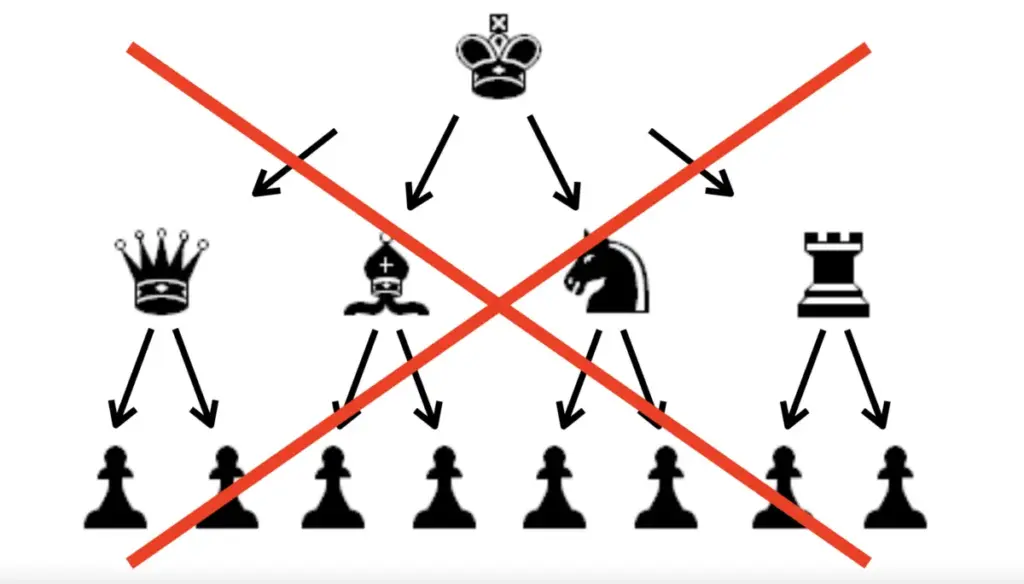
Many autistic people experience profound difficulties thinking of the world in hierarchical ways. Evolutionary anthropologists note that this cognitive trait reflects innate human collaborative cultural capabilities combined with a significantly reduced capacity for maintaining ongoing cognitive dissonance. This profile often falls well outside the bell curve of hypernormativity, shaping a distinct perspective on how societies operate and how humans relate to one another.
When autistic individuals learn about the social expectations attached to operating within hierarchically organized structures of social power, they frequently encounter difficulty comprehending why such structures are considered acceptable by the mainstream. Autistic people are often consciously aware of the pain and potential harm caused by exerting social power over others. They also feel the acute distress and cognitive dissonance that occur when authorities impose arbitrary demands incompatible with their unique individual sensitivity profiles.
Within the cultural framework of internalized ableism, this autistic reluctance to exert social power over others is often misinterpreted as a social deficit—specifically, an inability to be entrusted with leadership responsibilities. Conversely, the autistic reluctance to submit to arbitrary social power is frequently labeled as non-compliance, disagreeableness, or a disruption of the "natural" social order.
This paradox explains why, in certain concrete social situations, autistic individuals are dismissed as weak or incompetent leaders, while in other contexts, the very same individuals are punished for being aloof, arrogant, insensitive, or inappropriately competitive. In many cases, both conclusions are fundamentally misguided.
Instead, autistic people are much better understood as vital components of the cultural immune system within human societies. In the modern world, autistic individuals are uniquely positioned to reimagine healthier collective ways of being, championing human-scale, egalitarian cultural organisms.
The modern world is heavily dominated by the cultural framework of Homo Economicus, in which the majority of people experience social hierarchies as an immutable law of nature. This worldview is often justified by culturally biased evidence drawn from disciplines such as economics, evolutionary biology, and Western psychology. This paradigm is an outgrowth of a cultural heritage rooted in anthropocentric interpretations of monotheistic Abrahamic traditions, interpretations that rose to prominence during eras of colonial and neocolonial history.
Traumatised Autistic People
Within contemporary society, hypersensitive autistic individuals often experience trauma from a very young age. Children are exposed to the norms of Homo Economicus by well-intentioned parents and educators long before they learn anything substantial about Gaia and the living world. Critics argue this represents one of the most dehumanizing and life-denying aspects of modern life.
When this early exposure combines with rigid power dynamics in patriarchal or otherwise abusive family systems, children are placed at severe risk. In such environments, children—including autistic youth—frequently develop harmful trauma-coping mechanisms.
Due to unusual baseline sensitivity profiles and a reduced capacity for maintaining cognitive dissonance, traumatized autistic children are more likely than their neurotypical peers to develop a deep, pervasive distrust of humanity, sometimes to the point of being unable to extend trust to anyone, including their closest family members.
Consequently, highly traumatized autistic children can end up completely isolated. Their coping mechanisms mirror those of non-autistic trauma survivors, sometimes manifesting as bullying or extreme attempts to control family members, thereby perpetuating intergenerational trauma. Autistic people are neither more nor less likely than others to perpetuate trauma; however, those who do often differ in their reduced ability to maintain cognitive dissonance. This means their controlling agenda is typically open, and their desire for social control usually remains limited to their immediate family system rather than extending to the wider social sphere.
Much more frequently, due to their unusual sensitivity profiles, low tolerance for cognitive dissonance, and refusal to participate in arbitrary social games or submit to unjustifiable demands from authorities, autistic individuals find themselves on the receiving end of bullying and abuse.
The level of early childhood trauma experienced by many autistic people can severely impact their ability to form intimate relationships and extend trust. Fortunately, this dynamic has begun to shift with the advent of the internet, which has enabled autistic individuals worldwide to connect, share experiences, and learn from one another. Digital spaces have allowed those who felt alienated by culturally "well-adjusted" norms to find peers and forge lifelong relationships built on compatible sensitivity profiles.

Regrettably, some of these positive developments have been compromised by the rise of profit-oriented commercial social media platforms. These environments bring well-documented polarizing and traumatizing effects, including the active encouragement of super-human-scale social networks of superficial connections.
Autistic Culture
In recent years, driven by an innate reluctance or inability to participate in traditional social games, autistic people have increasingly gravitated toward genuine, human-scale online spaces. These spaces foster cosmolocal community co-creation, peer support, and egalitarian relationship-building on autistic terms, far beyond the influence of the dominant Homo Economicus culture.
The apparent autistic inability to think hierarchically often manifests as an advanced capacity to think and live entirely relationally. This relational orientation is visible in the growing interest and participation in human-scale ecologies of care support models, as well as global enthusiasm for the egalitarian neurodiventure worker cooperative model for engaging with the external social world.
Within the hypernormative culture dominating modern society, explaining what immersion in healthy autistic culture feels like—or describing the development of healthy, sacred lifetime relationships between autistic people—remains a challenge. Mainstream society often struggles to comprehend how autistic individuals support, love, and care for one another in ways that transcend the culturally impaired neuronormative imagination.
The evolving web of relationships, mutual aid, and peer support initiatives is best understood through the framework of emergent ecologies of care that extend beyond purely human boundaries.
While a common proverb states that it takes a village to raise a child, an autistic translation might suggest that an autistic person requires a human-scale autistic family to feel truly loved and alive. Most autistic individuals are not born into healthy autistic families; instead, they must co-create their support networks in their own time and space. In a healthy culture, autistic children are assisted in finding and building these unique families, but modern civilization has largely suppressed and lost this cultural knowledge.
Many indigenous cultures historically recognized children with unique qualities, paired them with adult mentors possessing similar traits, and guided them into specialized roles within their local communities. When embedded within a supportive ecology of care, individuals can thrive while sharing the collective joys and sorrows of life.
Understanding a Cultural Organism as a Set of Relationships
Within autistic culture, a human-scale cultural organism is understood fundamentally as a set of relationships, acknowledging that all humans possess inherent cognitive and emotional limits. This perspective fosters a deep appreciation for the concept that small is beautiful—a human scale that remains comprehensible and intimately integrated with the living Earth, or Gaia.
Beyond this scale, cultural institutions are often viewed as manifestations of anthropocentric hubris, particularly when they are shaped by permanent hierarchical structures of social power. Humans retain the capacity to appreciate the interdependencies and the beauty of diverse, unique, and complementary relationships within every healthy cultural organism, alongside rich interdependencies with other natural systems.
In healthy relationships and cultural organisms, there are no permanent social power differentials, and no single relationship is considered inherently more important than any other. Furthermore, healthy cultural organisms maintain reasonable backups for any relationships critical to group survival.
The self is shaped fundamentally by relationships. Anyone who has experienced complete isolation understands how the world shrinks to a solitary relationship with oneself, yet complete isolation is rarely absolute. Humans are inextricably part of Gaia and exist in a continuous relationship with the natural world.
Imprisonment in social isolation, particularly within urbanized environments stripped of nature, represents a severe deprivation. Integration into Gaia is viewed by many community advocates as a vital aspect of living well. Individual wellbeing is ultimately a derivative of the health of all human and non-human relationships a person maintains, underscoring that relational and communal health at a human scale are what truly matter.

Understanding the Modern Social World
The modern social world can often be understood most clearly from the margins, because mainstream sense-making mechanisms have become profoundly confused. When a culture destroys collective deliberation at a human scale, life is frequently experienced as incoherent from the perspective of individuals attempting to generate personal meaning.
Critics of modern institutional structures argue that there is little constructive to be learned from a growing, cancerous mass of bureaucratic and economic systems that undermine diverse cultures. Observers suggest that analysts can diagnose the symptoms and describe the widening dissonance between the stated theories and actual practices of societal institutions, but diagnosing a systemic issue does not equate to curing it.
Scholars across various fields have examined different facets of this systemic inertia. Journalists have detailed the legal engineering behind the concentration of capital, economists have analyzed the government machinery that backs capital with enforcement systems, and cultural critics have highlighted the societal diseases that emerge when human-scale limitations are ignored in favor of globalized, anthropocentric hubris.
When small groups form governments claiming to represent the best interests of entire populations, it often results in the accumulation of resources in the hands of a few. Over time, large-scale political institutions can widen inequality, exhaust natural resources, and alienate citizens who experience the cold indifference of distant governance. Rather than representing people, such massive institutional apparatuses frequently prioritize the protection of capital, money, and wealth—behaving almost like autonomous entities focused primarily on self-preservation.
This structural reality gives rise to an unwritten iron law of social design: everything within a system is permitted to change, provided that the established structure of social power remains maintained or strengthened. This dynamic is frequently observed across large corporations and centralized government departments alike.
Where to From Here?
Humans are fundamentally part of nature, having evolved to operate, survive, and thrive as cultural organisms at a human scale, particularly in challenging environments. While this innate capacity has been largely eclipsed by dominant global systems, the limitations of reforming institutional cancers point toward alternative paths for reviving healthy cultural organisms.
As established, super-human-scale institutions decay and become increasingly unreliable, individuals and small groups naturally begin to look elsewhere for sustenance and community. This transition mirrors the biological process of metamorphosis, where complex systems undergo profound restructuring.
While predicting the exact timeline and geography of such cultural shifts remains impossible, observers note that education in subsistence-level life skills and community resilience can prepare populations for change. For many oppressed or marginalized communities, the decline of overly complex, resource-intensive institutions can ultimately prove liberating when local communities are adequately equipped with practical survival and cooperative skills.
This transition presents wealthy industrialized nations with an overdue opportunity for new forms of cosmolocal collaboration with communities in the Global South. As global ecological and social crises intensify, populations in developed countries may increasingly experience the need for education in subsistence-level living, balancing extreme global inequalities through a form of reverse development assistance.
Human Cultural Adaptivity
Rebuilding healthy cultural organisms requires a profound shift in trust away from failing centralized institutions and toward mutual aid and community co-creation at a human scale. Scholars of indigenous wisdom emphasize that creating spaces of trust requires immense, sustained commitment. Confronting the underlying narratives of modern civilization can leave individuals feeling vulnerable, but doing the necessary work for the benefit of the planet and local communities remains essential.
This shift in trust is already occurring organically outside established institutions through self-selected and self-organizing groups operating on the intersectional margins of modern societies. By uncovering and documenting knowledge useful for human-scale groups, engaging in bidirectional learning between theory and practice, and learning by doing, communities are heading toward an uncertain but more life-affirming collective future.
Ultimately, there is no standardized recipe book for cultural renewal. There are only timeless, human-scale values and the innate human capacity for relational thinking, guiding communities as they navigate the path forward.