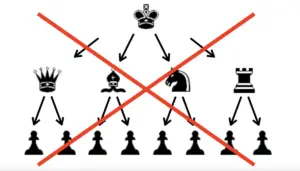





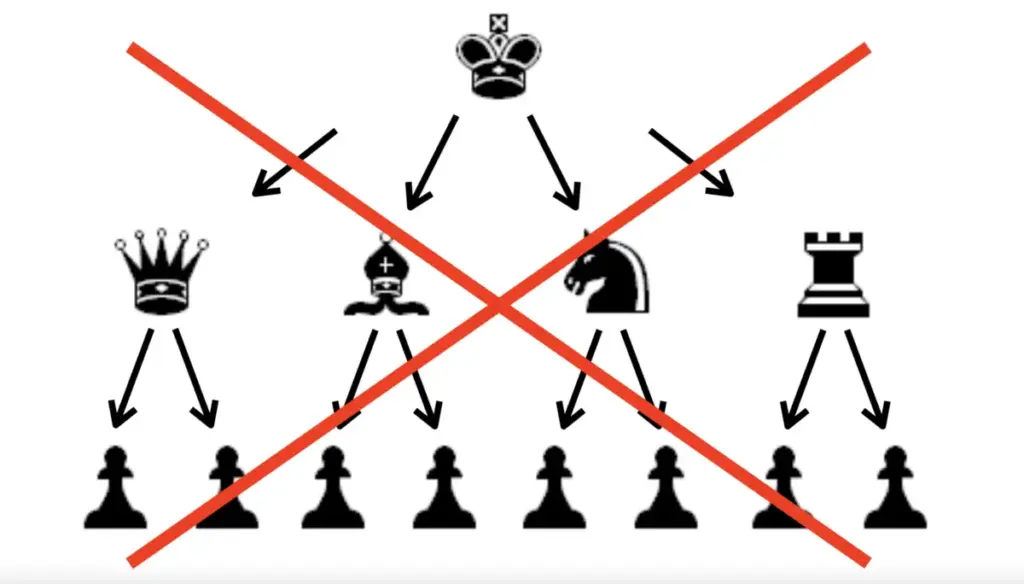
For many autistic individuals, navigating a world built on rigid hierarchical structures is not merely an inconvenience; it is a fundamental cognitive and sensory mismatch. Observers of human evolutionary history and neurodivergent culture point out that this difficulty reflects an innate collaborative capacity combined with a significantly reduced threshold for maintaining ongoing cognitive dissonance. Falling outside the standard bell curve of hypernormativity, autistic sensitivity profiles often make it nearly impossible to view top-down social power as natural, acceptable, or benign.
When autistic people encounter the social expectations embedded in hierarchically organized structures of power, they frequently struggle to comprehend why such systems are normalized. There is a keen, conscious awareness of the potential harm and interpersonal pain caused by exerting social power over others. At the same time, arbitrary demands imposed by authorities that run counter to unique individual sensitivity profiles generate acute psychological friction. Within the cultural framework of internalized ableism, however, these distinct behavioral responses are frequently misread as social deficits.
Mainstream society often interprets an autistic reluctance to exert power over others as an inability to handle leadership responsibilities. Conversely, a reluctance to submit to arbitrary authority is routinely labeled as non-compliance, disagreeableness, or a disruption of the so-called natural social order. Depending on the specific context, autistic individuals may be simultaneously dismissed as weak and incompetent leaders in one environment, while being punished as aloof, arrogant, or inappropriately competitive in another. Experts argue that both conclusions are deeply misguided, failing to recognize that neurodivergent individuals often function as a vital part of the cultural immune system of human societies, pointing the way toward healthier, human-scale egalitarian organisms.
The State Religion of Homo Economicus
The modern world remains heavily dominated by what cultural analysts term the state religion of Homo Economicus. Within this paradigm, the vast majority of people experience social hierarchies as an immutable law of nature, justified by culturally biased evidence drawn from disciplines such as mainstream economics, evolutionary biology, and Western psychology. This worldview is an outgrowth of historical interpretations rooted in anthropocentric readings of monotheistic traditions, which expanded dramatically during eras of colonialism and neocolonialism.
Consequently, hypersensitive autistic individuals often experience profound trauma from a very young age. Long before they learn anything substantial about the living world or the natural systems of Gaia, children are routinely immersed in the expectations of Homo Economicus by well-intentioned parents and educators. Combined with patriarchal and authoritarian family dynamics, this early exposure places children at severe risk of developing harmful trauma-coping mechanisms.

Because of their unique baseline sensitivity profiles and limited capacity for cognitive dissonance, traumatized autistic children may develop a deep, protective distrust of humanity, sometimes struggling to extend trust even to immediate family members. When isolation results, some individuals may adopt controlling behaviors within their immediate domestic spheres. Yet, autistic people are neither more nor less likely to perpetuate trauma than anyone else; when they do, their overarching agendas tend to be transparent rather than masked by systemic power structures. More frequently, their refusal to participate in wider social games or submit to unjustifiable demands leaves them on the receiving end of institutional bullying and social marginalization.
The Rise of Autistic Culture and Ecologies of Care
Fortunately, the advent of the internet has transformed the landscape for many neurodivergent individuals, enabling them to connect globally, share experiences, and build lifelong relationships based on compatible sensitivity profiles rather than forced assimilation. While commercial social media has introduced new layers of polarization and hyper-scaled networking pressure, autistic communities have increasingly shifted toward genuine, human-scale online spaces for cosmolocal community co-creation and peer support.
The characteristic autistic difficulty with hierarchical thinking is increasingly understood as an aptitude for relational living. This is evident in the growing interest in human-scale support models, such as Ecologies of Care, and the global spread of egalitarian worker cooperatives known as NeurodiVentures. Within healthy autistic culture, relationships are viewed not as rungs on a ladder, but as an interconnected web of mutual aid. While mainstream culture often struggles to imagine relationships beyond traditional neuronormative boundaries, neurodivergent communities continue to cultivate spaces where care, love, and survival are shared horizontally.
Anthropologists note that in many indigenous cultures, children with unique neurological profiles are recognized early, paired with adult mentors possessing similar traits, and guided into specialized community roles. Modern Western societies, by contrast, have largely lost this cultural knowledge, replacing community care with institutional control. Rebuilding these supportive ecosystems remains central to fostering collective wellbeing.
Understanding Cultural Organisms and Relational Health
Within authentic autistic culture, a human-scale cultural organism is understood fundamentally as a set of relationships. Recognizing the inherent cognitive and emotional limits of human beings, neurodivergent perspectives embrace the philosophy that small is beautiful. Cultural institutions that transcend human scale and rely on permanent hierarchies are viewed as expressions of anthropocentric hubris.

Healthy cultural organisms thrive on interdependencies and complementary relationships, devoid of permanent power differentials. In such systems, no single relationship is elevated above another, and critical functions feature natural redundancies to ensure group survival. Conversely, forced isolation—particularly in urbanized environments divorced from nature—acts as a severe form of psychological deprivation. True individual wellbeing is downstream from relational and communal health, anchored in a person’s integration with both human communities and the wider natural world.
The modern social world, critics argue, can only be accurately understood from the margins, because conventional sense-making mechanisms have been deeply compromised. When a society destroys its collective capacity for human-scale deliberation, life appears incoherent to individuals attempting to process reality at a natural scale. Institutions of capital, backed by the raw enforcement power of modern states and justified by rigid economic ideologies, frequently function as self-perpetuating corporate entities that prioritize their own survival over human needs.
Navigating the Metamorphosis of Human Culture
As established super-scale institutions display increasing rigidity and vulnerability to polycrises, many observers suggest that trying to reform entrenched cultural cancers is ultimately futile. Instead, society may be undergoing a structural metamorphosis akin to holometabolism in biological organisms. As large institutions decay, individuals and small groups are increasingly gravitating toward human-scale, life-affirming alternatives rooted in mutual aid and ecological awareness.
This cultural transition requires a profound shift in trust away from failing bureaucratic structures and toward community co-creation. Drawing on indigenous wisdom and neurodivergent solidarity, communities are actively documenting and sharing subsistence-level life skills, fostering omnidirectional learning between the Global North and Global South, and preparing for a more resilient collective future.
While there is no predefined recipe book for this transition, the foundational values remain clear: relational thinking, human-scale collaboration, and a return to the ecological bedrock of Gaia. As marginalized communities continue to forge trusted relationships outside the dominant paradigms, they demonstrate that another way of living is not only possible, but already quietly taking root.