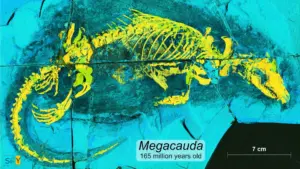









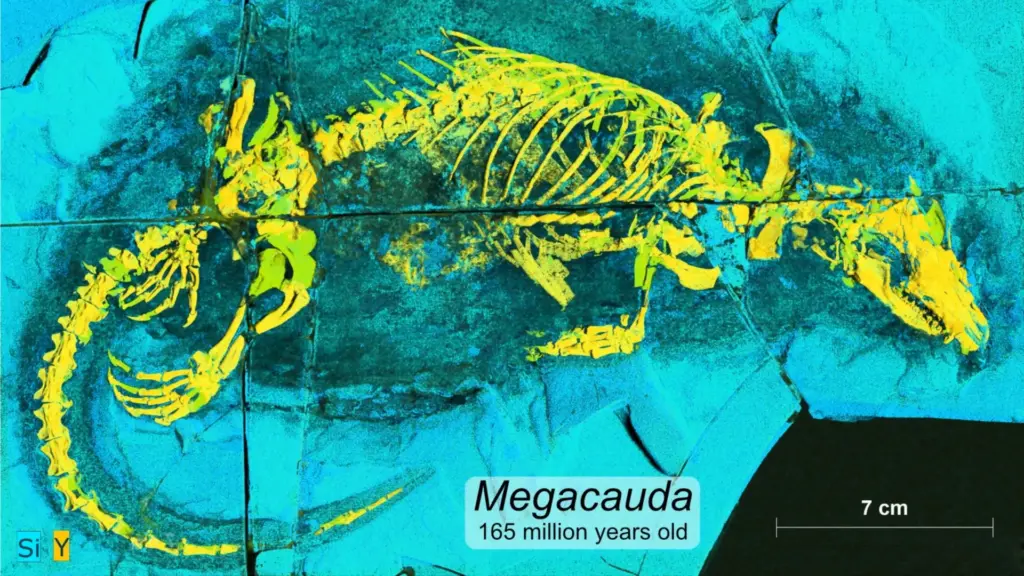
A remarkably preserved fossil discovered in the Xiayingzi region of Inner Mongolia has provided scientists with an unprecedented look into the evolutionary milestones of early mammals. The creature, a 165-million-year-old predator named Megacauda sungei, is reshaping our understanding of how ancient mammaliaforms adapted to their environments and developed the sophisticated physiological traits that would eventually define the mammalian lineage. Measuring approximately half a meter—roughly 20 inches—from its nose to its broad, flattened tail, this ancient hunter was a heavyweight among its Jurassic contemporaries, most of which were small, mouse-sized creatures.
The findings, which represent the culmination of years of collaborative research between scientists in Shenyang, Chicago, and Bonn, were recently published in the journal Nature. While the creature’s size and aquatic lifestyle are significant, the most profound revelation lies in its anatomy: Megacauda sungei possessed a highly developed soft palate, a structural breakthrough that allowed it to separate its mouth from its pharynx. This discovery provides the earliest known evidence of this anatomical feature, suggesting that the physiological mechanisms necessary for nursing and breathing simultaneously were already well-established millions of years before the rise of modern mammals.
The Evolutionary Significance of the Soft Palate
The development of the soft palate is a cornerstone of mammalian evolution. In most non-mammalian vertebrates, the arrangement of the hyoid bones in the throat is relatively simple, requiring specific physical maneuvers to ingest food. For instance, modern crocodiles must lift their heads and utilize gravity through sudden, jerking motions to move unchewed prey down their throats. According to Prof. Dr. Thomas Martin, a paleontologist at the University of Bonn, this reliance on gravity is a fundamental limitation of the reptilian swallowing mechanism.

In contrast, mammals possess a complex hyoid structure and a soft palate that effectively decouples the processes of breathing and swallowing. This biological "engineering" allows humans and other mammals to swallow liquids or solids even when gravity is working against them—such as drinking through a straw while hanging upside down. The significance of this cannot be overstated; it is the physiological gateway that enabled the emergence of lactation. By preventing liquid from entering the nasal passages, the soft palate allowed young mammals to consume nutrient-rich milk safely.
"It was this adaptation that made brain development, eventually leading to humans, possible," Professor Martin explains. "The soft palate and the shaping of the oral cavity and pharynx are directly linked to the evolution of mammals." Finding evidence of this structure in Megacauda sungei—an animal that lived during the Jurassic period—indicates that these complex biological systems were being refined much earlier than previously thought.
An Aquatic Predator in a Dinosaur-Dominated World
Megacauda sungei was not merely a physiological pioneer; it was also a specialized hunter. With its short, dense fur and a broad, paddle-like tail, the animal likely occupied an ecological niche similar to that of a modern otter, beaver, or platypus. Through the use of advanced computed tomography (CT) scans, the international research team created detailed three-dimensional reconstructions of the fossil, revealing a body morphology perfectly suited for an aquatic existence.
The reconstructions suggest that Megacauda sungei moved through the water by paddling with its front limbs while propelling its body forward with an undulating motion of its powerful tail. Its hind legs likely served as rudders, allowing for precise maneuvering in pursuit of prey. Professor Martin notes that this represents the earliest known evidence of an aquatic lifestyle in the mammal lineage.
Further examination of the creature’s dentition underscored its role as an efficient predator. It possessed teeth with distinct backward-curving cusps, which were ideally suited for gripping slippery, aquatic prey. Perhaps most surprising to the research team was the discovery of specialized canine teeth with three roots. This distinctive feature, when analyzed alongside other prehistoric specimens, allowed the team to classify Megacauda sungei as a member of the docodonts—a widespread and diverse group of extinct mammaliaforms that thrived during the Jurassic.
A Giant Among Contemporaries
To modern observers accustomed to megafauna such as elephants, rhinos, or whales, an animal weighing roughly two kilograms (4.4 pounds) may seem diminutive. However, within the context of the Mesozoic Era, Megacauda sungei was an anomaly. The Jurassic landscape was dominated by dinosaurs, and the mammalian ancestors of the time were largely relegated to the shadows, typically weighing only a few grams.
By occupying a "top predator" niche at half a meter in length, Megacauda sungei defied the typical size constraints of its era. It serves as a striking example of how early mammal relatives were not merely passive inhabitants of a dinosaur-dominated world, but were actively experimenting with size, shape, and ecological specialization. The fossil underscores a broader narrative in paleontology: that the "Age of Dinosaurs" was also a period of rapid and diverse evolution for the mammalian line.
A Journey from Inner Mongolia to Scientific Spotlight
The journey of Megacauda sungei from the fossil beds of Inner Mongolia to the pages of Nature is a testament to the power of international collaboration. The fossil was initially unearthed in the Xiayingzi region and eventually became part of the collection at the Paleontological Museum of Liaoning in Shenyang. Its scientific potential was only fully realized when it was subjected to a rigorous, multi-year examination by a team consisting of Prof. Dr. Chang-Fu Zhou of Shandong University, Prof. Dr. Zhe-Xi Luo of the University of Chicago, and Prof. Dr. Thomas Martin of the University of Bonn.
The researchers decided to honor Prof. Sun Ge, the Honorary Director of the Paleontological Museum of Liaoning, by incorporating his name into the species designation. The name Megacauda—meaning "large tail"—was combined with sungei to reflect both the creature’s defining physical feature and its tribute to the museum’s leadership.
"It is the result of a long period of teamwork," says Professor Martin, reflecting on the years of analysis, comparative studies, and anatomical documentation required to confirm the specimen’s status as a unique species.
This discovery is part of a growing body of evidence regarding the versatility of docodonts. Other fossils in this group have revealed that while some docodonts were mastering the water, others were adapting to life in the trees or burrowing underground like modern moles. This wide array of specialized behaviors across the Northern Hemisphere suggests that early mammals were far more successful and diverse than traditional models once assumed.
As paleontologists continue to analyze the remains of Megacauda sungei, the broader picture becomes increasingly clear: long before the extinction of the dinosaurs paved the way for modern mammals, their ancient relatives were already laying the groundwork for future success. Through their early experiments with anatomy, diet, and locomotion, these creatures proved that even in a world ruled by giants, the small and the specialized could secure a place of profound evolutionary importance.