







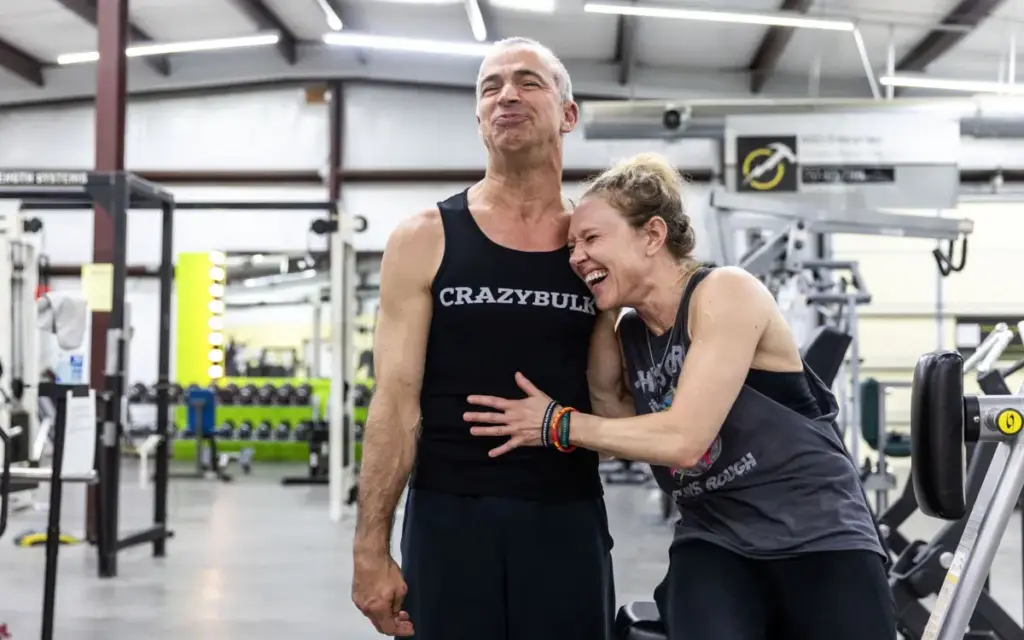
VIRGINIA BEACH, Va. — Inside the quiet hum of a local gym, the rhythmic clanking of iron plates serves as a steady heartbeat. Steve Alexy moves toward the weight rack with a deliberate, pigeon-toed gait. His left arm remains pinned tight against his torso, while his right arm swings in a slow, twitching motion that mirrors the neurological challenges of his cerebral palsy. A few feet away, Arlyn Smith approaches a pullup bar with short, measured, duck-footed steps, her focus absolute as she calculates the balance required for her next movement.
To the casual observer, they are a pair navigating a world not designed for their physical realities. But here, in the sanctuary of the weight room, the stares and whispered assumptions that follow them through the streets of Franklin, Virginia, evaporate. They are no longer defined by the way they walk or the slurred cadence of their speech; they are defined by the weight on the bar.
Alexy, 53, reaches the rack and prepares to hoist 45-pound dumbbells for his warmup. Smith, 45, secures a 35-pound weighted vest around her torso, grips the bar, and executes a series of pullups with a fluidity that belies her history of physical struggle. They are not merely exercising; they are competing, winning, and systematically dismantling the limitations society has placed upon them.

For the past five years, the couple has been a formidable presence in the world of powerlifting. They do not limit themselves to para-athlete divisions; they compete in open powerlifting contests, consistently proving that their dedication to the sport transcends medical labels. Their journey is one of mutual support, a shared endeavor to prove that strength is as much a matter of the spirit as it is of the muscle.
Smith, reflecting on her path to the platform, speaks with a sense of wonder. She spent decades believing that her physical condition—cerebellar ataxia, which affects the brain’s ability to coordinate movement and balance—meant that true athletic prowess was beyond her reach. "I could have gone my entire life and never even have tried, and I wouldn’t have known," she says.
That uncertainty vanished last year when the International Powerlifting Coalition officially recognized Smith as a world record holder. Competing in the 56-kilogram weight class within the women’s masters 45 to 49 division, she deadlifted 264.5 pounds—a staggering feat for any athlete, and a historic one for a woman weighing just 123 pounds. She had successfully lifted more than double her own body weight. Not to be outdone, Alexy claimed his own place in the record books in 2024, setting a United States Powerlifting Coalition deadlift record of 227 pounds in the men’s masters 50 to 54 division at 67.5 kilograms.
The road to these accolades was paved with years of navigating systemic misperceptions. As a child, Alexy was diagnosed with cerebral palsy, a neurological disorder that impacts muscle control and coordination. Growing up in Franklin, he found his first sense of purpose in the weight room of the local YMCA. By the time he turned 21, he was a fixture in the gym, discovering that while his body struggled to follow his commands, the iron obeyed the laws of physics consistently.
Between 2014 and 2019, Alexy pivoted to bodybuilding. These competitions were a different beast, focusing on aesthetic symmetry, muscle tone, and stage presence rather than pure, raw power. "I called it trying to look pretty," he says with a grin. Despite the challenges his condition posed for posing and stage movement, he dominated the circuit, winning nearly every one of the 13 competitions he entered. "Every time I played, I won," he says, his confidence reflecting a career defined by defying the odds.
It was during the twilight of his bodybuilding career that he met a woman backstage who would unknowingly change his life. A few years later, she reached out to suggest he meet a friend of hers—a woman who shared his experience of living with a physical disability while maintaining a deep-seated interest in athletics. Alexy made the call. "He texted," Smith recalls, "And we’re still together."
When they first met, Smith was at a crossroads. She was in the process of recovering from substance abuse and anorexia, having spent 15 years unable to move without the assistance of a wheelchair or a walker. Her life had been marked by tragedy and physical decline. Her father, who had once taken her to the track to watch her run laps as a child, had died by suicide when she was 21. Two years later, a drug overdose caused a stroke, leading to her permanent cerebellar ataxia.
Alexy saw past the chair and the walker; he saw an athlete who had been sidelined by circumstance. He encouraged her to pursue the strength she had long ago set aside. They began training together near her home in Williamsburg. The courtship was brief but transformative; within three months, Alexy had moved to the Peninsula to be near her, and six months later, they relocated to his hometown of Franklin to build a life together.
Their home is a place of shared interests—watching World Wrestling Entertainment, caring for their three-legged cat, and navigating the complexities of a world that frequently underestimates them. Both have dealt with the stinging reality that strangers often conflate their physical motor impairments with cognitive limitations.
"What was assumed was that something else was wrong with me because I couldn’t verbalize," Smith explains. "But the reason was, I physically could not, which was frustrating, because I had fully formed thoughts. I just couldn’t get them out."
This shared frustration has only deepened their bond. They recognize that they are, in essence, healthy, vibrant minds inhabiting bodies that require extra effort to command. "We are the same," Alexy says, a sentiment that resonates in every lift they perform at the Retro Flex Gym in Courtland, owned by Hunter Darden.
Darden, who has watched the couple train daily, speaks of them with genuine admiration. "They’re here almost every day," he notes. "They’re good people, really good people. They are inspiring people."
For Smith, the gym has been more than a place for personal records; it has been a place of liberation. Under Alexy’s patient guidance, she began to rely less on her walker. He encouraged her to set small, incremental goals—walking to the end of the driveway without assistance, then further, then navigating sidewalks. "No one in my life had ever supported me with things, like driving to the mailbox or walking down the sidewalk," she says.
As her confidence grew, so did her competitive output. Powerlifting requires mastery of the squat, the bench press, and the deadlift. Alexy’s path has been modified to account for his specific physical requirements; his knees turn inward under heavy squatting, and shoulder arthritis makes the bench press a source of significant pain, so he focuses his efforts elsewhere. Smith, however, has embraced all three disciplines.
The United States Powerlifting Coalition recently issued a formal certificate to Smith, recognizing her as the national standard-bearer for her weight class and division. It stands as a testament to her technical precision and sheer tenacity.
For Alexy and Smith, the trophies and the certificates are merely paper. The true victory lies in the daily act of walking into the gym, defying the glances of strangers, and moving weight that many able-bodied individuals would struggle to lift. They have turned their limitations into a platform, proving that while they may walk differently or speak with a different rhythm, their drive to succeed is universal. They continue to train, not for the recognition of others, but because they have found that the strongest version of themselves is the one they find on the lifting platform.