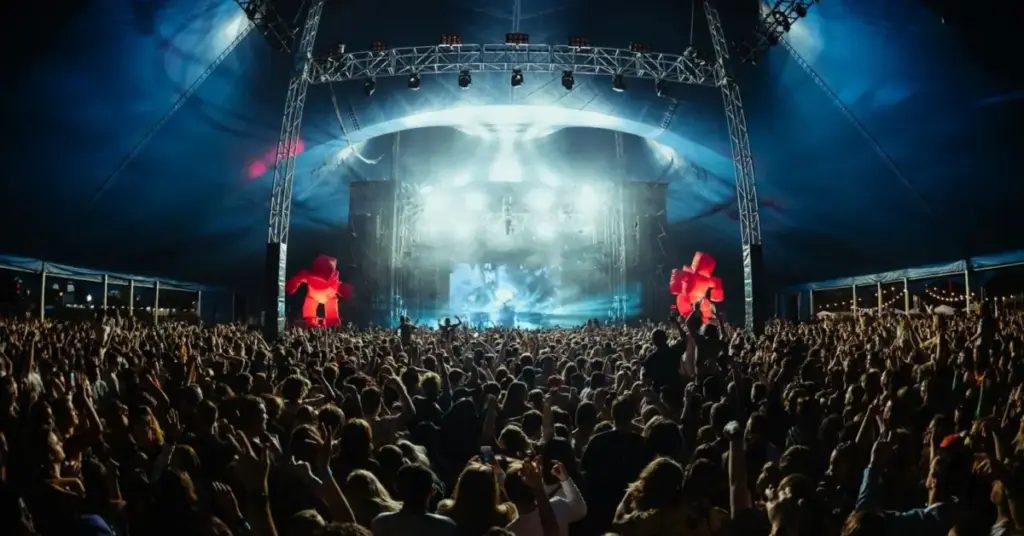
The journey toward the stadium began like any other night out for live music enthusiasts, following the shifting, vibrant crowd of fans eager for a memorable performance. For many attendees, however, stepping into an unfamiliar venue brings a distinct set of unknowns. Walking toward an open-air concert for the very first time, it is difficult to predict how the unique acoustics of an outdoor space will shape the soundscape, or how the volume will carry across wide expanses. Yet, for individuals who already navigate daily life with hearing loss, preparation is second nature. Knowing firsthand that no live performance is worth sacrificing the remaining hearing one possesses, coming equipped with proper protection is simply a necessary precaution.
Navigating the perimeter of the venue, the opening act drifted in from a distance, sounding remarkably restrained and registering at what felt like a manageable volume. That false sense of security vanished instantly upon rounding the corner toward the designated seating area. The sudden acoustic impact was staggering—a wall of noise that forced a physical recoil, prompting an immediate retreat behind a protective concrete barrier. With a quick adjustment, noise-canceling headphones and ear protection snapped snugly into place, remaining secure for the duration of the evening.
Yet, scanning the surrounding rows of fans revealed a striking contrast. Amidst a dense sea of music lovers, virtually no one else appeared to be taking precautions to safeguard their ears. This widespread oversight raises a troubling and persistent question in public health circles: why do so many concertgoers routinely ignore the obvious risks to their hearing in environments where the danger is entirely tangible?
The Risk Is Real and Measurable
During the course of the performance, monitoring the environment with modern technology told a clear, alarming story. Decibel readings captured via a smartwatch consistently hovered between 90 and 100 decibels, and many contemporary live music events push the acoustic boundaries even higher. According data from the National Institute on Deafness and Other Communication Disorders (NIDCD), exposure to sound levels reaching 100 decibels can begin causing permanent hearing damage in as little as 14 minutes.
The permanence of this physiological harm remains one of the most sobering aspects of noise-induced hearing loss. Once the auditory system suffers cellular trauma, it lacks the biological mechanism to repair itself. Scientists have yet to discover a reliable method to regenerate the delicate inner ear hair cells that are routinely battered and destroyed by excessive acoustic energy.
Despite the permanent nature of this damage, scientific research demonstrates that simple preventative measures yield profound results. In a randomized clinical trial conducted at an Amsterdam music festival—where ambient sound levels averaged 100 dBA—researchers found that 42 percent of unprotected ears exhibited temporary hearing loss following the event. By comparison, only 8 percent of ears shielded by proper earplugs suffered the same fate. Furthermore, secondary symptoms such as persistent ringing in the ears, known as tinnitus, occurred far less frequently among those who wore protective gear.
Why We Skip the Earplugs
Given that earplugs are inexpensive, widely accessible, and scientifically proven to preserve auditory health, their low adoption rate at major music events demands closer examination. Experts suggest that the widespread reluctance to wear protection stems from complex psychological and social factors rather than simple a lack of awareness.
Denial plays a powerful role, particularly among younger audiences. When an individual is in the prime of youth, the concept of long-term hearing degradation often feels entirely abstract and disconnected from the present moment. If the music sounds thrilling and the physical ears are not immediately aching, it is psychologically comfortable to assume that everything is fine. The cumulative consequences of acoustic trauma frequently remain hidden, surfacing only years later when conversational speech begins to blur.
Social dynamics also exert a tremendous influence over individual behavior. Human beings are inherently social creatures, and social norms dictate comfort levels in public spaces. When the vast majority of attendees choose to go unprotected, putting on earplugs can trigger feelings of self-consciousness and awkwardness. In the face of unspoken peer pressure, defaulting to the crowd behavior feels far easier than standing out.
Compounding these social hurdles is the persistent anxiety regarding sound quality. Many concertgoers harbor a lingering fear that inserting earplugs will distort, muffle, or ruin the very audio experience they paid significant money to enjoy. Others worry about potential aesthetic judgments from peers, wondering if wearing visible ear protection might make them look out of place or cause physical discomfort over a multi-hour show.
How to Make Hearing Protection the Norm
Within the high-energy environment of a live concert venue, traditional mitigation strategies are rarely feasible. Lowering the house volume is entirely out of the control of the audience, and physically relocating to a quieter zone far from the main stage often detracts from the immersive experience of the performance. These logistical constraints place the burden of safety squarely on personal protection. Yet, bridging the gap between theoretical knowledge and actual behavioral change remains a persistent challenge for public health advocates.
While knowing the statistics and acknowledging the dangers are critical first steps, translating that awareness into the physical act of inserting earplugs requires overcoming deeply ingrained habits and social hesitations. As the live entertainment industry continues to push acoustic boundaries, shifting the cultural perception of hearing protection from an anomaly to an accepted standard remains an ongoing endeavor for advocates and audiologists alike.
Enjoy the Music Without Paying for It Later
Attending live musical performances remains one of the most culturally enriching and emotionally resonant experiences available. Ensuring that this joy can be sustained across a lifetime requires recognizing hearing preservation as an essential component of concert attendance. For those stepping into a venue where protection is scarce, stepping up as an early adopter can ripple outward, subtly shifting the social landscape and empowering others to prioritize their own long-term health.
Copyright: Shari Eberts. A version of this post also appears on LivingWithHearingLoss.com.