








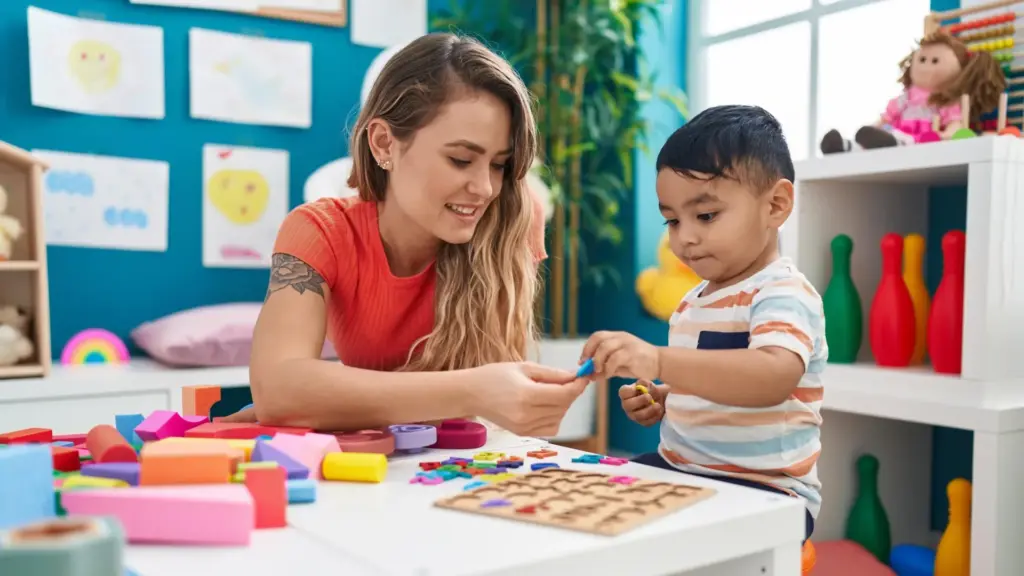
Students who attend public school pre-kindergarten programs consistently outperform their peers who receive family-based childcare throughout their K-12 education, according to significant new research conducted by Florida International University (FIU). The study, which offers one of the most comprehensive looks at early childhood education outcomes to date, suggests that the quality of instruction and the educational environment provided in the years immediately preceding kindergarten have a profound, lasting impact on a child’s academic trajectory through high school graduation.
The findings emerge from a massive, multi-decade investigation led by George Mason University and overseen by Charles Bleiker, an associate professor of teaching and learning at FIU. By analyzing the academic records of 400,000 students in Miami-Dade County, the research team was able to track participants from the third grade all the way through their secondary school years. This longitudinal approach provides a rare, birds-eye view of how early educational experiences translate into long-term success, revealing that the benefits of public pre-K4—the year of preschool preceding kindergarten—are not merely fleeting, but manifest as higher grades and superior standardized test scores that persist well into adolescence.
The Critical Role of Teacher Qualifications
To understand why public school pre-K settings yielded such distinct advantages, the research team categorized the preschool environments available to the study participants. They examined three primary models: public school pre-K programs, center-based daycare programs, and home-based childcare providers that participated in the Early Learning Coalition. While all observed programs were required to meet specific minimum standards for safety and operation, a glaring disparity in teacher credentials emerged as the primary differentiator.

Public school pre-K programs stood out as the only environment where teachers were universally required to hold a college degree. For Professor Bleiker, this finding is a definitive rebuttal to the persistent, often disparaging view that early childhood education is synonymous with basic supervision.
"They had more education and probably higher-quality teachers," Bleiker noted, emphasizing the correlation between pedagogical training and student outcomes. "It really tests the idea that having better-trained teachers or better curricula actually helps these kids. Critics often say teachers don’t need to be highly educated to teach young children, that it’s just babysitting and a waste of money. Our data says otherwise."
The implications of this data extend beyond academic performance. The research challenges the long-held assumption that early exposure to a school-like environment has a negligible effect on young children. Instead, the study indicates that familiarizing children with classroom routines at an earlier age may be a key factor in how smoothly they transition into the rigors of elementary school. When a child arrives in kindergarten already accustomed to the structure, expectations, and social dynamics of a classroom, they are better positioned to focus on learning rather than simply adjusting to the environment.
Developmental Expertise and Classroom Success
Beyond academic curriculum, the research highlights the importance of developmental psychology and classroom management. Teachers who have undergone formal preparation are better equipped to handle the emotional and social nuances inherent in a room full of young children. These educators can provide productive learning experiences rather than resorting to passive activities.
Bleiker is candid about the risks associated with less qualified care. "It makes a huge difference if you’ve been trained," he said. "Novice teachers without formal training struggle more. Some of these were mom-and-pop centers hiring people who aren’t fully qualified to teach. If a child spends those formative years in time out, watching videos, or being herded around, rather than being stimulated, these experiences spill over. They reach kindergarten not ready academically, socially, or emotionally."
This lack of stimulation, according to the research, creates a deficit that becomes difficult to close as children move into the higher grades. While a child in a high-quality, degree-led program is being guided through cognitive development, a child in an under-stimulated environment may be losing precious developmental time, leading to gaps in readiness that can persist for years.
A Diverse and Expansive Data Set
The credibility of this study is bolstered by its sheer scale and the demographic richness of the population analyzed. Professor Bleiker, who has been a central figure at FIU since 2001, has dedicated his career to examining school readiness among children receiving subsidized childcare. The inclusion of 400,000 students provides a level of statistical power rarely seen in education research.
Notably, the study features an exceptionally large Hispanic population, a demographic that comprises approximately 70 percent of the Miami-Dade community. This makes the research the largest study of its kind focused on Hispanic children, providing crucial insights into how early childhood interventions can be effectively tailored to diverse student populations.
The findings are already being put to practical use. Bleiker is currently applying the data to the development of curriculum interventions and early mathematics programs. He remains a vocal advocate for expanding access to structured learning opportunities, specifically targeting children starting at around age three, to ensure that the foundational skills needed for long-term success are established as early as possible.
However, Bleiker is careful to frame his findings in a way that suggests systemic evolution rather than a complete overhaul of the current model. He does not argue that public schools must become the sole providers of all early childhood education. Instead, he suggests that the success of the public school pre-K model provides a blueprint that can be adapted across the entire sector. By identifying the specific practices—such as higher educational standards for staff and evidence-based curricula—that make public school pre-K effective, researchers and policymakers can work to strengthen center-based and family-based programs, raising the quality of care for children regardless of where they are enrolled.
Guidance for Families
For parents currently navigating the complex landscape of voluntary pre-K options, the study offers more than just theoretical data; it provides a framework for decision-making. Choosing the right environment for a child is often a source of significant anxiety for families, particularly when resources are limited.
Bleiker advises that while credentials and educational standards are vital, parents must also act as the primary observers of their child’s individual experience. He encourages parents to pay close attention to how their child responds to their environment on a daily basis. If a child exhibits consistent distress or appears to be struggling in a particular setting, parents should feel empowered to seek out alternative providers. The research underscores that the quality of the individual experience is paramount; if a program is not providing the necessary stimulation and professional care, it may not be the right fit for the child’s development.
Ultimately, the research from FIU underscores a fundamental truth about early childhood education: the classroom is not just a place where children go while parents work; it is the laboratory where the foundations of future academic and social success are built. By professionalizing the field, investing in teacher training, and prioritizing developmentally appropriate instruction, the educational system can better ensure that all children—regardless of their background—arrive at the threshold of kindergarten prepared to thrive. As Bleiker continues his work, the focus remains on closing the achievement gap before it even begins, using the insights gained from thousands of Miami students to pave a clearer path forward for the next generation.