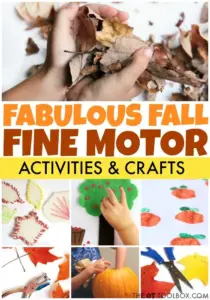









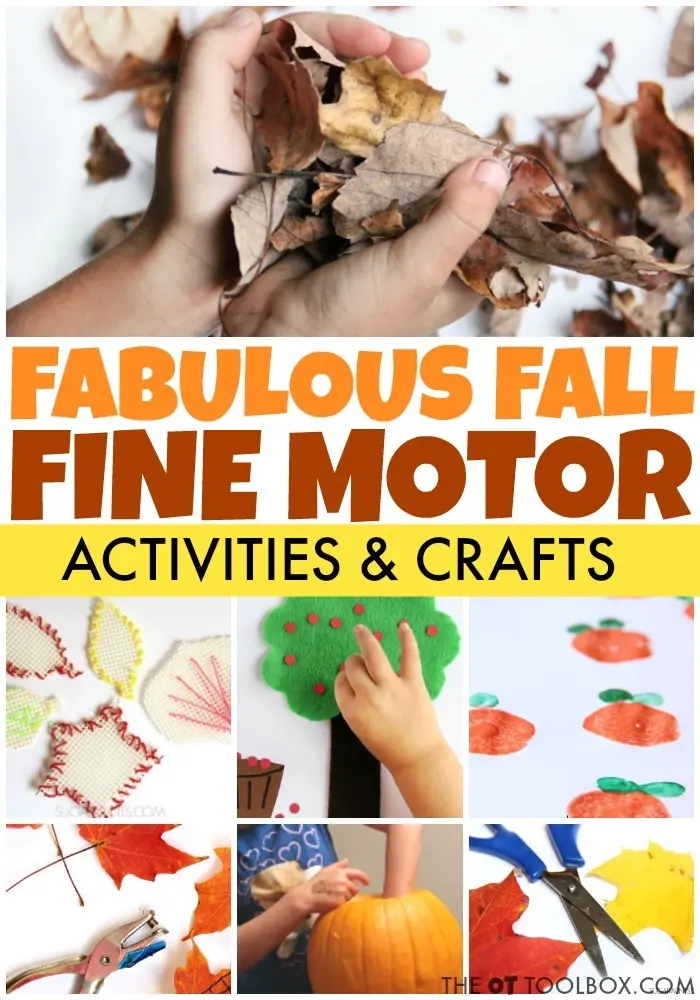
As the crisp autumn air arrives, bringing changing leaves, pumpkin spice, and harvest festivals, educators and occupational therapists are turning seasonal materials into powerful clinical tools. Rather than simply choosing fall-themed activities because they fit the calendar, professionals are leveraging items like apples, leaves, pumpkins, acorns, and farm elements to target specific fine motor needs in children.
The approach integrates seasonal play with targeted developmental interventions, addressing hand strength, finger dexterity, scissor skills, visual motor integration, and handwriting. Because many autumn-themed activities address several developmental domains simultaneously, therapists can adapt exercises to match individual children’s clinical requirements, offering a seamless blend of festive engagement and purposeful occupational therapy.
The seasonal shift provides a natural backdrop for introducing structured play that encourages a proper tripod grasp, enhances toddler development, and supports preschool occupational therapy goals. Experts emphasize that incorporating tactile sensory experiences—such as handling textured leaves or squishing scented play dough—promotes both fine and gross motor movement.

Hand strength remains a primary foundational requirement for everyday tasks like buttoning clothing, opening containers, and holding writing utensils. When children display weak hand strength, clinicians often introduce resistive materials that build intrinsic hand muscles without feeling like clinical work.
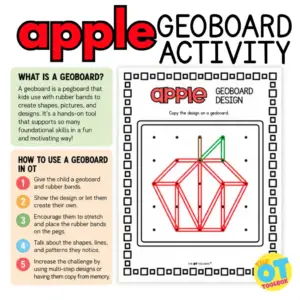
One prominent clinical strategy involves apple geoboards, where children recreate apple designs by stretching rubber bands across pegs. The physical act of pulling and positioning the bands provides essential resistance to fingers and hands, while also demanding precision and controlled release. This activity simultaneously targets hand and finger strength, bilateral coordination, visual motor skills, and motor planning. Therapists can easily scale the challenge by substituting thicker or more resistant bands or by simplifying visual patterns for children who struggle with the spatial demands.
Similarly, play dough offers a versatile medium for fine motor intervention regardless of the season. Rolling, squeezing, pinching, and pressing dough exercises small hand muscles while encouraging proper positioning such as pincer and tripod grasps, wrist stability, and arch development. The soft, pliable medium delivers a tactile sensory challenge paired with proprioceptive feedback. Therapists often hide mini leaves, fall erasers, or colored beads inside the dough to encourage deeper digital exploration, or utilize printable cards to prompt children to form specific autumn shapes.
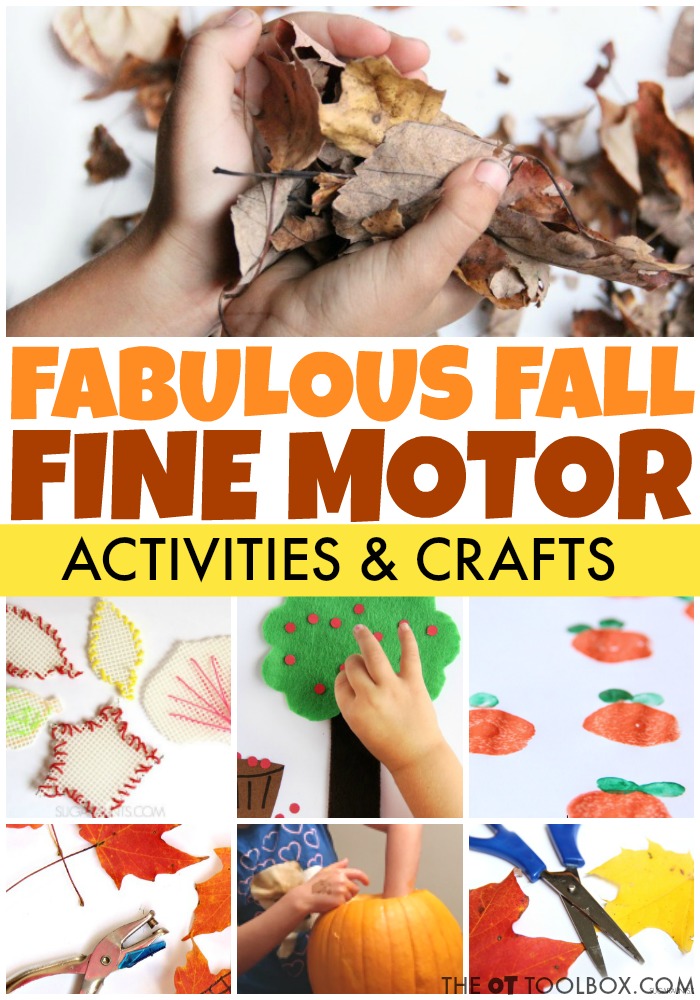
Another effective tool for building sustained hand force is the apple hole punch activity. By drawing or printing an apple and instructing a child to punch holes around its perimeter, therapists cultivate the sustained hand strength required for independent self-help skills, while simultaneously incorporating a visual-motor tracking component as the child navigates the contour of the shape.
Beyond raw strength, fine motor intervention frequently focuses on manual dexterity—the efficient, coordinated use of fingers for small, precise movements. Dexterity relies on a complex interplay of speed, precision, visual-motor integration, and strength. Fall manipulatives such as craft pom poms, seeds, mini erasers, paper clips, and small craft materials provide endless opportunities to refine finger manipulation.
Fall tree geoboards utilize similar mechanics to strengthen dexterity and coordination. By manipulating rubber bands around individual pegs, children learn to isolate their fingertips to grasp, stretch, reposition, and release bands with control, rather than relying on crude whole-hand grasps.
Paper clip activities, such as apple counting tasks, offer portable fine motor practice. Attaching the correct number of metal clips to laminated apple cards requires precise fingertip movements and promotes bilateral hand use, with one hand stabilizing the card while the other manipulates the fastener. This intervention simultaneously targets fingertip precision, bilateral coordination, dexterity, eye-hand coordination, and early number concepts.
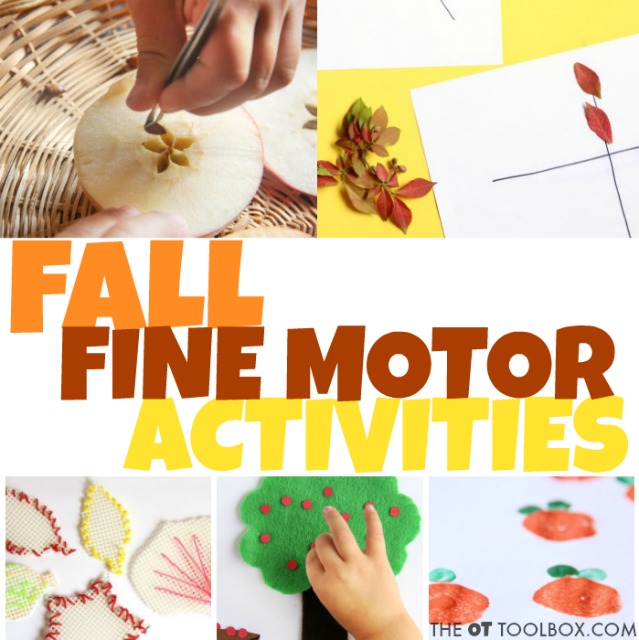
Craft pom pom transfers further expand dexterity options. By utilizing tongs or tweezers to move fall-colored pom poms into ice cube trays, muffin tins, or small containers, children refine their tool use and grasp precision. Therapists can easily grade the activity by altering the size of the pom poms or changing the grabbing tools to match the child’s current skill level.
Scissors represent another crucial developmental milestone that benefits significantly from seasonal integration. Apple cutting practice pages require children to cut along designated lines, coordinating two distinct hand functions simultaneously. While the dominant hand opens and closes the scissors, the non-dominant helper hand must stabilize, guide, and rotate the paper. Therapists carefully observe these sessions to assess how well a child coordinates bilateral movements, maintains proper thumb positioning, and controls the cutting path.
Natural materials provide even more avenues for scissor practice. Children can snip colorful fall foliage into small pieces or cut specific shapes from real leaves, enhancing line awareness and bilateral coordination. For classrooms without access to changing autumn foliage, paper leaves serve as a readily available alternative.
Cut-and-paste farm-themed and seasonal crafts elevate the cognitive and motor demands beyond simple cutting. These activities require executive functioning and direction-following, as children must cut out pieces, visually determine where they belong, orient them correctly, follow a sequential assembly plan, and glue them into precise positions. This multi-step process addresses scissor skills, bilateral coordination, visual-spatial awareness, sequencing, and cognitive planning.
Many children possess adequate hand strength and dexterity yet struggle when tasks demand visual-motor integration—the ability to coordinate what they see with how their hands move. Fall-themed directed drawing addresses this need by asking children to copy illustrations of acorns, leaves, apples, and pumpkins. Replicating these models requires visual scanning, spatial planning, and careful pencil control to reproduce lines and shapes accurately.
Pattern blocks combine fine motor manipulation with visual discrimination and spatial awareness. Children must identify the correct geometric pieces, determine their proper orientation, and position them to match a seasonal template. Similarly, seek-and-find or I Spy activities targeting fall items provide intense practice in visual scanning, figure-ground perception, and sustained visual attention. Therapists often enhance these worksheets by introducing a physical fine motor component, asking children to circle items, cover them with small manipulatives, or attach clothespins to corresponding pictures.
Handwriting interventions also find a natural home within autumn-themed curricula. Using structured writing prompts rather than isolated letter drills allows students to practice handwriting within a meaningful context. Depending on individual developmental levels, educators can adapt writing prompts for emerging writers practicing a single autumn word, beginning writers drafting a simple sentence, developing writers responding to a prompt, or older students planning and composing full paragraphs. Therapists can address specific handwriting components—such as line awareness, spacing, letter size, formation, and writing endurance—using a single unified set of prompt cards across an entire student caseload.
When specialized materials are unavailable, everyday objects found in the yard or home offer immediate, no-prep fine motor intervention. Leaves can be torn, crumpled, punched, cut, sorted, or strung. Acorns can be picked up with tongs, sorted, counted, or transferred. Play dough can be sculpted into harvest shapes, and ordinary household items like clothespins and bread ties can be repurposed to build hand strength and finger dexterity through creative crafting and sorting tasks.
As educators and therapists plan their seasonal schedules, a wide variety of ready-to-use resources remains accessible through professional networks such as The OT Toolbox Membership. These platforms offer curated fall materials spanning fine motor skill development, hand strength, scissor control, visual-motor integration, handwriting, executive functioning, and sensory processing, allowing professionals to select targeted interventions that meet the diverse needs of children during the autumn season.