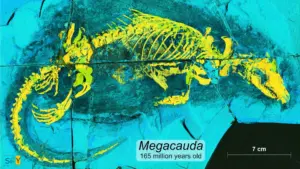









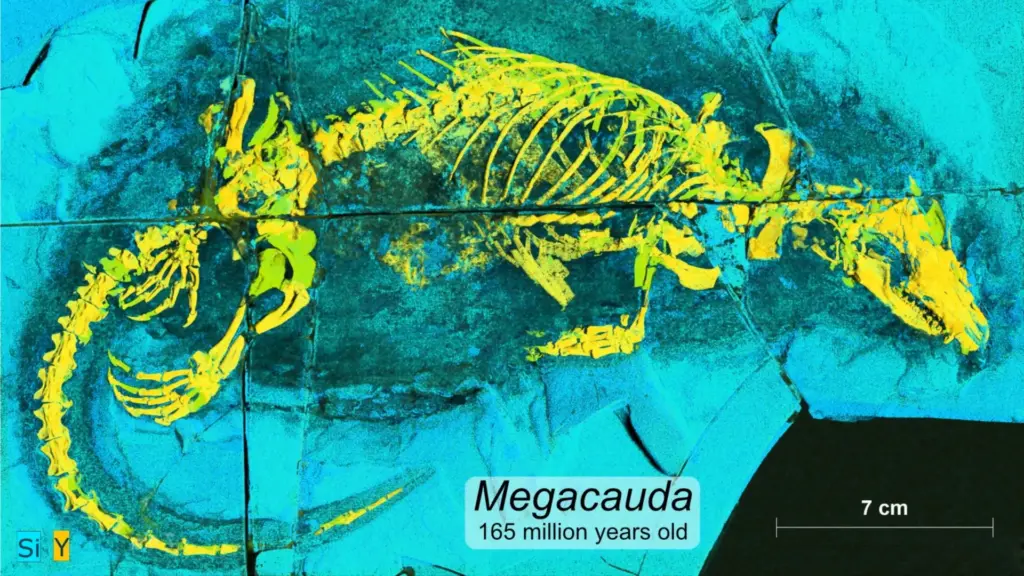
Deep within the fossil record of Inner Mongolia lies the story of a creature that, while small by modern standards, was a titan among its contemporaries. Scientists have unveiled the existence of Megacauda sungei, a furry, aquatic predator that thrived 165 million years ago during the Jurassic Period. Measuring approximately half a meter (20 inches) from its nose to the tip of its tail, this animal challenges our understanding of early mammalian history, offering an unexpected and profound glimpse into the anatomical innovations that eventually paved the way for human development.
The findings, the result of a rigorous, multi-year collaboration between researchers in Shenyang, Chicago, and Bonn, have been published in the prestigious journal Nature. While the sheer size of the creature—a heavyweight compared to the tiny, insect-eating mammals that dominated its era—is notable, its true scientific significance lies in a sophisticated internal anatomy that suggests mammals were far more evolutionarily advanced, and far earlier, than previously imagined.
How an Ancient Predator Reveals the Evolution of Swallowing
At the heart of the discovery is a feature that might seem mundane to the casual observer: the soft palate. Researchers discovered clear evidence that Megacauda sungei possessed a soft palate, an anatomical structure that effectively separates the mouth from the pharynx—the passage that connects the mouth to the throat. This development is not merely a biological curiosity; it is a fundamental pillar of mammalian survival.

In the vast majority of animals lacking a soft palate, the mechanics of swallowing are relatively primitive. These creatures, such as modern crocodiles, rely on a simple arrangement of hyoid bones in the throat. Because they lack the complex mechanism to isolate the airway from the food passage, they are forced to adopt extreme measures to eat. A crocodile, for instance, must lift its head and perform sudden, rhythmic jerking motions to force unchewed prey down its gullet. "This is achieved with the aid of gravity," explains paleontologist Prof. Dr. Thomas Martin from the University of Bonn.
Mammals, however, have evolved a far more elaborate hyoid structure, coupled with the soft palate, which allows for the swallowing of food or liquid even when gravity is working against them. Humans, for example, can drink through a straw while upside down and continue to breathe simultaneously. This ability is not just a convenience; it is a vital evolutionary milestone. It allows young mammals to consume nutrient-rich milk safely, preventing liquid from being aspirated into the nasal passages or lungs. By facilitating effective nursing, this adaptation provided an essential survival advantage, allowing the young to thrive and grow.
"It was this adaptation that made brain development, eventually leading to humans, possible," stresses Martin. "The soft palate and the shaping of the oral cavity and pharynx are directly linked to the evolution of mammals." The fact that Megacauda sungei possessed this feature 165 million years ago suggests that the internal machinery required for high-energy metabolism and the complex nursing of young was already in place long before the rise of modern mammal lineages.
A 165-Million-Year-Old Predator Built for Swimming
Beyond its internal anatomy, Megacauda sungei presents a compelling portrait of early ecological specialization. With its short, dense fur and a broad, flattened tail, the animal would have borne a striking resemblance to a modern otter, beaver, or platypus. Its entire physiology was finely tuned for life in the water.
To understand how this creature moved, scientists utilized high-resolution computed tomography (CT) scans of the fossilized remains, allowing them to create detailed three-dimensional reconstructions of its skeleton. These digital models reveal a creature optimized for aquatic movement. The evidence suggests that Megacauda sungei propelled itself through the water primarily by paddling with its powerful front legs, while its wide tail moved in an undulating motion, likely acting as a rudder and stabilizer. Its hind legs, meanwhile, were well-suited for maneuvering and changing direction in the water.
"It is the earliest evidence of an aquatic lifestyle in mammals," says the University of Bonn paleontologist. This discovery confirms that as early as the Jurassic period, mammalian ancestors were already diversifying into niche environments, moving away from the terrestrial insectivory that defined most of their contemporaries.
The animal’s dentition further confirms its predatory nature. The fossil revealed specialized teeth with backward-curving cusps, a classic adaptation for gripping and securing slippery aquatic prey. Perhaps most surprising to the research team were its canine teeth, which featured three roots—a distinct and complex characteristic that underscores the high level of evolutionary specialization present in this ancient lineage. Through meticulous comparison with other prehistoric specimens and living fauna, the team identified the creature as a member of the docodonts, an extinct group of early mammal relatives known as mammaliaforms. These animals were widespread during the Jurassic period, and Megacauda sungei stands as a testament to their ecological versatility.
A Tiny Giant in the Age of Dinosaurs
In the shadow of the gargantuan reptiles that defined the Mesozoic Era, Megacauda sungei occupied a unique position. "The new species Megacauda sungei is the largest of the mammaliaforms from the Jurassic," says Thomas Martin. At roughly half a meter in length and weighing approximately two kilograms (4.4 pounds), it is undeniably small when compared to the massive dinosaurs that roamed the Earth from 230 million to 66 million years ago. Yet, in the context of the early mammal world, where many species were no larger than a few grams, Megacauda sungei was a heavyweight predator.
Size is often relative, and in a landscape dominated by reptiles, this aquatic hunter was a significant player. Its presence challenges the notion that early mammals were merely scurrying, insignificant creatures waiting for the extinction of the dinosaurs to find their footing. Instead, Megacauda sungei proves that these early ancestors were actively occupying diverse ecological niches—including the water—and were developing complex anatomical features to dominate their specific environments.
An Extraordinary Fossil Discovery in Inner Mongolia
The identification of Megacauda sungei was the result of a fortunate convergence of scientific expertise. Years ago, the fossil was unearthed in the Xiayingzi region of Inner Mongolia and eventually entered the collection of the Paleontological Museum of Liaoning in Shenyang, China. However, it was not until a team of three distinguished paleontologists—Prof. Dr. Chang-Fu Zhou from Shandong University, Prof. Dr. Zhe-Xi Luo from the University of Chicago, and Prof. Dr. Thomas Martin from the University of Bonn—examined the specimen together that its true importance was realized.
Recognizing that they were looking at a previously unknown species, the researchers decided to pay tribute to the scientific community that facilitated the discovery. They named the species Megacauda sungei, combining the Latin term for "large tail" (Megacauda) with a name honoring Prof. Sun Ge, the Honorary Director of the Paleontological Museum of Liaoning.
The process of bringing this discovery to the public was exhaustive. Establishing the animal’s identity required years of meticulous analysis, comparative research, and documentation. "It is the result of a long period of teamwork," says Martin, noting that the depth of the research provided significant new insights into the early history of mammalian evolution.
The study of Megacauda sungei fits into a larger, emerging picture of the docodont group. Other fossil finds from the Jurassic period have shown that this group was remarkably diverse. While some docodonts were adapted for life in the trees, others were burrowing underground like moles, and Megacauda sungei mastered the water.
"This shows how widespread docodonts were in the Northern Hemisphere and that this diverse group of animals developed very different lifestyles at an incredibly early stage," concludes Martin. These findings illustrate a vibrant, experimental period in mammalian history. Long before the modern era, the ancestors of mammals were already pushing the boundaries of physiology and behavior, establishing the fundamental traits that would eventually define the success of their descendants in a changing world.