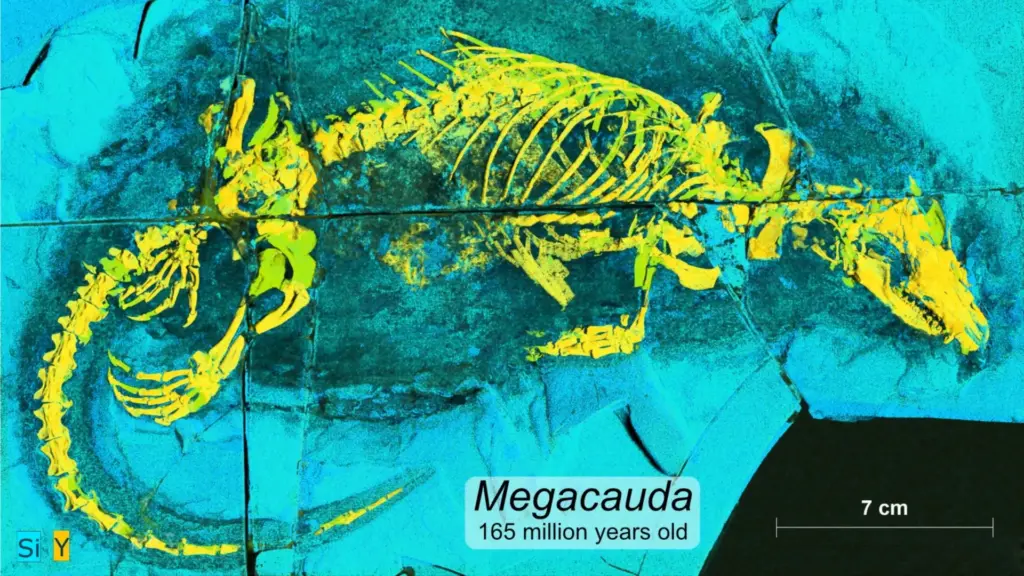
In the shadowed, dinosaur-dominated landscape of the Jurassic Period, 165 million years ago, a small, fur-covered hunter was prowling the waterways of what is now Inner Mongolia. While its stature—roughly half a meter from nose to tail—might seem modest by modern standards, the discovery of this creature, Megacauda sungei, has provided paleontologists with a profound new understanding of the evolutionary trajectory that eventually led to the rise of mammals.
A collaborative international study, involving researchers from the Paleontological Museum of Liaoning in Shenyang, the University of Chicago, and the University of Bonn, has unveiled how this ancient predator mastered a critical anatomical innovation: the soft palate. This structure, which separates the mouth from the pharynx, allowed for a complex swallowing mechanism that remains a cornerstone of mammalian biology today. The findings, recently published in the journal Nature, underscore that these early mammaliaforms were far more biologically advanced than previously assumed.
The Evolution of Swallowing
The significance of the soft palate cannot be overstated. In many non-mammalian vertebrates, the process of ingestion is relatively primitive, often relying on simple structures like the hyoid bones in the throat. Without a soft palate, these animals lack the ability to effectively compartmentalize the oral and nasal passages during the act of swallowing.

To illustrate this, paleontologist Prof. Dr. Thomas Martin of the University of Bonn points to modern crocodiles. "Crocodiles, for example, must lift their heads and perform sudden, jerking motions to move unchewed food down their throats," Martin explains. "This is achieved entirely with the aid of gravity."
In contrast, mammals have evolved a more elaborate hyoid structure and a sophisticated oral cavity that allows for controlled swallowing, even when gravity is working against the animal. This is the physiological mechanism that allows a human, for instance, to drink through a straw while hanging upside down without the liquid entering the nasal passages or choking the airways.
For early mammals, this was not merely a convenience; it was a survival necessity. This adaptation allowed nursing young to consume nutrient-rich milk safely and efficiently. By preventing liquid from entering the nasal passages, the soft palate ensured that feeding was a reliable, constant process, which in turn facilitated the metabolic demands of rapid growth and brain development.
"It was this adaptation that made brain development, eventually leading to humans, possible," says Martin. "The soft palate and the shaping of the oral cavity and pharynx are directly linked to the evolution of mammals." The discovery that Megacauda sungei already possessed this feature 165 million years ago reveals that the biological foundation for modern mammalian life was being laid long before the extinction of the dinosaurs.
A 165-Million-Year-Old Predator Built for Swimming
The physical reconstruction of Megacauda sungei paints a picture of a specialized, highly capable hunter. With its short, dense fur and a broad, flattened tail, the creature would have borne a striking resemblance to a modern otter, beaver, or platypus. Its entire physiology suggests a life dedicated to navigating aquatic environments.
To understand how the animal moved, researchers utilized computed tomography (CT) scans of the fossilized remains, allowing them to create intricate three-dimensional models of its skeletal structure. These reconstructions suggest a distinct style of locomotion: the animal likely propelled itself through the water by paddling with its front limbs, while its powerful, flat tail provided an undulating motion. The hind legs, meanwhile, were ideally positioned to act as rudders, allowing for agile changes in direction as it hunted for prey.
"It is the earliest evidence of an aquatic lifestyle in mammals," Prof. Martin notes. This level of specialization at such an early stage in mammalian history suggests that the ancestors of modern mammals were rapidly diversifying into niche environments, far earlier than the fossil record had previously indicated.
The creature’s dental anatomy further confirms its status as a specialized hunter. Along with backward-curving cusps on its teeth, which were perfectly adapted for gripping slippery, aquatic prey, Megacauda sungei possessed specialized, three-rooted canine teeth. This feature was particularly surprising to the research team, as it demonstrates an advanced level of dental complexity that researchers had not expected to find in a specimen from this era.
By conducting detailed comparative analyses between the fossil and other prehistoric specimens, as well as living mammals, the team identified Megacauda sungei as a member of the docodonts. These were an extinct group of mammaliaforms—early relatives of modern mammals—that were widespread during the Jurassic Period. The discovery of this specific fossil in the Xiayingzi region of Inner Mongolia has provided a vital missing piece in the puzzle of docodont diversity.
A Tiny Giant in the Age of Dinosaurs
In the context of the Mesozoic Era, which stretched from approximately 230 million to 66 million years ago, size was a relative concept. The world was firmly under the dominion of gargantuan dinosaurs, and most early mammaliaforms were diminutive, often weighing only a few grams.
Against this backdrop, Megacauda sungei was an outlier. Weighing in at approximately two kilograms (about 4.4 pounds) and measuring half a meter long, it was a titan among its contemporaries. While it might seem insignificant compared to the massive herbivores and predators of the Jurassic landscape, it was, in its own domain, a formidable top predator. It successfully carved out a niche as an aquatic carnivore, thriving in an environment where many other mammals were limited to terrestrial or arboreal lifestyles.
An Extraordinary Fossil Discovery in Inner Mongolia
The identification of Megacauda sungei is a testament to the power of international collaboration and institutional persistence. The fossil was unearthed in Inner Mongolia years ago and was initially acquired by the Paleontological Museum of Liaoning in Shenyang as part of a larger collection. For a time, its full significance remained hidden, buried within the museum’s extensive archives.
It was only when three world-renowned experts—Prof. Dr. Chang-Fu Zhou of Shandong University, Prof. Dr. Zhe-Xi Luo of the University of Chicago, and Prof. Dr. Thomas Martin of the University of Bonn—examined the specimen together that its true nature became apparent. The researchers recognized that the fossil did not belong to any previously cataloged species.
To honor the institution that preserved the fossil, they named the creature Megacauda sungei. The name "Megacauda" refers to the animal’s distinct, broad tail, while "sungei" serves as a tribute to Prof. Sun Ge, the Honorary Director of the Paleontological Museum of Liaoning.
"It is the result of a long period of teamwork," says Martin, reflecting on the years of analysis required to classify the specimen and document its unique anatomical traits.
The discovery has sent ripples through the paleontological community, offering a new perspective on how quickly mammalian ancestors adapted to the challenges of their environment. Other fossils from the docodont group have shown that these animals were already experimenting with diverse lifestyles: some were burrowers that occupied tunnels like modern moles, others were adapted to life in the trees, and now, with Megacauda sungei, we know that others were highly capable swimmers.
"This shows how widespread docodonts were in the Northern Hemisphere and that this diverse group of animals developed very different lifestyles at an incredibly early stage," summarizes Martin. As researchers continue to analyze the data from this remarkable fossil, it becomes increasingly clear that the history of mammals is not one of slow, uniform progress, but rather one of rapid, innovative experimentation. Long before modern mammals ascended to dominance, their ancestors were already exploring the water, the earth, and the trees, laying the groundwork for the biological complexity that defines the mammals of today.