






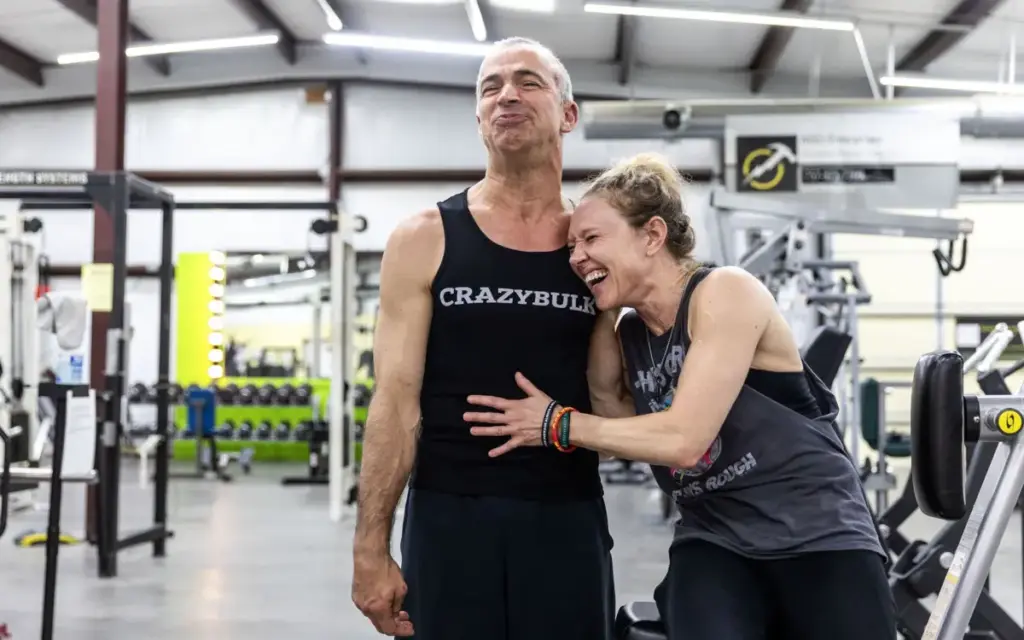
VIRGINIA BEACH, Va. — Inside the quiet hum of a local gym, the rhythmic clanging of iron plates serves as a steady heartbeat. Steve Alexy, 53, moves toward the dumbbell rack with a gait that is deliberate and pigeon-toed. His right arm remains tucked tight against his torso, while his left arm swings in a twitching, irregular arc—a visible manifestation of the cerebral palsy he has managed since childhood. Just a few feet away, his longtime partner, 45-year-old Arlyn Smith, navigates the floor with small, duck-footed steps, her movements calculated to ensure balance as she approaches the pullup bar.
To the casual observer, their physical movements are the primary focus. But in the sanctuary of the gym, these two athletes have long since moved past the discomfort of being watched. They are not merely exercising; they are training for excellence, and they have become accustomed to the inevitable, lingering glances that follow them through daily life.
Alexy, with practiced precision, reaches for a pair of 45-pound dumbbells to begin his warmup. Nearby, Smith secures a 35-pound weighted vest before gripping the bar, hoisting herself up with a fluidity that belies the cerebellar ataxia—a condition affecting balance and motor control—that has defined her adult life. For this Franklin, Virginia, couple, the gym is a theater of defiance, a place where they have proven that physical limitations do not dictate one’s capacity for strength.

The pair are not just casual fitness enthusiasts; they are world-class powerlifters. Over the last five years, they have transitioned from personal wellness journeys to the competitive stage, participating in high-stakes powerlifting meets that include both able-bodied and para-athletes. More often than not, they find themselves standing on the podium, holding trophies that serve as tangible evidence of their persistence.
For Smith, the journey to the platform was one of self-discovery. "I could have gone my entire life and never even have tried, and I wouldn’t have known," she says of her dormant potential. That potential revealed itself in spectacular fashion last year when the International Powerlifting Coalition officially recognized her as a world record holder. Competing in the women’s masters 45-49 division at 56 kilograms, Smith executed a deadlift of 264.5 pounds—a staggering feat that saw her lift more than twice her own body weight.
Alexy’s achievements are equally formidable. In 2024, he set a United States Powerlifting Coalition deadlift record in the men’s masters 50-54 division, successfully pulling 227 pounds in the 67.5-kilogram weight class.
The path to these records has been anything but linear. Alexy grew up in Franklin, learning to manage the daily realities of cerebral palsy, a neurological disorder that affects muscle tone and coordination. He found his initial footing in the world of fitness as a teenager, beginning a lifelong habit of visiting the local YMCA weight room shortly after turning 21. By 2014, he had shifted his focus to competitive bodybuilding. During that five-year span, he entered 13 competitions, treating the stage as a platform to showcase muscle tone and aesthetic symmetry.
"I called it trying to look pretty," he jokes. He was exceptionally successful at it, winning nearly every competition he entered. "Every time I played," he says with a smile, "I won."
It was during one of his final bodybuilding events that his life intersected with Smith’s. A chance encounter with a mutual friend backstage led to a phone call, and eventually, a relationship that would reshape both of their lives. At the time they met, Smith was navigating a profoundly difficult chapter. She was in recovery for substance abuse and anorexia, and had not moved unassisted by a walker or wheelchair for 15 years.
Smith’s life had been marked by tragedy and physical struggle. As a child, she had harbored dreams of being an athlete, often running laps at the track while her father looked on. By the time she was 21, however, her father had taken his own life, and she was left to navigate her adulthood alone. At age 23, an overdose induced a stroke, which resulted in permanent cerebellar ataxia—the condition that robbed her of her ability to balance and move with ease.
When Alexy and Smith met, they bonded immediately over their shared experiences. After a three-month courtship, Alexy moved to the Peninsula to be closer to her, and within six months, they had relocated to his hometown of Franklin. Their home became a place of shared support, filled with the simple joys of watching World Wrestling Entertainment and caring for their three-legged cat.
Yet, outside those walls, the world often presented a more hostile environment. They frequently faced the stinging frustration of being misjudged by strangers who conflated their physical disabilities with cognitive impairment.
"What was assumed was that something else was wrong with me because I couldn’t verbalize," Smith explains. "But the reason was, I physically could not, which was frustrating, because I had fully formed thoughts. I just couldn’t get them out."
This shared experience of being trapped in bodies that did not reflect the clarity of their minds created an unbreakable bond. "We are the same," Alexy notes.
Their training at the Retro Flex Gym in Courtland has become a cornerstone of their lives. Hunter Darden, the owner of the facility, has watched their transformation firsthand. "They’re here almost every day," Darden says. "They’re good people, really good people. They are inspiring people."
Under Alexy’s encouragement, Smith began to push the boundaries of her physical mobility. He challenged her to rely less on her walker, starting with small goals like walking to the end of the driveway. Eventually, she began navigating the sidewalk unassisted—a milestone that meant the world to her. "No one in my life had ever supported me with things, like driving to the mailbox or walking down the sidewalk," she reflects.
As her confidence grew, so did her ambition. She began competing in powerlifting, a sport that tests strength across three disciplines: the squat, the bench press, and the deadlift. Alexy’s approach to the sport is necessarily adapted; he avoids the squat because his knees tend to turn inward under heavy load, and arthritis in his shoulders makes the bench press physically untenable. Smith, however, competes in all three categories.
The validation of their efforts arrived in the form of official accolades. This year, the United States Powerlifting Coalition issued a certificate for Smith, formally acknowledging that she had set the national standard for her weight class and division. The document stands as a testament to her success in competition, but for Smith and Alexy, the true victory is the ongoing process of defying expectations.
They continue to train, day after day, in the gym in Courtland. They are a partnership built on the foundation of shared struggle and mutual elevation, proving that while they may move differently than the world expects, their strength is undeniable and their records are permanent. Every lift is a statement, every day in the gym a victory against the assumptions of others. They have found a space where the noise of the world fades, leaving only the sound of the weights and the quiet, steady rhythm of their own progress.