








The acquisition of speech sounds is a fundamental milestone in childhood development, yet for many children and teens, certain phonemes present significant, persistent challenges. Among the most notorious of these is the /r/ sound, a phoneme that frequently serves as a point of frustration for both speech-language pathologists (SLPs) and the students they support. To address this common clinical hurdle, a new resource has been introduced to help professionals and parents navigate the complexities of /r/ elicitation through a specialized collection of techniques and exercises.
The /r/ sound is widely regarded by speech experts as one of the most difficult sounds to teach and master. Unlike sounds that are produced with visible lip or tongue placement, the /r/ sound is notoriously elusive. Because it requires precise, internal adjustments of the tongue and oral cavity—often referred to as "articulators"—it is difficult for a child to observe the sound being made by others. This lack of visual feedback makes the traditional method of "watch me and do what I do" significantly less effective than it is for sounds like /p/ or /m/, where the lips clearly come together.
For educators and parents, the challenge lies in guiding a student to find the correct tongue tension and placement within the mouth without being able to point to a specific visual cue. When a student cannot see the intended target, the process of articulation therapy often stalls, leading to a breakdown in confidence and prolonged frustration for the learner.

To combat this, specialists are increasingly emphasizing the importance of "elicitation." This phase of speech therapy is critical; it is the process of helping the child or teen identify exactly how to produce a sound in isolation before moving on to complex linguistic tasks. Before a student can be expected to produce the /r/ sound in words, sentences, or spontaneous conversation, they must first master the mechanics of the sound on its own. Elicitation techniques act as a bridge, helping the student discover the physical sensations associated with the sound, such as the specific placement of the tongue tip or the necessary degree of tension in the sides of the tongue.

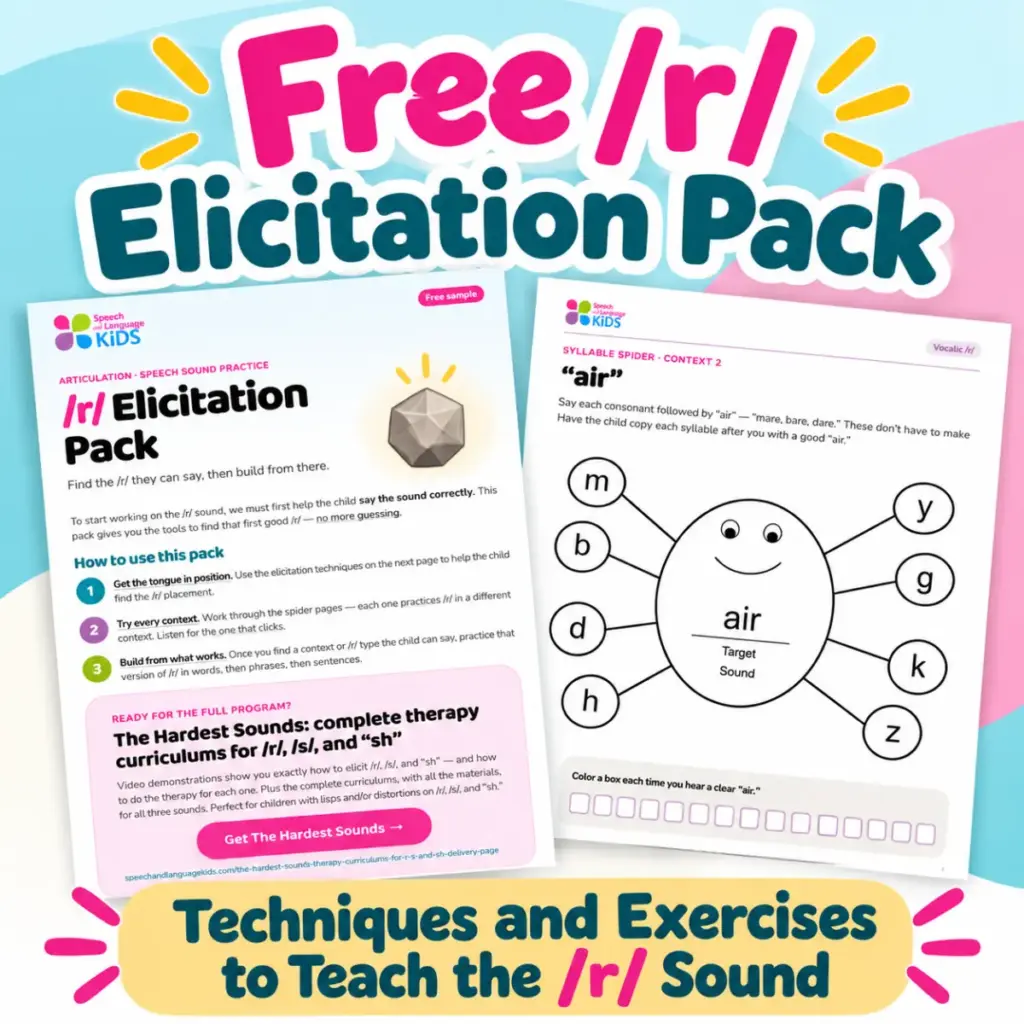
In response to the demand for more effective tools in this area, a new /r/ Elicitation Pack has been released. This resource compiles a variety of specialized strategies designed to simplify the learning curve for the /r/ sound. The pack focuses on breaking down the biomechanics of speech, providing exercises that allow the student to isolate the sound and build the necessary muscle memory required for clear articulation. By providing a structured approach to this initial phase of therapy, the pack aims to reduce the time spent in the early stages of sound acquisition, allowing students to progress more rapidly toward fluency.
Accompanying these resources is a video demonstration that illustrates how these strategies can be applied in a practical setting. Visualizing the techniques is often the missing link for many practitioners who may have theoretical knowledge but require guidance on the execution of specific exercises. The video serves to demystify the process, offering a clear, actionable look at how to guide a child through the trial-and-error process of finding the /r/ sound.
The significance of these materials extends beyond the initial elicitation phase. Speech and language experts have noted that the difficulty associated with sounds like /r/, /s/, and the "sh" sound often necessitates a more comprehensive approach to therapy. Because these phonemes are functionally different from simpler sounds, they frequently require a more structured curriculum that spans from initial sound discovery to mastery in everyday speech.
Building on the foundation provided by the elicitation pack, there is a growing movement toward implementing structured "Hardest Sounds" curricula. These programs are designed to provide a cohesive, long-term roadmap for students who struggle with the most complex phonemes in the English language. Rather than treating these sounds as isolated hurdles, a structured curriculum integrates them into a broader therapy program. This holistic approach ensures that once a child learns to elicit the sound, they have the practice materials and the developmental scaffolding necessary to maintain that sound in various contexts.

The "Hardest Sounds" curriculum, which encompasses the /r/, /s/, and "sh" sounds, is intended for use by both clinical professionals and parents at home. By standardizing the approach to these specific sounds, the program aims to provide consistency. Consistency is a vital component of successful speech therapy; when a child receives the same guidance and utilizes the same exercises across different environments, they are more likely to internalize the correct tongue placement and articulation patterns.
This curriculum is particularly beneficial for those who have found standard, generalized speech therapy materials to be insufficient for their specific needs. Because the /r/ sound, in particular, is so variable—often requiring different tongue shapes depending on the vowel that follows it—having a targeted program allows for a more nuanced and successful intervention. The program helps parents and therapists alike by removing the guesswork, offering a clear path forward that moves from the initial "elicitation" stage into the "generalization" stage, where the sound becomes a natural part of the child’s speech.
The development of these resources reflects a shift in the field of speech-language pathology toward more specialized, accessible, and structured support systems. As the understanding of phonological development deepens, the tools provided to those on the front lines of therapy must evolve. By focusing on the specific mechanics of difficult sounds and providing a clear path from elicitation to mastery, these programs are helping to ensure that children and teens have the support they need to communicate clearly and confidently.
For parents and educators who have felt overwhelmed by the challenge of teaching the /r/ sound, these developments represent a significant step forward. By utilizing proven elicitation strategies and following a structured curriculum, the daunting task of correcting complex speech patterns becomes a manageable, step-by-step process. Whether the goal is to improve the clarity of a child’s speech for school, social interaction, or personal confidence, the focus on foundational elicitation remains the most effective way to start the journey toward clear communication. As these resources continue to be utilized in both clinical and home settings, the hope is that the barrier to mastering the /r/ sound will become significantly easier to overcome, providing students with the tools they need to succeed in their speech development.