






As the excitement of summer fades and school districts across the country welcome students back for the autumn term, educators and specialists are transitioning their classrooms and clinics to seasonal themes. Among the most popular tools for early September in school-based occupational therapy is the apple theme, offering a versatile foundation for targeted interventions.
Therapists utilizing resources such as The OT Toolbox Membership are organizing their digital dashboards by theme to pull a wide variety of printable and hands-on materials tailored to individual student needs. By selecting apple-themed modules from membership sidebars, practitioners can quickly access resources ranging from geoboard activities and emotions "I Spy" sheets to directed drawings, handwriting practice, pattern worksheets, and cutting exercises. These materials are designed to address a comprehensive spectrum of school-based caseload requirements, including fine motor dexterity, scissor proficiency, self-regulation, executive functioning, and handwriting development.
The transition to crisp fall days brings a shift in both the physical environment and the developmental targets for pediatric therapy. While autumn imagery naturally evokes thoughts of hot apple cider, apple picking, and baking pies, it also signals a crucial period for foundational skill-building as children readjust to structured learning environments. Experts note that breaking down activity lists into specific developmental domains—such as sensory integration, motor planning, visual processing, cognitive skills, and social interaction—allows therapists to tailor daily sessions effectively.
Apple Sensory Activities
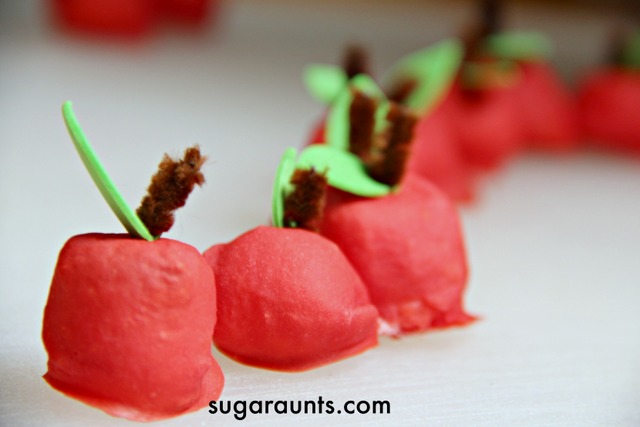
Sensory integration serves as a cornerstone for many pediatric occupational therapy programs, particularly during the initial weeks of the school year when children are recalibrating to the sensory demands of a classroom. To address heavy work through the hands that provides simultaneous proprioceptive input and tactile engagement, therapists frequently incorporate baked cotton ball apples into their sessions. These tactile objects are utilized in sensory play and fine motor tasks to help regulate children who experience hyper- or hyposensitivity.
Sensory bins also provide rich opportunities for experiential learning. An apple-cinnamon sensory bin setup, for instance, can be integrated with magnet letters hidden beneath the filler material. As children search for and spell out words like "apple," they engage in tactile-kinesthetic learning that supports children struggling with shape constancy and letter reversals. Physically holding and manipulating the letters helps wire their memory for future academic tasks.
Other texture-based interventions include applesauce oobleck, a seasonal variation of traditional slime. The inclusion of applesauce introduces a novel tactile experience coupled with the scent of apples and cinnamon. Beyond addressing sensory processing concerns, practitioners often utilize slime and oobleck creation as a practical medium to target attention, sequencing, and direction-following. When paired with guided discussion, these sensory media can also function as an adjunct to socioemotional interventions.

Apple Fine Motor Activities
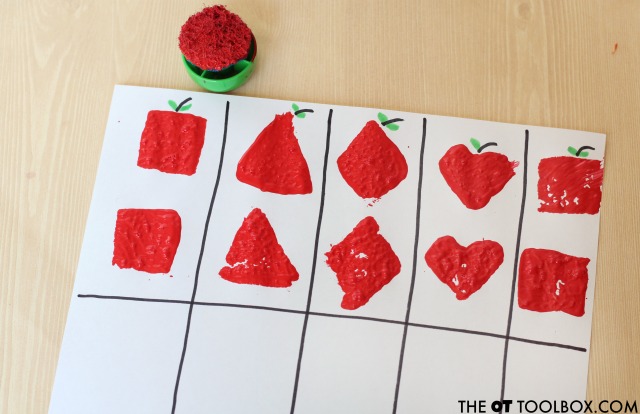
Developing hand strength, dexterity, and refined grasps is essential for functional tasks such as handwriting, managing clothing fasteners, and manipulating classroom tools. Apple-themed fine motor tasks offer multi-sensory avenues to achieve these objectives. Activities like apple-themed fine motor math provide engaging contexts for manipulative play, while toilet paper tube apple stamps allow children to practice precision, eye-hand coordination, and crossing the midline.
Simpler interventions, such as poking toothpicks into apples, offer satisfying sensory and fine motor feedback for children of various ages. Holding thin toothpicks requires a refined pincer or tripod grasp, directly preparing the small muscles of the hand for the demands of writing and buttoning. Similarly, apple pointillism projects utilizing standard hole punches help strengthen hand muscles while encouraging the pincer grasp required to pick up tiny paper circles.

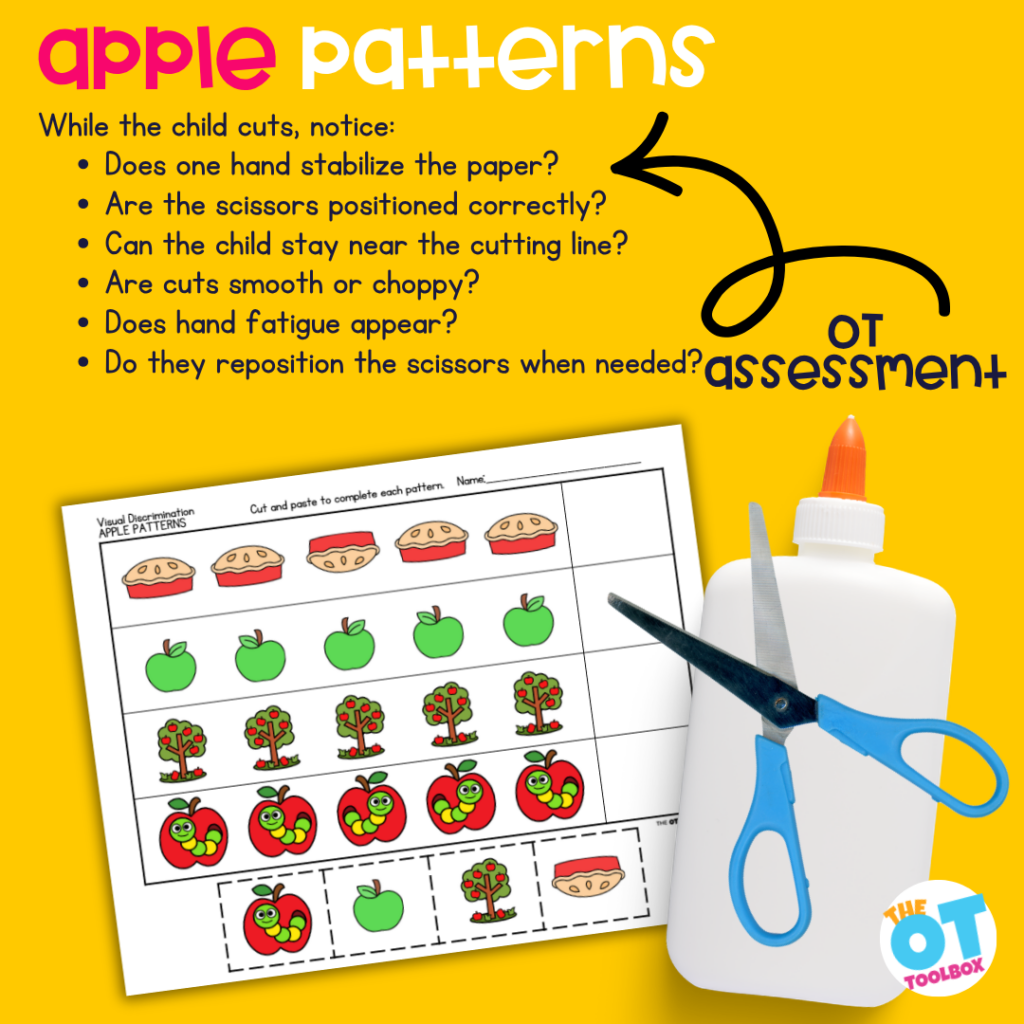
Pattern worksheets provide dual utility in early-year screenings. When children engage in apple-themed cutting worksheets at the start of the school year, occupational therapists can observe critical baseline indicators, including how the child handles scissors, maintains posture, and plans movements. These observations assist clinicians in documenting current functional levels and shaping intervention goals for the academic year ahead.
Apple Gross Motor Activities
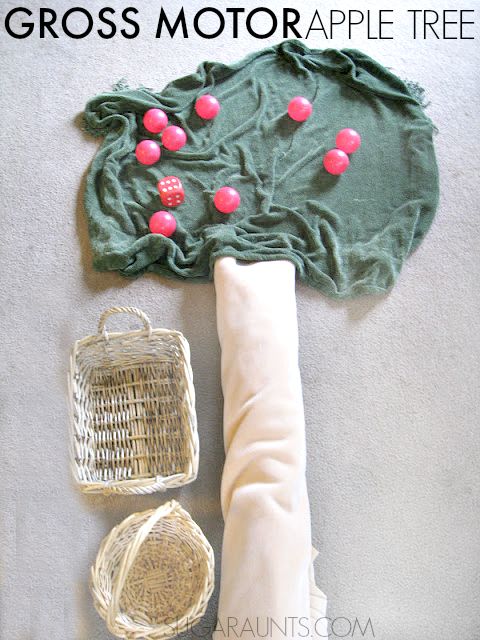
Gross motor development remains a critical component of occupational therapy, supporting core strength, endurance, balance, postural control, and motor planning. Incorporating an apple theme into gross motor interventions allows practitioners to address these fundamental physical requirements within an engaging seasonal framework.
Indoor balance beams decorated with apple motifs are frequently used to address balance, vestibular processing, and proprioceptive input. Movement-based brain breaks centered around an apple theme provide effective channels for self-regulation through whole-body movement. Additionally, classic children’s literature such as Ten Apples Up on Top by Dr. Seuss offers inspiration for gross motor coordination and balance exercises. By mimicking animal movements from the story or balancing felt apples on their heads, children practice postural stability and body awareness.
Apple Visual Perception Activities
Visual perceptual skills—including visual discrimination, form constancy, visual closure, and spatial awareness—are vital for reading, writing, and navigating the physical environment. Apple-themed shape activities and Lego construction tasks challenge children to replicate visual patterns and build structures matching a target image, fostering problem-solving and spatial orientation.
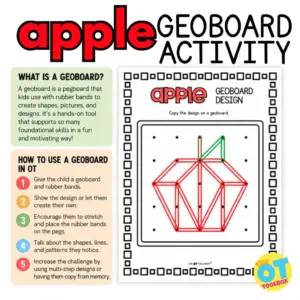
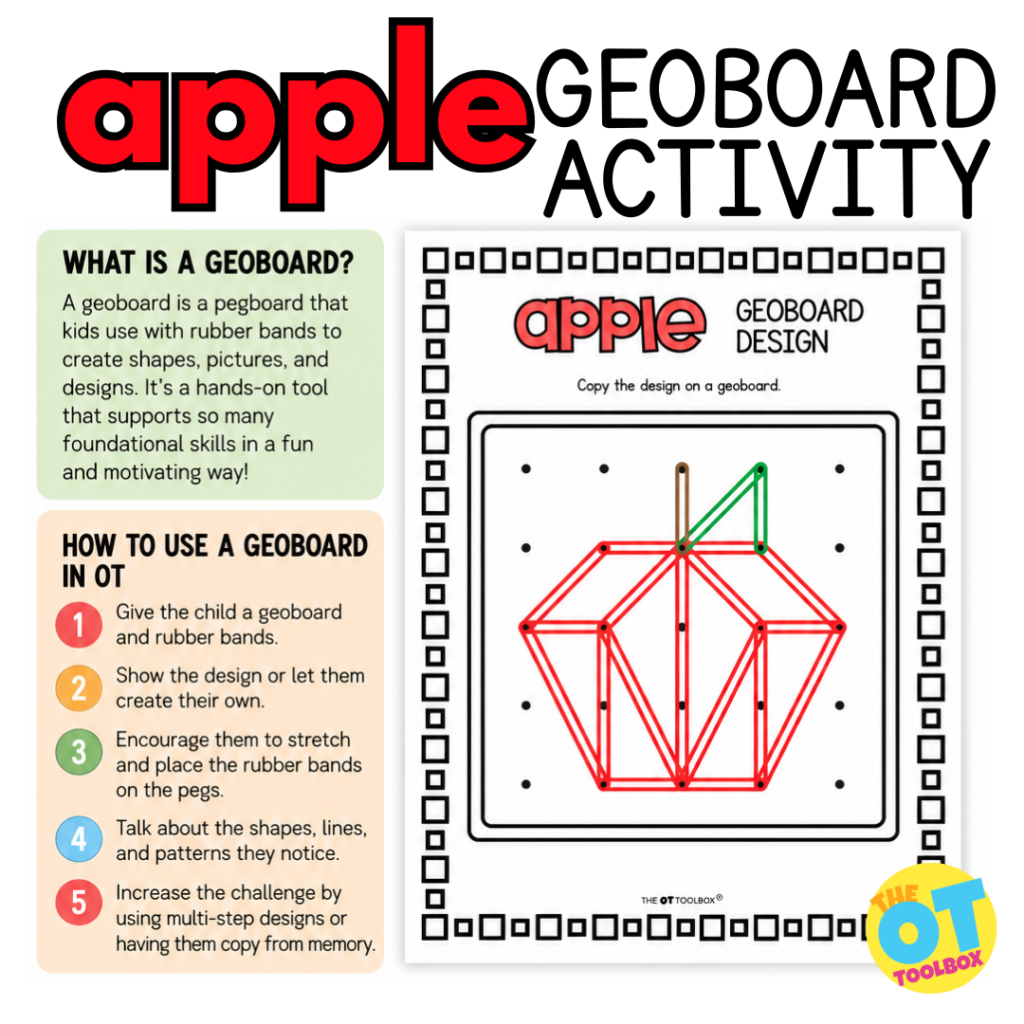
Printable apple geoboards represent another core resource utilized in therapy sessions to address hand strength, arch development, finger isolation, bilateral coordination, and visual motor integration. By copying apple designs onto a geoboard using rubber bands, children experience resistance that strengthens finger muscles while demanding visual attention to locate correct pegs and reproduce spatial designs. Therapists can easily grade these activities up or down by adjusting the complexity of the design, incorporating memory recall, or pairing the visual task with a short handwriting assignment describing the finished product.
Apple Executive Function Activities
Cooking and construction tasks naturally bridge fine motor play and executive functioning. Activities such as preparing apple salt dough provide rich sensory feedback while challenging working memory, planning, and task completion. Storybooks like The Apple Pie Tree by Zoe Hall introduce life cycles and recipes, serving as effective narrative tools to build attention and sequencing abilities. Furthermore, manipulative materials like red apple cups can be adapted for spelling games, letter recognition, and mixed-word sorting, functioning as versatile interventions for cognitive development.
Apple Handwriting Activities
Handwriting interventions are heavily integrated into apple-themed curricula through writing prompts, directed drawings with foundational lines, and letter-recognition sensory bins. Clinicians often scale writing tasks according to a student’s developmental stage. Beginning writers may focus on producing a single apple-related vocabulary word, while developing writers compose complete sentences. Older students often tackle descriptive paragraphs detailing the botanical lifecycle of an apple from seed to fruit. For students working on advanced executive functioning, open-ended writing prompts encourage independent topic brainstorming, thought organization, drafting, and editing.
Apple Activities for Social Emotional Skills
Social communication and interaction are equally vital components of a comprehensive therapy program. Structured group activities utilizing apple themes—such as those developed by specialized social communication groups—encourage peer interaction, turn-taking, and cooperative play in controlled settings.
Sydney Thorson, OTR/L, a school-based occupational therapist with a background in Human Development and Family Studies, emphasizes the importance of individualized and meaningful treatment for each child and family. As an active practitioner and children’s author and illustrator, Thorson highlights that seasonal themes like apples provide a reliable bridge between academic readiness, motor skill development, and creative engagement as students embark on a new school year.