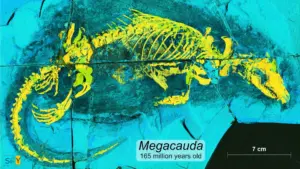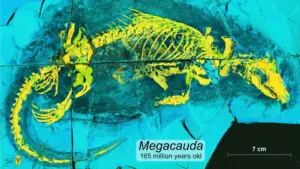









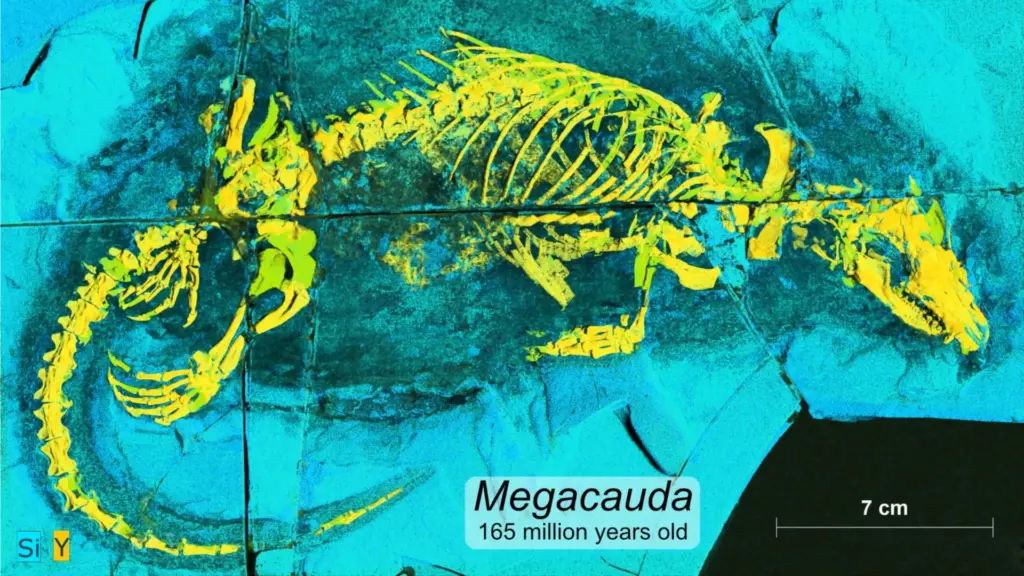
A remarkable fossil discovery from the Jurassic period is providing scientists with a transformative look at the early evolution of mammals. Unearthed in the fossil-rich deposits of Xiayingzi, Inner Mongolia, the newly identified species Megacauda sungei has emerged as a critical piece in the puzzle of how our distant ancestors transitioned from simple, small-bodied creatures to the complex, nursing animals that eventually inherited the Earth.
Measuring approximately half a meter—or 20 inches—from its nose to the tip of its broad, flattened tail, Megacauda sungei was a formidable presence in the shadows of the dinosaur-dominated Jurassic landscape. While its physical dimensions might seem modest by modern standards, researchers from an international collaboration in Shenyang, Chicago, and Bonn have identified it as a heavyweight among its contemporaries. The findings, published in the prestigious journal Nature, reveal that this ancient creature was not merely a survivor, but a specialized hunter that occupied an aquatic niche 165 million years ago.
How an Ancient Predator Reveals the Evolution of Swallowing
While the size and hunting prowess of Megacauda sungei are notable, the true scientific breakthrough lies within its skeletal anatomy. Through the use of advanced computed tomography (CT) scans, the research team—led by Prof. Dr. Chang-Fu Zhou of Shandong University, Prof. Dr. Zhe-Xi Luo of the University of Chicago, and Prof. Dr. Thomas Martin of the University of Bonn—discovered evidence of a sophisticated soft palate.

In most non-mammalian vertebrates, the mouth and the pharynx—the passage connecting the mouth to the throat—are not separated by a complex soft palate. This structural limitation necessitates different, often cumbersome, feeding strategies. For instance, modern crocodilians, which lack this mammalian feature, must rely on gravity and sudden, jerky head movements to maneuver unchewed food down their gullets.
"This is achieved with the aid of gravity," explains paleontologist Prof. Dr. Thomas Martin. By contrast, the development of a soft palate allowed mammals to decouple the act of breathing from the act of swallowing. This anatomical refinement, already present in Megacauda sungei millions of years before the rise of modern mammals, was a revolutionary evolutionary advantage.
Beyond simply making it easier to consume food, the soft palate served a vital biological function: it enabled efficient nursing. By preventing liquid from entering the nasal passages, the structure allowed young mammals to consume nutrient-rich milk safely while simultaneously maintaining their oxygen intake. This, according to Professor Martin, was a turning point in evolutionary history. "It was this adaptation that made brain development, eventually leading to humans, possible," Martin stresses. "The soft palate and the shaping of the oral cavity and pharynx are directly linked to the evolution of mammals."
A 165-Million-Year-Old Predator Built for Swimming
With its short, dense fur and a broad, paddle-like tail, Megacauda sungei would have resembled a prehistoric otter, beaver, or platypus. Its physiology was clearly optimized for a life in the water, a lifestyle that was previously thought to have emerged much later in the mammalian lineage.
The three-dimensional reconstructions derived from the CT scans provide a vivid picture of how the animal navigated its environment. Scientists believe the creature propelled itself through the water using a combination of paddling motions from its front legs and a graceful, undulating motion of its tail, while its hind legs acted as rudders for precise steering.
"It is the earliest evidence of an aquatic lifestyle in mammals," notes Professor Martin.
The dental anatomy of the specimen further confirms its status as an apex hunter of its scale. The animal featured backward-curving cusps on its teeth, an ideal adaptation for gripping slippery, aquatic prey. Furthermore, the researchers were surprised to discover that the creature possessed specialized three-rooted canine teeth, a distinct morphological feature that further highlights the surprising complexity of early mammaliaforms.
Through rigorous comparative analysis with other prehistoric specimens and living counterparts, the team determined that the animal belonged to the docodonts. This extinct group of early mammal relatives was remarkably widespread during the Jurassic period, occupying diverse ecological roles across the Northern Hemisphere.
A Tiny Giant in the Age of Dinosaurs
The term "predator" often conjures images of massive, prehistoric beasts, but in the context of the Mesozoic Era—which stretched from approximately 230 million to 66 million years ago—the reality was often much smaller. During this time, the world was dominated by dinosaurs, and early mammalian relatives were largely relegated to the fringes, with many species weighing only a few grams.
In this context, Megacauda sungei was an anomaly. Weighing in at approximately two kilograms (4.4 pounds) and reaching half a meter in length, this aquatic hunter was effectively a heavyweight among its peers. While it would appear diminutive standing alongside modern elephants or rhinoceroses, it represented a significant shift in the biological capabilities of its time.
The discovery of such a specialized and relatively large mammaliaform challenges previous assumptions about the limitations faced by mammals during the age of the dinosaurs. It suggests that while dinosaurs commanded the terrestrial landscape, their mammalian contemporaries were already diversifying, occupying niches in the trees, burrowing underground like modern moles, and, in the case of Megacauda, conquering the water.
An Extraordinary Fossil Discovery in Inner Mongolia
The identification of Megacauda sungei is the culmination of a decade-long international effort. The fossil was initially unearthed in Inner Mongolia and later acquired by the Paleontological Museum of Liaoning in Shenyang as part of a larger collection. However, its significance remained hidden until a collaborative team of experts from China, the United States, and Germany began an intensive, multi-year study.
The process of bringing this species to light involved exhaustive analysis, meticulous comparisons with global fossil records, and extensive documentation. To honor the museum’s role in preserving the find, the team named the species in recognition of Prof. Sun Ge, the Honorary Director of the Paleontological Museum of Liaoning. The name Megacauda—meaning "large tail"—was combined with the species designation sungei to immortalize both the animal’s most prominent physical feature and the scientific legacy of the institution.
"It is the result of a long period of teamwork," Professor Martin says.
The findings regarding Megacauda sungei serve as a powerful reminder of how much of the history of life on Earth remains to be uncovered. By demonstrating how quickly and dramatically early mammal relatives adapted to their environments, the discovery forces a reassessment of the evolutionary timeline. It confirms that long before the extinction of the dinosaurs paved the way for the dominance of modern mammals, our ancient relatives were already experimenting with an impressive range of survival strategies, from complex oral anatomy to specialized aquatic locomotion. The story of Megacauda is not just the story of a single prehistoric animal; it is a vital chapter in the broader, ongoing history of mammalian innovation.