







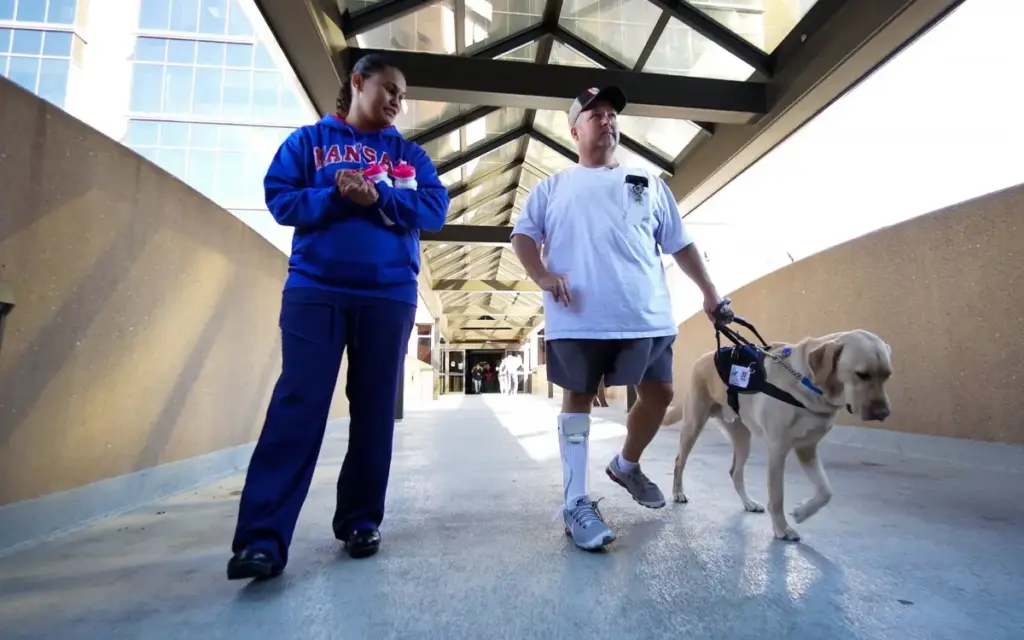
HARTFORD, Conn. — When Olivia Streaman first applied for a service dog four years ago to assist her father, who lives with Parkinson’s disease, she anticipated it would bring a measure of relief. Instead, she describes the outcome as entirely life-changing. The canine companion, a highly trained dog named Peanut, allowed her father to maintain a vital degree of independence and provided essential support with his daily mobility.
Witnessing firsthand the profound and stabilizing bond between her father and his working animal ultimately shifted Streaman’s career path. Today, she works as a development associate at Educating Canines Assisting with Disabilities, a Winsted-based nonprofit originally founded in 1995 by Lu and Dale Picard. The organization’s overarching mission is to empower individuals facing physical and developmental challenges to achieve greater independence, confidence, and mobility through the partnership of specially educated dogs.
However, Streaman and her colleagues at the nonprofit are now throwing their energy into a legislative battle. They are actively campaigning to change Connecticut state law to make it explicitly illegal to intentionally misrepresent a pet as a legitimate service dog. According to advocates, the proliferation of untrained pets falsely passed off as service animals has created a pervasive public relations and logistical nightmare, unfairly casting a shadow over reputable service dog owners who rely on their animals to navigate everyday life. To combat the trend, Educating Canines Assisting with Disabilities has launched an online petition aimed at protecting service dogs and the handlers who depend on them for safety and inclusion.

The core of the problem, Streaman explains, lies in the widespread misrepresentation of ordinary pets as working animals. Owners frequently acquire fake vests, official-looking badges, printed certificates, or dubious online "registrations" via the internet to pass off untrained household pets as legitimate service dogs.
This fraudulent behavior has tangible, damaging consequences for individuals with genuine medical needs. Streaman points to a recent unsettling encounter at a local Costco store, where her father was subjected to aggressive questioning by staff. Unbeknownst to him, a customer’s pet had previously been brought into the establishment and had an indoor bathroom accident, while another untrained dog had barked aggressively at shoppers. These isolated incidents understandably made employees hesitant and cautious about allowing animals inside.
Unfortunately, because Peanut looks like any other dog, store staff projected those past negative experiences onto Streaman’s father. Peanut is a meticulously trained service dog who remains faithfully by his side to steady his movements, yet the actions of irresponsible pet owners have placed an unfair burden on legitimate handlers.
"It’s hard for my dad to talk and be heard clearly," Streaman noted, reflecting on the toll these confrontations take. "Because of the questioning, it caused anxiety and made my dad not want to go again. One of the purposes of a service dog is to give their handlers greater mobility and confidence to be independent and leave their homes. But when they are being questioned constantly, it makes them want to be more reclusive and stay indoors."
The rise of internet-bought certificates and vests has only exacerbated the confusion. Streaman points out that a true, fully trained service dog undergoes approximately 1,500 hours of rigorous preparation—roughly two years of specialized instruction—before ever being matched with a handler. Paradoxically, legitimate working service dogs do not typically come with mandatory official vests, government paperwork, or specialized collars, which inadvertently makes it easier for bad actors to fake the credentials of an untrained pet.
Despite this, Streaman emphasizes that there are distinct behavioral markers that separate a working professional animal from an imposter. A true service dog possesses an exceptionally calm temperament, refuses to bark or become overly excited, and never wanders away from its owner’s side.
"Being able to watch how the dog behaves with its handler is the biggest tell," Streaman said. "A legitimate service dog will not get distracted easily, bark, or sniff around. Once the vest is put on a service dog, it’s incredible to watch them step into that helper role immediately."
A Growing Debate
While the frustration among handlers of legitimate animals is palpable, the broader community of trainers and advocates reveals a more complex picture surrounding the issue of poorly behaved animals in public spaces. Kasey Nash, who founded Joyful Paws Service Dogs in Windsor in 2017, acknowledges that while there is an intense community debate over misrepresented animals, she believes many instances stem from inadequate training rather than deliberate, malicious fraud.
"I think there has to be some nuance in this debate from my experience working with service dog owners," Nash said. "Many times dogs are not trained adequately. You have to remember some of these handlers are severely disabled and sometimes the dog is not properly or professionally trained and can exhibit behavioral issues. It’s not that the owner is being intentionally misleading, it’s that the dog just isn’t trained properly."
Nash cautions that the word "fake" is a loaded term that unfairly implies an individual is entirely unimpaired and knowingly dragging a pet into public spaces under false pretenses. In reality, she notes, many handlers are genuinely disabled individuals who attempted to train their own animals to mitigate their disabilities but lacked access to professional guidance, robust support systems, or sufficient financial resources.
The financial hurdle alone is staggering. A fully trained professional service dog can cost upwards of $40,000, creating an insurmountable barrier for many people living with disabilities. To bridge this gap, Nash’s business offers specialized training programs that allow handlers to bring their own dogs in to be trained. For many clients, this owner-training model represents the only accessible and affordable pathway to obtaining a qualified service animal.
Training plans vary wildly depending on the specific dog, the individual handler, the nature of the disability, and any prior training background. Nash strives to accommodate individual budgets by utilizing group classes, seminars, and webinars to minimize costs, alongside providing outside resources for self-motivated clients.
Furthermore, the legal landscape governing service animals remains intentionally broad. Under the federal Americans with Disabilities Act, there is no mandate requiring professional training, accredited training programs, official government registries, ID cards, or formal certification.
"The laws are vaguely written as to what qualifies as a service dog, that is certainly true, but ultimately that means more people can have access," Nash said. "I actually agree with the laws we have in the United States. Another thing that comes up a lot is that people don’t know the service dog laws. I think if we’re going to address the problem of poorly trained service dogs, I don’t think we should attack the individual person. I think part of the solution is educating businesses on what they can do and what their role is."
Laws as They Stand Now
According to guidelines from the Advocates for Service Animal Partners, business and establishment owners are legally permitted to ask service dog handlers only two specific questions under the ADA: Is the dog a service animal required because of a disability? And what specific work or task has the dog been trained to perform?
Federal regulations strictly forbid workers from demanding medical papers, special identification cards, or physical proof of training. Furthermore, legally trained service animals are granted access to any public area where the general public is permitted to go. By contrast, emotional support animals and standard household pets lack this specialized training and do not share the same legal protections, meaning businesses can lawfully deny them entry.
"Part of the way businesses can defend themselves is through asking those two questions," Nash said. "If someone was intentionally faking a service dog, they would probably not be able to answer those questions very well. Also, the other side of it, is that even if someone answers those questions appropriately, there are behaviors to look for. If the dog is behaving aggressively or jumping on people, it can become more obvious the dog is not properly trained."
Because federal ADA requirements do not mandate documentation, retail workers and business employees cannot lawfully bar entry to anyone in a public space who asserts they have a service dog, provided the animal remains under control. However, when an animal acts out, displays aggression, or lacks discipline, it frequently creates friction for legitimate teams.
Advocates like Streaman point out that more than half of U.S. states have already enacted legislation penalizing fraudulent service dog misrepresentation, leaving Connecticut trailing behind neighboring jurisdictions. In most states where the practice is outlawed, first offenses carry civil fines ranging from $100 to $500, while repeat violations or stricter state statutes classify the deception as a misdemeanor carrying potential jail time.
Efforts to introduce similar accountability in Connecticut have faced legislative hurdles. Last year, the Connecticut Senate passed SB 1386—a bill primarily centered on dog-breed insurance regulations—which also directed a state commission to study whether a formal misrepresentation penalty should be established for service dogs. Ultimately, the commission did not formulate a penalty, and the provision failed to become law.
"We are asking the Connecticut General Assembly that if someone knowingly misrepresents their pet as a service dog they will have to face repercussions," Streaman said. "We’re just asking to keep the momentum going and have circulated a petition online. We just want there to be a penalty in place as many states already have."