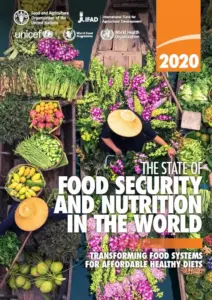









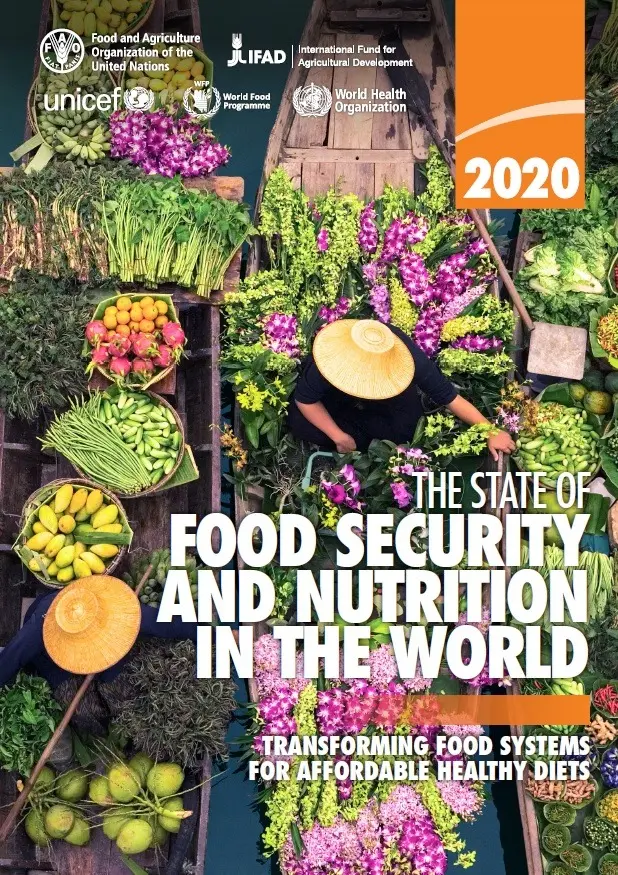
ROME — World hunger has continued its worrisome upward trajectory over the past five years, with tens of millions of people joining the ranks of the chronically undernourished as nations globally grapple with multiple and compounding forms of malnutrition. Five years after the international community pledged to eradicate hunger and food insecurity by 2030, a comprehensive new United Nations study warns that the world remains dangerously off-track to meet its most ambitious developmental goals.
The latest edition of The State of Food Security and Nutrition in the World, published today, estimates that approximately 690 million people went hungry in 2019. This figure represents an increase of 10 million people compared to 2018 estimates, and a staggering rise of nearly 60 million people over a five-year period. Beyond those experiencing outright hunger, the report highlights that high food costs and low economic affordability mean that billions of people around the globe are entirely unable to afford or access a healthy, nutritious diet.
Geographically, the largest absolute number of hungry people remains concentrated in Asia, though the crisis is expanding at its fastest pace in Africa. Furthermore, looking ahead, the global fallout from the COVID-19 pandemic threatens to worsen the situation dramatically, potentially tipping more than 130 million additional people into chronic hunger by the close of 2020. Periodic flare-ups of acute hunger linked to the broader context of the pandemic could cause this grim number to escalate even further at various points throughout the year.
This authoritative annual study serves as the premier global tracking mechanism for monitoring progress toward the eradication of hunger and all forms of malnutrition. It is collaboratively produced by five specialized United Nations agencies: the Food and Agriculture Organization (FAO), the International Fund for Agricultural Development (IFAD), the United Nations Children’s Fund (UNICEF), the UN World Food Programme (WFP), and the World Health Organization (WHO).
In the foreword to the report, the executive heads of these five agencies issue a stark and unified warning. Five years after the global community committed itself to ending hunger, food insecurity, and every form of malnutrition, they write that the world remains firmly off-track to achieve this critical objective by the target date of 2030. The leaders emphasize that structural flaws within global food systems must be urgently addressed if this negative trajectory is to be reversed.
The Hunger Numbers Explained
In the current edition of the study, critical data updates for China and several other highly populous countries have led to a substantial recalibration in the overall estimation of the global hungry population, bringing the baseline down to the current figure of 690 million. These updates involved crucial parameters measuring inequality in food consumption within societies across 13 countries with a combined population approaching 2.5 billion people, including Bangladesh, China, Colombia, Ecuador, Ethiopia, Mexico, Mongolia, Mozambique, Nigeria, Pakistan, Peru, Sudan, and Thailand. In particular, revisions regarding the size of China’s population had the single largest impact on the global statistical totals.
Nevertheless, despite these methodological updates and adjustments, the underlying global trend remains entirely unchanged. When researchers revised the entire historical hunger data series backward to the year 2000, the resulting conclusion was unequivocal: after steadily and encouragingly diminishing for decades, chronic hunger slowly began to creep upward in 2014 and has continued to rise ever since.
A breakdown of the numbers reveals regional disparities across the globe. Asia continues to house the greatest total number of undernourished individuals, with an estimated 381 million people affected. Africa follows in second place with 250 million undernourished people, while Latin America and the Caribbean account for approximately 48 million.
While the global prevalence of undernourishment—defined as the overall percentage of hungry people within the world’s population—has held relatively steady at 8.9 percent, the absolute numbers have continued an upward climb since 2014. This statistical reality indicates that over the past five years, the growth of global hunger has kept pace directly with the growth of the overall global population.
This trend masks significant regional variations. In percentage terms, Africa stands out as the hardest-hit region and is growing increasingly vulnerable, with 19.1 percent of its population currently undernourished. This proportion is more than double the recorded rates in Asia, which stands at 8.3 percent, and in Latin America and the Caribbean, which sits at 7.4 percent. If current demographic and economic trends persist unchecked, projections indicate that by the year 2030, Africa will be home to more than half of all the chronically hungry people on the planet.
The Pandemic’s Toll
Just as progress toward halting and reversing the spread of hunger has stalled, the sudden emergence of the COVID-19 pandemic has served to intensely amplify the underlying vulnerabilities and structural inadequacies of global food systems. For the purposes of the report, food systems are understood to encompass the entire network of activities, processes, and institutions that affect the production, distribution, and consumption of food.
While researchers note that it remains too early to assess the full, long-term impact of national lockdowns and other stringent containment measures enacted worldwide, the report provides alarming preliminary estimates. At a bare minimum, the economic recession triggered by COVID-19 is projected to push another 83 million people into hunger during 2020. In a more severe economic scenario, that figure could soar as high as 132 million additional people. This profound setback casts severe doubt on the international community’s ability to achieve Sustainable Development Goal 2, which calls for achieving Zero Hunger.
Unhealthy Diets, Food Insufficiency, and Malnutrition
Overcoming the interconnected crises of hunger and malnutrition in all its manifestations—which includes undernutrition, deficiencies in vital micronutrients, as well as rising rates of overweight and obesity—requires looking far beyond merely securing enough raw calories for mere survival. What people eat, and particularly what growing children consume, must also be sufficiently nutritious. Yet, a primary obstacle standing in the way of proper nutrition is the prohibitively high cost of nutritious food items coupled with the low economic purchasing power that leaves healthy diets out of reach for vast numbers of households.
The report presents compelling evidence demonstrating that a healthy diet costs significantly more than the international extreme poverty threshold of US$ 1.90 per day. The study calculates that even the least expensive healthy diet option available in local markets costs roughly five times the price of simply filling one’s stomach with a diet composed entirely of cheap starches. Globally, nutrient-rich food groups—such as dairy, fresh fruits, vegetables, and protein-dense foods derived from both plant and animal sources—remain the most expensive categories to purchase.
Recent estimates suggest that a staggering 3 billion people, or even more, are financially unable to afford a basic healthy diet. In sub-Saharan Africa and southern Asia, this distressing reality affects 57 percent of the total population. However, no region of the world is entirely spared, with affordability gaps existing even within wealthy industrialized nations in North America and Europe.
Partly as a direct consequence of these economic barriers, the global race to eliminate malnutrition appears severely compromised. According to the findings, nearly one-quarter to one-third of children under the age of five—amounting to approximately 191 million children worldwide—suffered from stunting or wasting in 2019, meaning they were structurally too short or too thin for their age. Simultaneously, another 38 million children under five were classified as overweight. Among the adult population, rates of obesity have expanded to the point where it has become a global health crisis in its own right.
A Call to Action
The report argues that when long-term environmental sustainability considerations are factored into economic calculations, a decisive global transition toward healthy diets would help check the dangerous backslide into hunger while generating enormous financial savings. The study calculates that such a dietary shift would allow the staggering health care costs associated with unhealthy diets—projected to reach US$ 1.3 trillion annually by 2030—to be almost entirely offset. Furthermore, the diet-related social and environmental costs of greenhouse gas emissions, estimated at US$ 1.7 trillion, could be reduced by up to three-quarters.
To achieve this, the study calls for a comprehensive transformation of global food systems designed to systematically reduce the cost of nutritious foods while increasing the overall affordability of healthy diets. While the specific policy solutions will necessarily vary from country to country, and even within local municipalities, the broader answers require targeted interventions spanning the entire food supply chain, improving the local food environment, and reforming the political economies that govern international trade, public expenditure, and agricultural investment policies.
The report urges national governments to mainstream nutrition principles directly into their broader agricultural approaches; to work aggressively toward cutting cost-escalating factors involved in the production, storage, transport, distribution, and marketing of food, including the reduction of inefficiencies and everyday food loss and waste; to actively support local, small-scale producers to grow and sell more nutritious varieties of food while securing their reliable access to local and regional markets; to prioritize children’s nutrition as the demographic category in the most urgent need of protection; to foster meaningful behavioral change through targeted public education and communication campaigns; and to embed nutrition objectives firmly within national social protection systems and long-term investment strategies.
The executive heads of the five United Nations agencies behind The State of Food Security and Nutrition in the World—FAO Director-General Qu Dongyu, IFAD President Gilbert F. Houngbo, UNICEF Executive Director Henrietta H. Fore, WFP Executive Director David Beasley, and WHO Director-General Tedros Adhanom Ghebreyesus—reaffirmed their collective commitment to supporting this momentous shift. They pledged to ensure that the necessary transformation unfolds in a sustainable manner, safeguarding the well-being of both people and the planet.