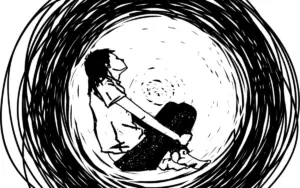










It is a familiar, heavy sensation that often arrives hand-in-hand with a fever, a cough, or sudden exhaustion: the sinking feeling of guilt.
Recently, while traveling to help care for a one-year-old grandchild, a sudden wave of dizziness forced a grandmother to retreat to bed. Unable to shake the ailment, she ultimately decided to travel home to convalesce, grappling with an overwhelming sense of guilt despite her daughter’s profound kindness, care, and understanding.
It raises a universal question that millions of people confront during moments of physical vulnerability: Have you ever felt the need to apologize simply for being sick?

Perhaps you have felt terrible about canceling plans at the last minute, worried that a partner might resent you for asking for assistance, or forced your body to keep moving when it desperately needed to rest. It is widely acknowledged that being sick is miserable enough on its own. Yet, human beings routinely heap layers of guilt on top of physical suffering.
This phenomenon is remarkably common. People frequently report feeling guilty for becoming a burden to others. They confess a deep-seated hatred for being perceived as weak, lazy, or taking advantage of people’s good nature. They loathe being unproductive and failing to contribute to daily responsibilities. Ironically, many of these same individuals express immense joy in caring for others and would never want their loved ones to feel guilty for needing assistance in return.
Of course, human beings do not consciously choose to contract viruses, develop infections, or experience sudden physiological crashes. So why does an occurrence entirely beyond personal control trigger a psychological response as though a moral wrong has been committed?
The Roots of Childhood Conditioning
According to psychological insights, early life experiences offer vital clues to this behavior. During childhood, individuals learn a great deal about which emotions and needs are deemed acceptable by their families and communities, and which ones are not.
If caregivers routinely responded to a child’s vulnerability with irritation, criticism, or emotional withdrawal, that child may have internalized the lesson that needing help was somehow inherently bad. Even within deeply loving families, children frequently absorb underlying messages that praise strength, independence, and helpfulness while disparaging neediness, laziness, or self-indulgence.
Consider a typical upbringing where parents worked exhaustively to provide for the household. In homes where a parent worked as a physician, for instance, a child might quickly learn that they had to be severely ill to justify staying home from school and receiving the attention and care they craved. In such environments, independence is heavily valued, often because busy parents are striving to manage their own heavy burdens without cracking under pressure.
Seemingly, these formative lessons stay with individuals well into adulthood, shaping how they perceive illness and human vulnerability. They become deeply ingrained values and emotional wiring. Consequently, when adults fall ill and find themselves forced to rest or depend on others, an automatic wave of guilt washes over them, often leaving them entirely perplexed as to its origin.
What the Change Triangle Can Teach Us About Guilt
To better understand these complex emotional reactions, mental health professionals often point to frameworks like the Change Triangle. Adapted from academic literature on human emotions, this conceptual tool helps individuals understand their internal states and determine constructive ways to navigate them.
The framework maps out four primary categories of emotional experience: defenses, inhibitory emotions, core emotions, and a regulated state. The ultimate goal of engaging with this model is to help reset the human nervous system, steering it back toward emotional regulation so that individuals can spend more time feeling calm, centered, and confident.
Core emotions—which include sadness, fear, anger, joy, excitement, and disgust—are entirely natural responses to the shifting circumstances of life. They provide essential information about what truly matters to a person and what their mind and body require at any given moment.
However, these core emotions can also make individuals feel profoundly vulnerable, particularly if they never received education or guidance regarding what these feelings are and why they exist. When family environments implicitly or explicitly communicate that certain feelings or needs are unacceptable, people often learn to block those primary feelings with inhibitory emotions, such as guilt, shame, and anxiety.
These inhibitory emotions actively interfere with the ability to experience core emotions freely. For instance, if a child’s parents cannot tolerate expressions of anger, that child may develop deep-seated guilt or shame simply for feeling angry. Conversely, if parents receive anger with understanding and establish appropriate limits on how to channel it constructively, the child is far more likely to embrace anger as a normal part of the human spectrum and express it in healthy ways.
To manage the discomfort of these unprocessed emotions, people frequently turn to psychological defenses—anything an individual does to avoid feeling what is happening internally. Common defenses range from excessive drinking and perfectionism to clinical depression.
A classic illustration of this dynamic involves everyday scenarios, such as an individual named Violet who contracted the flu just days before her sister’s wedding. Naturally, Violet felt deep sadness about missing the momentous family event. She also felt angry about the abysmal timing of the illness and scared about the severity of her physical symptoms.
Yet, instead of simply allowing herself to experience these completely understandable primary emotions, Violet was immediately overwhelmed by guilt over disappointing her sister and the rest of her family. To manage that suffocating guilt, she apologized repeatedly to her relatives and even seriously considered attending the gathering while actively contagious, though her family sensibly told her to stay home and recover.
In this scenario, sadness, anger, and fear were effectively buried deep beneath a heavy blanket of guilt. That guilt subsequently drove behaviors that could have jeopardized her health and the health of others. This exact dynamic is why experts continually encourage people to look at their guilt with curiosity rather than automatically accepting its validity.
When Guilt Is Unfounded
Guilt certainly serves an important, adaptive purpose when an individual has genuinely hurt someone or violated their core personal values. In those instances, it acts as a moral compass, motivating people to apologize and make amends. However, guilt frequently arises in situations where no wrongdoing has occurred whatsoever—such as the simple, biological reality of falling ill.
When unearned guilt surfaces, experts suggest pausing to ask two distinct questions: Did I actually do something wrong? Or am I merely feeling guilty because I have a legitimate human need that makes me feel uncomfortable? The distinction between these two states is critical.
One of the most effective interventions is to gently direct attention toward the emotions residing underneath the guilt. The next time illness strikes and guilt sets in, individuals are encouraged to pause, breathe, and notice precisely where that guilt is felt physically within the body—perhaps as a sinking sensation in the stomach or a tight constriction in the chest.
From there, asking a simple internal question can be transformative: "If I weren’t feeling guilty right now, what else might I be feeling?"
The answer might reveal that the person is genuinely scared about their health, sad about missing a milestone, angry that their body has seemingly let them down, or simply lonely and longing for someone to look after them. Whatever surfaces, the practice requires accepting, validating, and making room for that primary emotional truth.
An individual might softly tell themselves, "Of course I’m sad; I was really looking forward to that trip," or, "Of course I’m scared; I don’t know when my strength will return." There is no need to judge or attempt to forcefully change these core emotions. Instead, the path forward involves acknowledging them, understanding their origin, and allowing the mind and body to experience them in manageable doses.
Processing an emotion fully involves naming it, sensing its physical manifestation, noticing the physical impulse, releasing the associated energy, and riding the wave of the feeling until a genuine internal shift and physical release occurs. Through practice, people can learn to navigate their emotions directly, at which point the crushing weight of unearned guilt invariably begins to soften.
Reframing Illness as Biology, Not Failure
Modern society places an extraordinary cultural premium on productivity, unwavering independence, and the relentless habit of pushing through physical discomfort. Within such a climate, it is remarkably easy to internalize the destructive belief that resting is equivalent to laziness or that needing help is a sign of personal weakness.
However, human biology operates on entirely different terms. Bodies get sick. They get tired. They require active attention and attentive care. That reality is not a personal failure; it is simply biology.
Working through frameworks like the Change Triangle ultimately aims to guide individuals back toward the openhearted state of their authentic self—a place where they retain greater access to calm, clarity, compassion, and connection. From this grounded vantage point, people can readily recognize that being sick is inherently difficult without unnecessarily compounding the experience with shame or self-recrimination.
In this balanced state, an individual can feel genuinely sad about missed opportunities, anxious about health concerns, or frustrated by temporary physical limitations, all while treating themselves with profound kindness and allowing the people who love them to step in and help.
The next time guilt flares up during a bout of illness, it is worth pausing to consider a straightforward perspective: If a cherished friend or family member were lying in that exact same bed, would anyone dream of making them feel ashamed for needing rest and care? The answer is invariably no. Extending that same basic generosity to oneself is a vital step toward healing—a lesson put into practice over the weekend with remarkably comforting results.