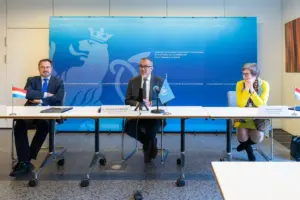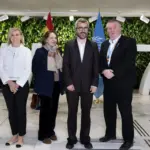

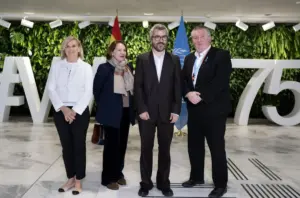
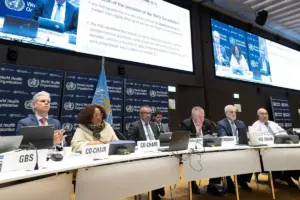

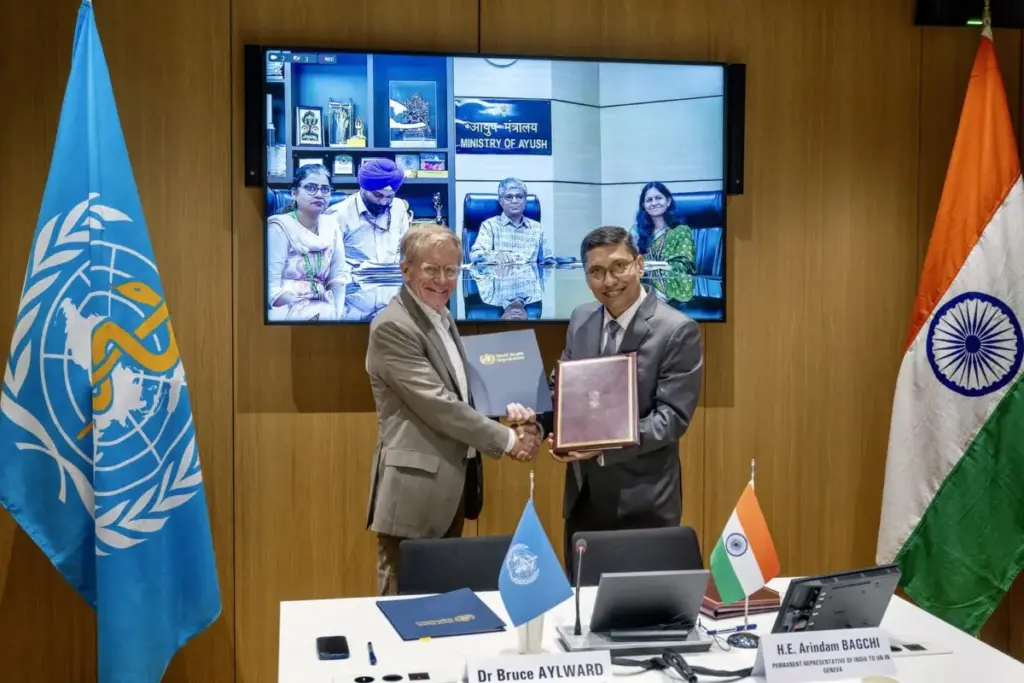
GENEVA — In a landmark commitment to the future of global healthcare and holistic well-being, the Government of India has formally pledged US$ 85 million over a ten-year period, spanning from 2022 to 2032, to support the programming and expansion of the World Health Organization (WHO) Global Traditional Medicine Centre. The agreement was finalized during a high-level signing ceremony held in Geneva, marking a pivotal moment in international health collaboration.
This substantial financial contribution from India is specifically earmarked to power a comprehensive, cross-sectoral program of work designed to dramatically strengthen the evidence base for traditional medicine worldwide. By generating rigorous data and collecting vital evidence concerning traditional medicine policies, clinical practices, manufactured products, and public utilization patterns, the initiative seeks to bridge longstanding gaps in global health data.
The newly formalized donor agreement forms a crucial component of a broader, visionary US$ 250 million investment made by the Government of India to facilitate the initial establishment and ongoing operation of the WHO Global Centre for Traditional Medicine. This larger financial package encompasses critical support for the Centre’s overarching workplan, the outfitting of its interim premises, and the construction of its permanent, state-of-the-art building.
Through this far-reaching partnership, the funding will significantly scale up the WHO’s institutional capacities regarding traditional medicine across multiple technical divisions and geographic regions. Operating in the true spirit of global collaboration and solidarity, a portion of this generous contribution from India will also be integrated into the broader WHO Investment Round, directly resourcing the organization’s essential core work spanning the 2025–2028 operational window.
The announcement arrives at a critical juncture for international public health initiatives, where health authorities are increasingly looking toward holistic and inclusive models to achieve universal coverage.
“India’s commitment and leadership in expanding the evidence-based contribution of traditional medicine to the health and well-being of all people and the planet, comes at an opportune moment,” observed Dr Bruce Aylward, Assistant Director-General of the Universal Health Coverage and Life Course division of the WHO. He emphasized that when traditional medicine is properly supported and integrated within national health systems, it serves as a powerful vehicle to reach vulnerable populations who are most often left behind by conventional systems. According to Dr Aylward, the thoughtful integration of traditional practices and indigenous knowledge remains critical to ultimately achieving health for all.
Reflecting on the collaborative efforts required to reach this milestone, Vice Minister Vaidya Rajesh Kotecha, Secretary of the Ministry of Ayush for the Government of India, underscored the deep diplomatic and strategic alignment behind the project.

“The signing of this donor agreement is a major milestone towards achieving the shared vision of Honourable Prime Minister of India Shri Narendra Modi and WHO Director-General Tedros for the development of the WHO Global Traditional Medicine Centre at Jamnagar in India,” stated Vice Minister Kotecha during the proceedings in Geneva.
Echoing these sentiments, Ambassador Arindam Bagchi, Permanent Representative of India to the United Nations and other International Organizations in Geneva, reaffirmed his nation’s steadfast dedication to the international health agenda.
“India remains committed to supporting WHO in its work to strengthen traditional medicine systems globally for achieving universal health coverage and serving the entire humanity, especially through this Global Centre in Jamnagar, which would help focus these efforts to benefit all Member States,” Ambassador Bagchi remarked.
Headquartered in Jamnagar, India, the WHO Global Traditional Medicine Centre functions as a premier global knowledge hub, concentrating its research and operational efforts across five tightly inter-connected core areas of work. These pivotal domains include rigorous research and evidence generation; the integration of traditional medicine into primary health care and universal health coverage frameworks; the preservation and respect of Indigenous Knowledges and biodiversity; the utilization of digital health applications; and the coordination of the biennial WHO Global Traditional Medicine Summit alongside international partnerships. The day-to-day operations and strategic direction of the Centre are currently led by Dr Shyama Kuruvilla, Director a.i.
The institutional evolution of the Centre builds upon a foundation of high-level global dialogues, most notably the historic first WHO traditional medicine global summit, which convened in August 2023 in the state of Gujarat, India. That landmark gathering culminated in the adoption of a comprehensive multi-stakeholder action agenda famously known as the Gujarat Declaration. Building on the momentum generated in Gujarat, the international community is already preparing for the next WHO Global Summit, scheduled for November 2025. This upcoming summit will serve as a vital follow-up platform, aligning closely with the anticipated launch of the ambitious 2025–2034 Global Strategy for Traditional Medicine, which is slated to be introduced at the 78th World Health Assembly in May 2025.
India’s unwavering support for traditional medicine is far from a recent development, finding expression instead through a rich history of long-standing partnerships and technical agreements with the WHO. In 2023, for instance, India entered into a dedicated five-year agreement specifically designed to back the technical operations of the WHO’s Traditional, Complementary and Integrative Medicine (TCI) unit.
The TCI unit currently plays a central role in orchestrating the development of the Member State-requested WHO traditional medicine global strategy for the 2025–2034 decade. Furthermore, the unit routinely publishes authoritative benchmark documents, establishes standardized terminologies, and releases other evidence-informed technical products aimed at assisting national health authorities in integrating traditional medicine safely, effectively, and responsibly into their domestic healthcare infrastructures.
To maximize efficiency and eliminate institutional silos, the WHO Global Traditional Medicine Centre and the TCI unit collaborate extensively with diverse teams across the entire organization. This cooperative spirit is operationalized through regular meetings of the WHO Technical Expert Network—a specialized body jointly coordinated by the Centre and the TCI unit to actively promote a unified "One WHO" approach toward traditional medicine, seamlessly bridging headquarters, regional offices, and country-level operations worldwide.