










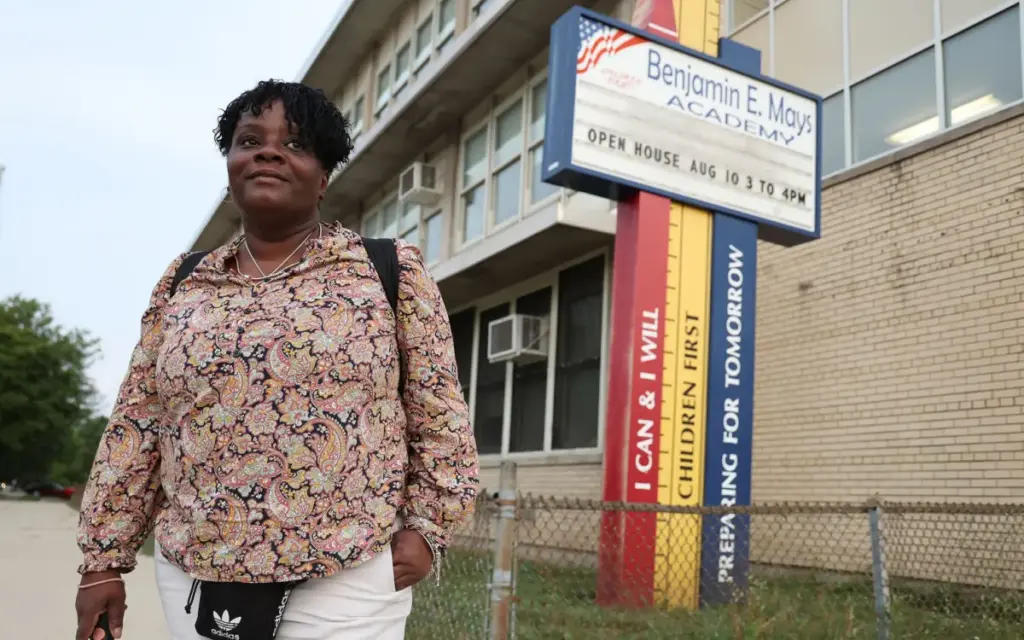
CHICAGO — For years, Maria Johnson slipped quietly into Chicago Public Schools classrooms as a volunteer parent, serving as an extra set of hands to help students sound out their reading, guide them through assignments, and offer a comforting presence in hallways where resources were often stretched thin. She cannot recall the exact year she started, noting only that the passage of time is marked by her eldest son, who is now 22 years old.
"I was not only trying to be there for my son, but I wanted to be there for other children, because I know everybody doesn’t get that," Johnson said, reflecting on her long tenure as a school volunteer.
She had no intention of stopping her unpaid community work. Then, last fall, an innovative statewide initiative offered to help turn that deep-seated commitment into a sustainable career. Through free classes, comprehensive test preparation, and dedicated one-on-one coaching, the program aimed to guide her toward official licensure as a paid paraprofessional. Seven months later, the effort bore fruit: Johnson was officially hired as a special education classroom assistant, commonly known as a SECA, at Benjamin E. Mays Academy in the Englewood neighborhood on Chicago’s South Side.

Johnson, 53, already held a college degree, but she had not been a student herself for more than three decades, making the prospect of returning to formal testing and coursework daunting. Yet, with the support of the program, she navigated the transition. "I just felt like that was God opening up a door for me to have a career," she said.
The initiative that changed Johnson’s trajectory is known as Ladders of Opportunity, a relatively new statewide nonprofit organization working diligently to address Illinois’ chronic and widespread shortage of school paraprofessionals. The program grew organically out of the Parent Engagement Institute, an organization dedicated to recruiting parents to volunteer actively in their children’s schools. Ladders takes that mission a significant step further, identifying parents who have logged at least 100 volunteer hours and possess a demonstrated interest in pursuing an education career, and funneling them into a formal licensure track.
The demographic makeup of the program reflects the communities it primarily serves: most participants are Black and Latina mothers hailing from Chicago’s South and West sides.
Within Chicago Public Schools (CPS), perennial staffing imbalances have long left some campuses struggling to fill vital roles, frequently operating without adequate numbers of SECAs, teacher assistants, and other essential support staff. While overall district vacancy rates have reached all-time lows in recent years, CPS continues to grapple with the complex challenge of how to best recruit and retain qualified workers for these demanding positions. Furthermore, paraprofessional turnover tends to be stubbornly high across the entire state of Illinois, driven in large part by low hourly pay scales and minimal initial training requirements.
Faced with these persistent systemic hurdles, program organizers asked a simple yet profound question: Why not look directly to the parents who are already present, dedicated, and invested on campus?
"You’ve got to have healthy schools for a healthy community. And for that, you’ve got to have engaged and involved parents," said Flor Dimas, co-manager of the Ladders of Opportunity program. "They are stakeholders."
Since its inception in 2023, more than 1,100 parents across Illinois have successfully become licensed paraprofessionals through the Ladders program. This total includes 373 parents within Chicago Public Schools alone. The initiative is currently fueled by a substantial $25 million grant from the Illinois Department of Human Services, enabling its expansion to 11 pilot sites distributed across the state.
Participants in the program are typically recruited through community-based organizers who are already embedded directly within local schools. Depending on the specific licensure track they choose, participants receive weeks of intensive training covering professional development, digital literacy, and English as a Second Language (ESL), all carefully tailored to help them pass the rigorous state certification exams. Along the way, they receive crucial supportive services, including personal coaching, childcare assistance during program activities, and complete reimbursement for all state licensure fees. Later in the process, dedicated coaches guide parents smoothly through the hiring process by conducting mock interviews and assisting with resume-building.
For Maria Johnson, the journey was tested by unforeseen personal adversity. She completed the program successfully even after she was diagnosed with breast cancer in February, all while continuing to care for her 6-year-old son, who is "proud of his mama," she noted with pride. Her designated coach, an organizer with the community group Teamwork Englewood, helped push her through the daunting paperwork and rigorous studying sessions when her energy flagged.
"They were right there. They said, ’Don’t give up, Maria. No, I’m not letting you give up,’" Johnson recalled.
What parents bring to the school environment upon hiring is something organizers argue is difficult to overstate. They offer invaluable lived experience, deep relationships built over years of daily drop-offs and pickups, authentic cultural fluency, and hundreds of hours already logged inside real classrooms.
"Who is impacted by parents in the classroom? Students," Dimas said, addressing a room of two dozen community organizers at a program kickoff event. "They look like them, they talk like them, they live in the community."
Many of these newly licensed parents ultimately end up working as SECAs, frequently stepping into roles as bilingual SECAs, which happen to be among the most sought-after and difficult-to-fill hires within Chicago Public Schools. Their daily responsibilities are demanding and comprehensive, including targeted tutoring, detailed note-taking, student mobility support, and personal care assistance for students with severe disabilities. It is exacting, hands-on work, and the district has historically struggled to keep pace with the demand. In 2018, CPS was forced to undergo a state corrective action after being found systematically failing to provide mandated services to students with disabilities, a shortfall that prominently included a lack of sufficient SECAs.
Since 2019, the share of students with disabilities within the district has grown from 14.6% to 17.3%, representing nearly 55,000 students overall. Over that same timeframe, CPS has added a staggering 3,600 SECA positions to try to keep pace with the rising need, according to district employee rosters. While the district’s overall SECA vacancy rate stands at a relatively low 2%—with about 160 openings recorded at the start of the month—those numbers remain noticeably higher in CPS administrative networks located on the South and West sides, according to district data. Officials attempted to adjust special education staffing protocols last year, partly in an effort to shift more SECAs into historically underserved communities, though that administrative move ultimately did little to substantially redistribute staffing levels.
Barb Cohen, a special education advocate at the Legal Council for Health Justice, said she firmly believes that vacancy rates and retention issues would drop significantly if the district provided better initial training—a glaring gap that the Ladders program is actively aiming to close. To qualify as a SECA under current state rules, applicants must pass a basic skills exam covering reading, writing, and math, or alternatively hold a college degree or 60 college credit hours in any subject matter.
SEIU Local 73, the labor union representing SECAs within Chicago Public Schools, won a hard-fought concession for the first time in its most recent contract: one day of paid onboarding and professional training for new hires.
"We have people who are hired because they have the required number of college credit hours in anything under the sun, but no particular training to work with children and no particular knowledge of disabilities," Cohen pointed out.
At Darwin Elementary School in the Logan Square neighborhood, Principal Daniel De Los Reyes hired four Ladders participants last year, initially bringing them on primarily as miscellaneous workers who fill in part-time as lunch and recess monitors. For an administrator, knowing that a parent has successfully graduated from a rigorous training program "allows [him] to vet, train and develop the mindset, the disposition and the work ethic" of job applicants before placing them in critical roles.
Darwin Elementary features a robust dual-language program, and more than a third of its total student body consists of English language learners. The school has welcomed scores of newly arrived immigrant families in recent years, according to De Los Reyes. In this environment, the Ladders initiative creates an essential pipeline for predominantly Latina mothers to transition into formal educators. These parents routinely help run school programming and assist in setting up cultural events and decorations for Días de los Muertos and Hispanic Heritage Month.
"There’s a need in school, and there’s a resource in the community," De Los Reyes said.
De Los Reyes understands the paraprofessional experience firsthand, having worked as a paraprofessional for four years before eventually becoming a classroom teacher and later a school principal. Statewide, more than 160 Ladders parents have gone on to become accredited substitute teachers, and about a dozen have already earned full professional educator licenses.
"I have Ladders graduates from last year who I can see as primary bilingual teachers," he said. "I often have the mindset that the solutions lie within the building, or within the community."
Across the city in the West Lawn neighborhood, Anna Sanchez was hired in April to work as a substitute SECA at Hurley Elementary School, where her 7-year-old daughter is enrolled as a second-grade student. Before participating in the program, Sanchez worked at a local ice cream shop.
Her single biggest worry when entering the program was the language barrier. Having grown up in Mexico and lived in the United States for 17 years, she was deeply uncertain whether she possessed the academic English proficiency required to pass an hourslong state licensure examination. Through the support of the Ladders program, she learned that and much more, she noted—discovering how to successfully navigate a professional workplace, how to properly support children with diverse disabilities, and how best to engage constructively with students.
"I learned that we should not only focus on the students, but also support and guide parents on how they can also help their children outside of school," Sanchez said, speaking in Spanish.
Looking ahead, her ultimate ambition is clear: she wants to become a fully certified classroom teacher.