






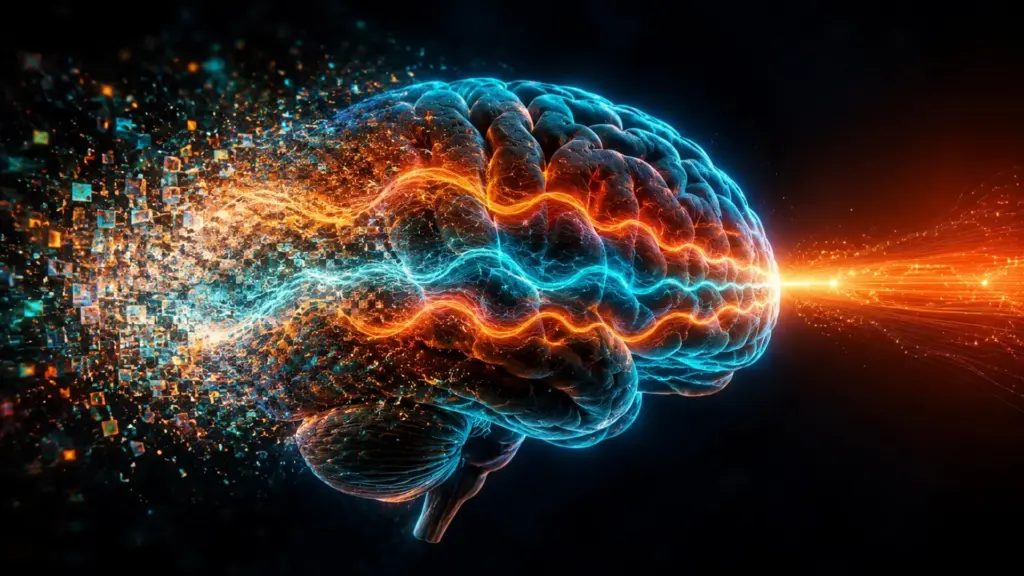
Your brain and the ocean share a feature that is as fundamental as it is unexpected: waves. While the rhythmic undulations of the sea are visible to the naked eye, a similar, more subtle phenomenon occurs within the grey matter of the human brain. Electrical activity, flickering across the brain’s surface, creates patterns known as traveling brain waves or neural traveling waves. Like the waves cresting in the ocean, these patterns can arise from a variety of sources, including internal neural activity or reactions to external sensory stimuli. Emerging research suggests these waves are far more than idle electrical static; they appear to play a critical role in influencing our attention and behavior from one millisecond to the next.
Now, a team of neuroscientists at the Salk Institute has bridged the gap between physiological observation and computational theory to propose a broader, more cohesive explanation for the purpose of these waves. Their research, published in the journal Neuron on July 21, 2026, posits that neural traveling waves function as a powerful computational engine within the visual cortex. By propagating through intricate neural circuits, these waves likely assist the visual cortex—and potentially other regions of the brain—in constructing internal representations of the outside world. This process is essential for our ability to perceive current events, reconstruct recent information, and anticipate what might happen next.
Why Traveling Brain Waves Matter
The journey toward this new understanding began in 2020, when Salk neuroscientist John Reynolds, PhD, became the first to identify traveling brain waves within the visual systems of awake animals. His laboratory’s subsequent work established a direct link between these waves and the success of an animal’s visual perception; specifically, the waves were associated with whether an animal successfully noticed an object placed in its field of vision.

This discovery offers a scientific basis for a common, often frustrating human experience: the "keys-in-hand" phenomenon. We have all experienced the sensation of frantically searching for an object, such as a set of keys or a phone, only to realize that the item was sitting in plain sight the entire time. In those moments, the object was present in our visual field, but our brain failed to register it. Reynolds’ work suggests that the absence of the correct neural traveling wave at that precise moment may be the culprit, preventing the brain from successfully processing the visual stimulus despite the information being available to the retina.
Once Reynolds and his colleagues established that these waves were not merely artifacts but active participants in sensory perception, a larger, more profound question emerged: Why does the brain expend the energy to generate these waves in the first place?
"This paper lays out, for the first time in a single integrated framework, what the brain can actually compute by virtue of having this recurrent wave-generating circuitry," says Reynolds, who served as the senior and co-corresponding author of the study.
A Possible Engine for Perception and Prediction
By focusing their research on the visual cortex, the scientists identified four primary functions for neural traveling waves. First, they appear to modulate perception from moment to moment. Second, they act as a mechanism to transform raw, recent sensory data into a coherent internal representation. Third, they generate short-term predictions about the surrounding environment. Finally, they preserve and replay patterns associated with the memories of events as they unfold over time.
Collectively, these abilities suggest that traveling waves are central to how the brain interprets the deluge of incoming information, rather than being a byproduct of background electrical activity. For years, such activity was often dismissed as "noise" in the nervous system, but the Salk team’s framework argues for a complete reevaluation of this electrical phenomenon.
Brain Waves May Be More Than Electrical Noise
Under this new framework, neural brain waves are classified as purposeful activity rather than random electrical interference. The neural connections responsible for generating these waves do far more than simply transmit signals from one point to another. These connections, known for their "synaptic weights," possess the ability to alter their physiology in ways that reflect information learned from the outside world.
Every sight, smell, sound, and action experienced by an animal acts as a data point that can modify the connections involved in producing these waves. Over time, this cumulative learning process shapes the neural circuitry the brain relies upon to construct an accurate internal representation of its surroundings.
"This is, in a meaningful sense, analogous to what large language models like ChatGPT do," Reynolds explains. "They learn statistical structure from language and use that knowledge to generate meaningful and appropriately structured text that reflects the patterns of language. The brain may be doing something functionally similar—a biological generative model built from the ground up by experience."
This comparison highlights the sophisticated nature of the brain’s "hardware." Just as a large language model is trained on vast datasets to predict the next logical word in a sentence, the brain is trained on a lifetime of sensory experience to predict the next logical state of the world.
How the Brain Builds an Internal Model of the World
Whenever sensory information hits the brain, the organ is immediately confronted with a fundamental, high-stakes problem: What am I most likely sensing right now?
The environment is inherently complex, yet it is also governed by predictable rules. Objects occupy three-dimensional space, and the images projected onto the retina shift constantly as the eyes and body move through the world. These changing signals exist within strict constraints imposed by the laws of physics and the biology of our sensory systems.
The framework proposed by the Salk researchers suggests that the brain learns these recurring patterns and stores them within complex networks of synapses. These networks, in turn, generate traveling waves that help the brain resolve ambiguity, allowing it to determine the most likely causes of incoming sensory information. By doing so, the brain can assemble a reliable, coherent internal model of the surrounding world.
In this view, traveling waves are the mechanism that transforms a constant, chaotic flood of sensory signals into the structured reality we perceive. They enable us to predict outcomes, navigate safely, and make sense of our experiences. Understanding this process brings researchers significantly closer to solving one of the most enduring mysteries in neuroscience: how the human brain manages to compute the busy and often messy world around us with such apparent ease.
The research effort was a collaborative endeavor, featuring contributions from Lyle Muller of UT Dallas and the Fields Institute, Alexandra Busch of the Fields Institute and Western University, and Zachary Davis of the University of Utah.
The study received broad support from several institutions and funding bodies, including the National Institutes of Health (grant numbers R01 EY028723, U01 NS131914, U01 NS139877, and EY014800). Additional support was provided by Research to Prevent Blindness, the Natural Sciences and Engineering Research Council of Canada, Western University, Compute Ontario, and the Digital Research Alliance of Canada. As the scientific community continues to explore the role of traveling waves, this integrated framework provides a robust foundation for future investigations into the computational power of the human brain.