





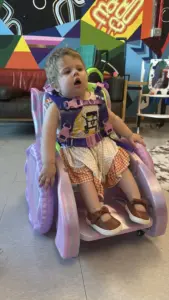



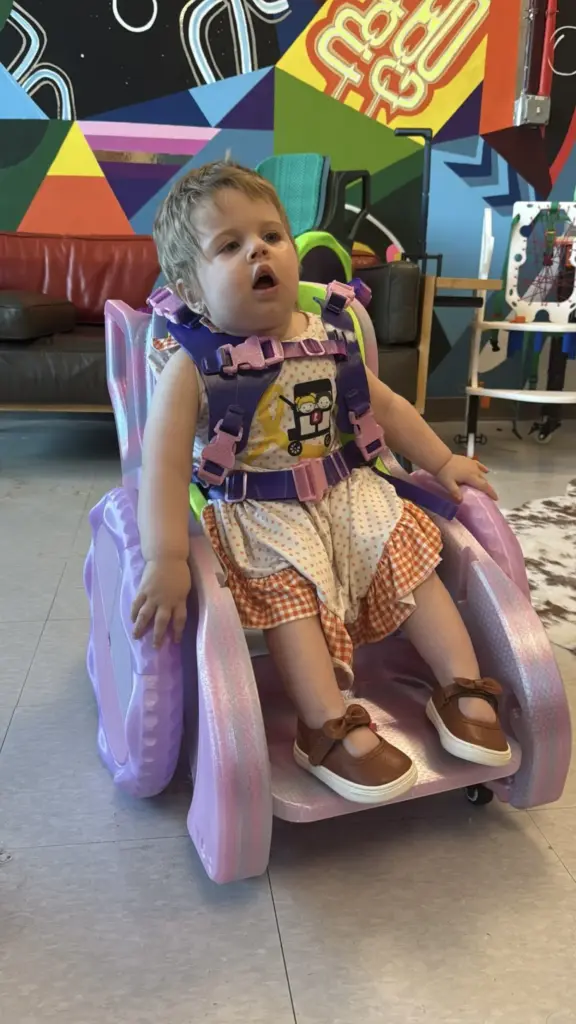
At Monroe Carell Jr. Children’s Hospital in Nashville, the newest piece of mobility equipment is a 3D-printed wheelchair—built layer by layer by a gaming and technology specialist who had never set out to design a wheelchair at all.
That detail matters. It is a small sign of a much bigger shift happening in pediatric care: hospitals, schools, and even individual families are starting to manufacture the assistive technology that the traditional medical supply chain has struggled to deliver affordably, quickly, or in a way that feels like it was made for an actual child instead of a generic patient.
What’s Actually Happening at Monroe Carell
The story centers on Graden Knapp, whose day job is making hospital stays more bearable for kids through toys, video games, and other fun tools. While working at Monroe Carell, Knapp noticed something more fundamental than entertainment was missing: the hospital did not have enough wheelchairs suited to its young patients’ needs.

So he taught himself a new skill. According to reports from local news outlet WTVF, Knapp came across "Made Good"—almost certainly MakeGood, a New Orleans-based disability design nonprofit given the matching name and mission—and used a design the group provided to spend two to three months printing the components and assembling what is now the hospital’s first nearly-complete 3D-printed wheelchair. The source reporting does not name the specific model Knapp built.
The plan is not just to park the chair in a hospital closet. Knapp’s intent is for patients to take the wheelchair home with them after discharge, turning a piece of hospital equipment into something a child keeps, customizes, and grows into.
It is a small, almost grassroots project. But it points to where pediatric assistive technology may be headed: produced on-site, tailored to the individual child, and built around the idea that a wheelchair can be both functional and something a kid is excited to use.
The Likely Design Behind the Wheelchair: MakeGood’s Toddler Mobility Trainer
A caveat upfront: local reporting does not name the specific model Knapp built, so what follows is an inference based on available public data rather than a confirmed fact. MakeGood’s flagship—and, as far as public reporting shows, its only fully 3D-printable wheelchair design—is the Toddler Mobility Trainer, which matches descriptions closely enough as a printed children’s mobility device sourced from a nonprofit of charity engineers to stand as the most probable match.
With that caveat in place, here is what is publicly known about the Toddler Mobility Trainer. It is a fully 3D-printable mobility device for children roughly ages one to eight, built by MakeGood in collaboration with the industrial design firm LINK PBC and the nonprofit TOM Global, and announced in late 2025. Nearly every part—frame, wheels, tires, seat, and even the straps—is printed on a consumer-grade machine optimized for standard desktop printers, and the pieces snap together without tools, screws, or glue in a jigsaw style. If something breaks, a caregiver can simply reprint that one piece instead of replacing the entire chair.
MakeGood has released the design as a free, open-source file online, explicitly so that anyone with a 3D printer and some filament—whether a parent, a school librarian, or a hospital technologist like Knapp—can produce one at home or in a classroom. According to organizational figures released in late 2025, MakeGood has delivered over 3,000 free assistive devices of various kinds since its founding in 2021.
The Real Story: Cost
This is where the project stops being a feel-good local news segment and starts being a genuine accessibility story.

A traditional pediatric wheelchair in the United States typically costs between $1,200 and $5,000, and custom or powered pediatric models can run well past $12,000 once specialized seating, materials, and electronics are factored in, according to pricing breakdowns from medical equipment retailers. That is before accounting for the fact that growing children outgrow wheelchairs every couple of years, multiplying the lifetime cost, and that insurance frequently denies or only partially covers these claims.
By contrast, MakeGood states that a complete Toddler Mobility Trainer can be produced for about $150 in materials. Technical breakdowns itemize this as roughly eight to ten spools of standard PETG filament, two to three spools of flexible TPU, and a small amount of hardware, including six bolts, two nuts, two washers, and standard casters. That $150 figure is specifically what MakeGood reports for the trainer model. While it cannot be definitively confirmed as the exact design or cost of the wheelchair Knapp built at Monroe Carell, local reports do note Knapp’s own estimate that his hospital build came out to roughly ten times cheaper than a typical wheelchair—a figure that lines up closely with what a budget-conscious printed build achieves relative to commercial alternatives.
The reason the savings are so dramatic is not just cheaper materials; it is the elimination of an entire layer of manufacturing, distribution, and retail markup that conventional durable medical equipment carries. A traditional wheelchair has to be designed once, tooled for mass production, manufactured in a factory, shipped internationally, stocked by a medical supplier, and marked up at each step. A 3D-printed version skips nearly all of that, allowing the design to exist as a digital file while the production facility is whatever desktop printer happens to be sitting in a hospital office, school library, or spare room.
How Accessible Is This, Really?
"Cheap" and "accessible" are not automatically the same thing, making it valuable to look closely at what is actually required to make a chair like the Toddler Mobility Trainer. Producing a functional device still demands access to a reliable mid-sized 3D printer, a basic understanding of printer calibration, electrical power, and several kilograms of polymer filament. For a major children’s hospital in Nashville, those resources are easily accessible. For a rural clinic or a low-income family, acquiring even a desktop printer and rolls of filament can represent a significant financial hurdle, though still vastly lower than the barrier to entry for commercial medical equipment.
That combination of a low one-time equipment cost, inexpensive consumable materials, an open-source design, and minimal specialized manufacturing expertise is what makes this fundamentally different from earlier eras of do-it-yourself medical equipment. It is not just cheaper; it is replicable by schools, hospitals, and individual families almost anywhere a printer and an internet connection exist.
Why This Matters Even More in the Global South
The Nashville story centers on a single hospital with one printer and one motivated employee. But the underlying technology has implications that extend far beyond Tennessee, particularly for low- and middle-income countries, where access to mobility devices is dramatically worse than in wealthy nations.
The scale of the gap is stark. Data from international health reports published by organizations like the World Health Organization and UNICEF indicate that more than 2.5 billion people worldwide need at least one assistive product, such as a wheelchair, hearing aid, or communication device, yet nearly one billion of them are denied access. Analyses of developing nations show access to necessary devices can be as low as three percent of total need in poorer regions, compared to roughly ninety percent in wealthy countries. Separate peer-reviewed studies on wheelchair service provision, citing global population estimates, put the number of people who need a wheelchair worldwide at roughly 77 million, of whom only a small fraction have access in less-resourced settings. Furthermore, international health data notes that an estimated eighty percent of people with disabilities live in developing or low-resource countries—precisely the places where commercial wheelchair supply chains are thinnest and import costs are highest.
This is the exact gap that low-cost, open-source 3D-printed designs are positioned to close. Because the files can be downloaded anywhere via the internet, there are no international shipping delays, import tariffs, or supply chain bottlenecks for finished medical goods. Local technicians can manufacture replacement parts on demand, meaning a broken caster or a cracked footrest does not require ordering an expensive replacement part from an overseas manufacturer.
Why Hospitals and Institutions Should Pay Attention
The case for hospitals, schools, and disability-focused nonprofits to invest in this technology comes down to core practical advantages demonstrated by projects like the one in Nashville. Institutions can slash equipment budgets by producing custom-fit mobility devices on demand, tailor chairs precisely to the physical dimensions of individual children rather than relying on standard sizing tiers, and foster a sense of personal ownership by letting kids customize their devices with colors and designs that make medical equipment feel less intimidating.
None of this means 3D-printed devices are ready to fully replace clinically prescribed, insurance-covered wheelchairs for every patient. Durability, weight limits, and long-term clinical validation remain active areas of research and development. But for the specific use case shown at Monroe Carell—getting a functional, well-fitted mobility device into a young child’s hands quickly and cheaply—the technology is already working today in a clinical environment. The question for other medical centers, educational institutions, and global health organizations is not whether the approach works, but when they will begin printing their own.