


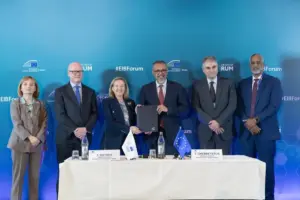


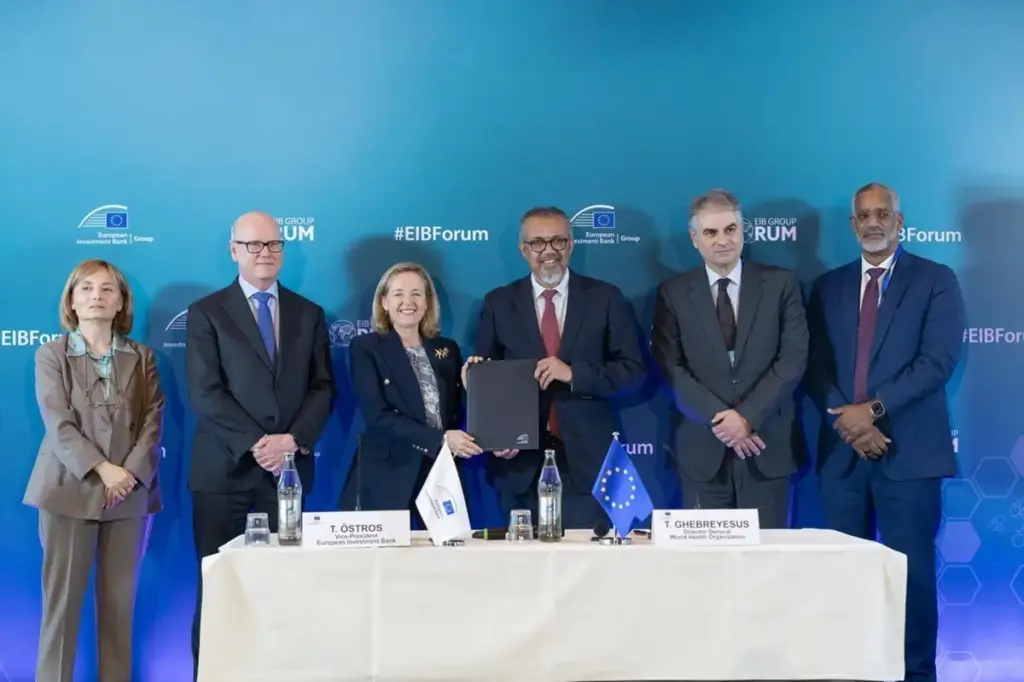
LUXEMBOURG — In a significant move to bolster the resilience of Lebanon’s beleaguered healthcare system, the World Health Organization (WHO) and the European Investment Bank (EIB) have formalized a strategic partnership aimed at addressing critical gaps in the country’s medical infrastructure. On 6 March 2025, during the prestigious EIB Group Forum held in Luxembourg, WHO Director-General Dr. Tedros Adhanom Ghebreyesus and EIB Vice-President Thomas Östros signed a landmark agreement, confirming a €10 million grant dedicated to restoring essential health services in Lebanon.
This collaborative initiative arrives at a pivotal moment for Lebanon, a nation that has been grappling with a prolonged and multifaceted socio-economic crisis. The infusion of capital is earmarked for two primary objectives: the reconstruction of the nation’s Central Public Health Laboratory and the immediate provision of life-saving medications for tens of thousands of vulnerable patients suffering from chronic conditions.
The signing ceremony in Luxembourg underscored the urgency of the intervention. As the healthcare sector in Lebanon faces ongoing systemic challenges, the partnership between the WHO and EIB Global is designed to act as a catalyst for stabilization, ensuring that the most vulnerable populations retain access to essential medical care despite the prevailing instability.

The restoration of the Central Public Health Laboratory stands as the cornerstone of this new agreement. For any national health system, a central laboratory serves as the backbone of disease surveillance, diagnostic capacity, and public health security. Without a functioning facility to monitor outbreaks, analyze samples, and maintain high-quality diagnostic standards, the entire national health framework remains dangerously fragile. By prioritizing the re-establishment of this laboratory, the WHO and EIB are focusing on long-term sustainability, aiming to restore a critical piece of infrastructure that is vital not only for routine care but for the country’s ability to respond to future health crises and infectious disease threats.
Beyond the brick-and-mortar reconstruction, the initiative addresses the human dimension of the crisis. The €10 million grant will facilitate the procurement and distribution of essential medicines for more than 50,000 individuals living with chronic diseases. For these patients—many of whom have been disproportionately impacted by inflation, supply chain disruptions, and the depletion of medical stocks—the initiative provides a vital lifeline.
The focus on chronic conditions, specifically diabetes, cardiovascular diseases, and cancer, reflects a strategic assessment of the most urgent medical needs currently facing the Lebanese population. These conditions require consistent, uninterrupted medication protocols. Any lapse in the supply of insulin, blood pressure medication, or oncology drugs can lead to rapid deterioration in a patient’s health, resulting in long-term complications or preventable mortality. By securing the supply chain for these specific therapeutic areas, the WHO and EIB are directly mitigating the risk of a surge in preventable health complications, thereby relieving some of the immense pressure currently placed on Lebanon’s hospitals and clinical centers.
The involvement of EIB Global, the development arm of the European Investment Bank, highlights the growing role of international financial institutions in supporting social infrastructure in regions facing protracted crises. While the EIB is traditionally known for large-scale infrastructure projects, such as energy grids or transport networks, its partnership with the WHO demonstrates a refined approach to development aid—one that recognizes that a functioning healthcare system is an essential component of economic and social stability.
For the World Health Organization, the agreement represents a practical application of its mandate to support countries in strengthening their health systems toward the goal of Universal Health Coverage. By leveraging the technical expertise of the WHO in humanitarian and development health settings alongside the financial capacity of the EIB, the initiative ensures that the allocated funds are deployed efficiently and with a focus on measurable health outcomes.
The context of this partnership cannot be overstated. Lebanon has faced years of severe economic contraction, which has triggered a mass exodus of healthcare professionals and created chronic shortages of basic medical supplies. Pharmacies and hospitals across the country have reported recurring gaps in their inventories, leaving many patients to navigate a fractured system where the cost of life-saving drugs has become prohibitive. This grant serves as a critical stopgap measure, intended to stabilize the delivery of healthcare services while simultaneously rebuilding the institutional capacity that will be necessary for a future recovery.
The collaborative nature of this initiative also signals a broader commitment from the international community to maintain its engagement with Lebanon’s health sector. By aligning the efforts of the WHO and EIB, the project aims to create a more robust framework for health governance, ensuring that aid is not merely a transient relief effort but a foundational step toward revitalizing the national health system. The reconstruction of the Central Public Health Laboratory, in particular, will serve as a symbol of this renewed commitment to institutional strength, providing the state with the tools necessary to exercise oversight and maintain high clinical standards.
As the implementation phase of the project begins, both the WHO and the EIB will likely focus on transparent procurement processes and the establishment of reliable distribution channels. The logistical challenge of ensuring that medications reach the patients who need them most, particularly in remote or underserved areas, will be a key performance indicator for the partnership. The involvement of the WHO ensures that these health interventions are grounded in evidence-based protocols, prioritizing the clinical needs of the patients and the epidemiological realities of the country.
The agreement signed in Luxembourg is more than just a financial transaction; it is a manifestation of the necessity for cross-sectoral collaboration in the face of complex humanitarian challenges. By integrating financial investment with technical public health oversight, the WHO and EIB are attempting to address the root causes of the current health crisis in Lebanon.
For the citizens of Lebanon, the success of this initiative will be measured in tangible terms: the availability of essential medicines on pharmacy shelves, the consistent operation of diagnostic services, and the assurance that critical care is accessible to those suffering from chronic illnesses. As the project moves forward, the international community will be watching closely, as the partnership could serve as a model for how global financial and health organizations can work together to bolster public health systems in fragile and conflict-affected environments.
The partnership underscores the fundamental belief that health is a human right and a pillar of societal resilience. Through this €10 million grant, the EIB and the WHO are taking a decisive step to ensure that the healthcare system in Lebanon receives the support it desperately requires, providing a vital bridge to a more stable and resilient future for the nation’s public health infrastructure.