





PITTSBURGH — From a distance, Dominic Quagliozzi’s large textile installation titled “Blue Morpho” commands attention, resembling a magnificent, multicolored butterfly securely affixed to a bright gallery wall at Contemporary Craft.
Step closer, however, and the materials tell an entirely different, more intimate story. The Worcester, Massachusetts-based artist constructed the piece partly from hospital gowns and moving blankets. Having lived with cystic fibrosis for much of his life and undergone a double lung transplant in 2015, Quagliozzi has been continuously surrounded by hospitals, clinical spaces, and their distinct materials.
“From a distance, it just looks like a butterfly,” he said. “And then as you get closer, you can kind of see the detail,” including the familiar, repeating patterns of a standard-issue hospital gown.

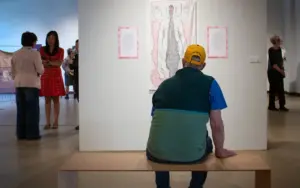
That profound transformation—shifting fluidly from an attractive, visually striking object into something far more complicated, intimate, and potentially uncomfortable—lies at the very heart of “Textures of Being.” The exhibition opened in September and runs through January 16 at the prominent craft gallery located in Pittsburgh’s vibrant Lawrenceville neighborhood.
The comprehensive show brings together compelling works by 14 artists with disabilities. This group comprises two specially invited artists alongside 12 others selected through an open call for submissions from the gallery. Together, these creators utilize a diverse array of traditional and contemporary mediums, including fiber, ceramics, metal, paper, and mixed media. Rather than treating disability as a deficit to be overcome, hidden, or medically corrected, their artistic practices draw directly and unapologetically from disabled bodies and lived experiences.
The exhibition highlights a broad and growing cultural movement known as disability art. Within this movement, artists critically examine disability from their own distinct perspectives, challenging prevailing notions about how bodies are viewed, treated, and accommodated by medicine, culture, and society at large.
Yu-San Cheng, Contemporary Craft’s director of visual engagement and one of the exhibition’s primary jurors, explained that the title of the show was chosen deliberately to refer to both physical textures and something far less tangible.
“The texture means the textures that you encounter that you can feel, but it also means the textures of our lived experience,” she said.
Cheng points out that textiles recur prominently throughout the exhibit, a curatorial choice she views as embodying the idea of softness as a distinct form of strength. Craft, she notes, also offers a familiar, approachable entry point into a subject matter that some gallery visitors might initially find difficult or emotionally challenging.
“You use mugs, you feel the clay every day. You wear clothes every day,” she said.
These familiar materials can make the gallery space more inviting, effectively lowering psychological barriers and encouraging open conversations about disability, chronic illness, and the realities of the human body.
The Disability Experience
Chicago artist Sandie Chun-Shan Yi, one of the two invited artists featured in the exhibition, emphasizes that artists with disabilities are actively pioneering a completely different visual vocabulary.
“We don’t see disabled people being represented in more complex ways [that] show the complexity of what disability means,” she said. She and other like-minded creators are dedicated to exploring how societal meanings of disability are continuously constructed within our culture.
Born in Taiwan with two fingers on each hand and two toes on each foot, Yi felt her physical differences early in life. As a child, she recalls, strangers would sometimes treat her body as an operational problem in need of a solution, offering unwanted help or making rigid assumptions about what she could and could not accomplish.
It took years of personal growth—and eventual encounters with other artists with disabilities—before she began to frame those experiences as part of something much larger than herself.
Learning about disability art and disability studies provided her with a crucial vocabulary for experiences she had previously struggled to articulate. Instead of viewing disability primarily through a tired cultural narrative of “overcoming” adversity, she began actively questioning the deeply ingrained assumptions that shaped both how society and she herself viewed her physical form.
That crucial paradigm shift helped lead her to what she calls her "Crip Couture" series, an innovative form of wearable art centered squarely on disabled bodies and stories. The word “crip,” a term historically deployed as a harsh insult, has been reclaimed by many individuals within the disability community as a powerful marker of identity and pride.
Unlike mainstream fashion design, which typically modifies existing garments to adapt to disabled bodies, Yi starts her creative process from the perspective of disability itself. For instance, she designs specialized items like two-fingered gloves, thoughtfully incorporating the actual bodies, personal histories, and lived experiences of people with disabilities directly into the garments.
“It’s about caring,” she said.
The exhibition’s other invited artist, Bhavna Mehta, approaches the very same thematic territory through an entirely different set of materials and techniques.
Born and raised in India and now based in San Diego, Mehta contracted polio at the age of 7 and has relied on a wheelchair since childhood. She originally trained in science and technology, working professionally as a software engineer before transitioning to art as a full-time career around the age of 40, according to Cheng.
Her intricate, breathtaking work combines delicate paper cutting and detailed embroidery—practices with deep roots in her childhood in India. Mehta has written that she grew up in an extended family surrounded by women who regularly embroidered, knitted, and sewed. In her current artistic practice, she uses “paper as skin and thread to connect and mend,” while drawing heavily upon traditional Indian folk art.
For “Textures of Being,” those specialized techniques become a deeply personal method for examining her own body and its extensive medical history.
One striking work begins with a preserved 1980s X-ray of Mehta’s spine that she kept for decades before ultimately deciding to embroider it. Rather than leaving it as a cold, clinical image of a body altered by polio and subsequent medical interventions, she has crafted her own agency and narrative over the medical record.
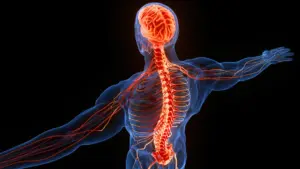
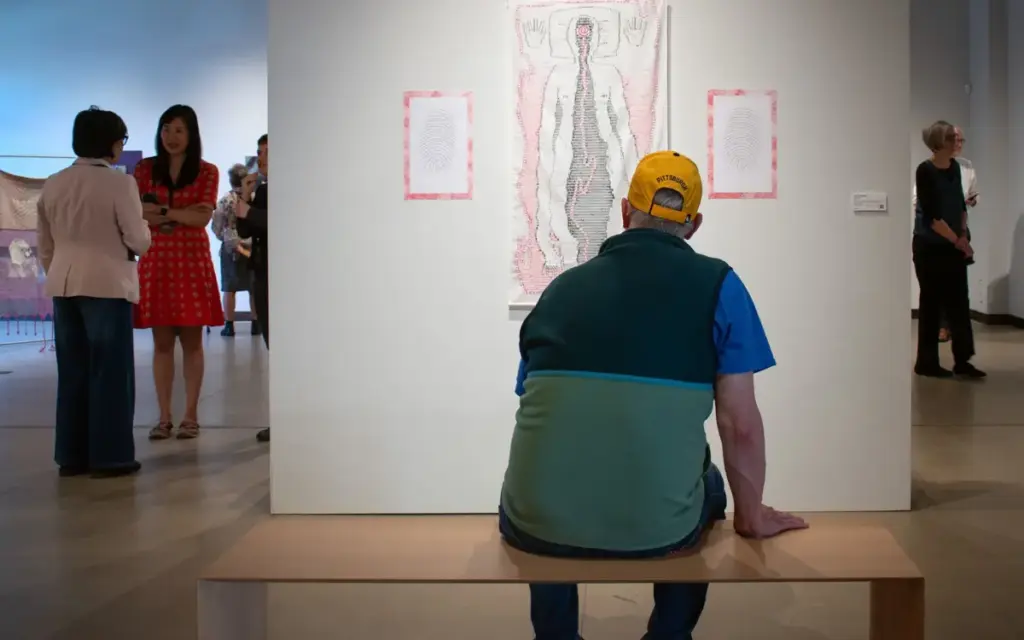
That creative impulse reaches a monumental scale in “Fault Lines,” a sprawling, complex paper installation based on a detailed cross-section of the spinal cord. Mehta developed the piece after consulting extensively with researchers at the Salk Institute in California to better understand the microscopic ways the polio virus attacks motor neurons. Tiny, hand-cut paper forms, individually pinned in place with meticulous care, map the intricate structures and biological functions of the spinal cord.
The resulting installation is simultaneously delicate, beautiful, scientifically accurate, and deeply personal. Cheng described the piece as a reflection of Mehta’s profound desire to truly understand her own disability rather than accepting a detached medical explanation as the final word on her body.
Experience into Artwork
Like Mehta, Quagliozzi deliberately transforms clinical medical objects into evocative artistic materials. Throughout much of his career, he has incorporated hospital gowns, linens, nitrile gloves, and even the dark antiseptic solution Betadine into his mixed-media works.
As a young boy, he dreamed of becoming an athlete, but his worsening lung function made physical exertion increasingly difficult. He adapted by drawing athletes, inventing fictional team logos, and crafting pretend jerseys.
Over time, chronic illness naturally became the primary subject of his art.
“Art has obviously very much helped me process and learn how to speak about it,” he said.
Assembled from colored and cut hospital gowns and moving blankets, “Blue Morpho” carries a tangible history woven directly into its fabric, which has absorbed stains, tears, and physical wear—what he refers to as the “residue of emotion and labor and physicality.”
Moving blankets carry an additional, poignant association. Living with a chronic, severe illness often means being repeatedly uprooted from ordinary, everyday life and abruptly moved back into a hospital room for days or weeks at a time.
His second piece in the exhibition, “Co-Parenting,” is even more intensely personal. Quagliozzi saved the specialized, lung-shaped pillow he was given immediately following his transplant to brace against his chest when coughing or moving.
Years later, after becoming a father, he combined that exact transplant pillow with one of his young son’s old teddy bears. He carefully cut and reconstructed the stuffed bear into the distinct shape of human lungs and fastened it securely to the medical pillow.
The title of the piece references his complex relationship with the anonymous organ donor whose healthy lungs ultimately kept him alive.
“Without my donor’s lungs, I wouldn’t have had my son,” Quagliozzi said. “I would’ve died before that.”
Taking diligent care of the donated lungs, he noted, has allowed him in turn to care for his own child.
His life story continues to evolve. Eleven years after his major transplant, Quagliozzi shared that he has recently developed early signs of organ rejection and is currently undergoing treatment. Even that unsettling medical development, he suggested, may eventually become material for his artistic practice.
While he admits to feeling natural sadness and disappointment, he also views the challenge as “an exciting time for my work because I can get a whole other set of experiences that I can draw from.”
Quagliozzi’s perspective aligns closely with Yi’s observation that people with disabilities are frequently pigeonholed by society as either tragic figures or one-dimensional heroes—a portrayal she finds overly simplistic.
Yi wants to focus on “holding a space for disability and for all the joy, the pain,” and the vast spectrum of human experiences that exist between them.
“Textures of Being” remains on view through January 16 at Contemporary Craft in Pittsburgh. Admission to the gallery is free to the public.