




Why does the left hemisphere of the brain dictate movement for the right side of the body, while the right hemisphere governs the left? This curious, cross-wired architecture of the vertebrate nervous system has long been one of biology’s most intriguing enigmas. For decades, scientists have debated whether this arrangement offered some forgotten survival advantage or if it was merely a biological quirk. Now, new research suggests that this contralateral organization—the technical term for the body’s midline-crossing connections—is not a modern innovation, but an evolutionary inheritance reaching back half a billion years.
Dr. Martin Wessendorf, a neuroscientist and associate professor emeritus at the University of Minnesota, has spent his career examining the intricate mechanisms by which the brainstem regulates spinal cord neurons. Collaborating with cognitive neuroscientist Daniel Wang, who specializes in neurodegenerative conditions, the duo set out to trace the evolutionary origins of these crossed connections. Their findings, recently published in the journal Frontiers in Neuroanatomy, propose a compelling hypothesis: the nervous system’s cross-wired design was not originally intended for movement or sensation as we understand it today, but was instead an architectural byproduct of the way ancient vertebrates organized their visual systems.
The Optical Origins of Brain Symmetry
To understand the current layout of the human brain, one must look toward the eyes. When light enters the eye through the lens, it behaves according to basic optical physics: the image projected onto the retina is reversed. Consequently, objects occupying the right side of an animal’s visual field are projected onto the left side of the retina, and vice versa.

This sensory data travels via the optic nerve to a critical intersection known as the optic chiasm. Here, the nerve fibers undergo a selective sorting process, ensuring that information captured by the left retina is shunted to the right side of the brain, and data from the right retina is sent to the left. This ensures that the brain maintains a coherent, spatial map of the world.
Crucially, this visual information is processed in an ancient midbrain structure called the optic tectum—or the superior colliculus in mammals. Because the optic tectum is found in virtually every vertebrate species, it is considered a foundational structure of the nervous system. Within this region, the brain maps the external world, allowing for reflexive, high-speed responses to environmental stimuli. If a predator flashes into view, the optic tectum allows the animal to react instantaneously. Because the tectum organizes these visual maps on the opposite side of the brain from where the image originated, it established a template for cross-lateral organization that would persist throughout evolutionary history.
The Evolution of Sensory Pathways
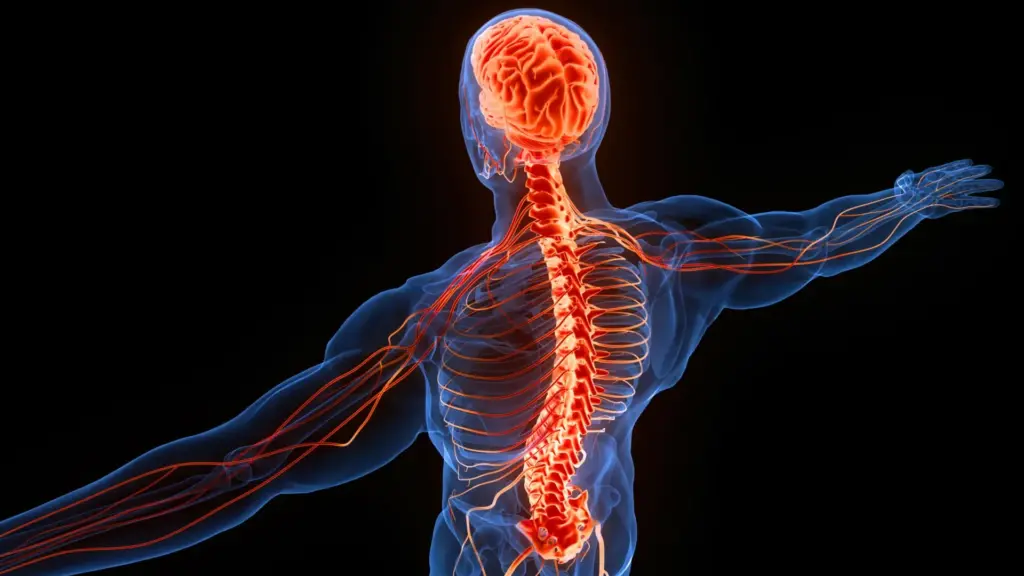
Beyond vision, the researchers investigated two major pathways responsible for transmitting sensations—such as touch, vibration, and pain—from the body to the brain. These pathways, which are prevalent in tetrapods (four-limbed animals including mammals, birds, reptiles, and amphibians), reinforce the idea that crossed wiring is a deeply embedded evolutionary trait.
The first, the dorsal column pathway, is responsible for processing gentle touch, proprioception (the sense of body position), and vibration. In tetrapods, these signals travel up the dorsal section of the spinal cord before reaching the brainstem, where they cross over to the opposite hemisphere. While this specific pathway is absent in fish, its consistent presence across the broader tetrapod lineage suggests it became a fixed feature early in the transition to land-dwelling life.
The second, the spinothalamic tract, handles sensations involving pain, itching, and temperature. Unlike the dorsal column, this pathway crosses the midline within the spinal cord itself before ascending to the thalamus, a critical sensory relay hub. Evidence of this cross-wiring appears even in some cartilaginous fish, such as sharks and rays, indicating that the roots of these sensory circuits predate the emergence of modern land vertebrates by a significant margin.
Translating Sensation into Movement
The crossed organization of the nervous system is not limited to incoming sensory information; it is mirrored in how the brain executes motor control. The researchers identified three primary pathways involved in skeletal muscle movement that follow this contralateral design.
The first is the tectospinal pathway, which acts as a bridge between the optic tectum and the spinal cord. Because the optic tectum processes not just sight, but also auditory and physical sensations, it creates a unified map of the environment. If an unexpected sound occurs to your left, the tectospinal pathway facilitates an instinctive, rapid turn toward the source. This circuit, which sends signals from the deepest layers of the optic tectum to the opposite side of the spinal cord, is found in most tetrapods and even some cartilaginous fish, highlighting its ancient utility for survival.
The second, the rubrospinal pathway, originates in the red nucleus of the midbrain. It is a critical circuit for limb control and is particularly well-developed in mammals, though it also appears in various other tetrapods and cartilaginous fish. Together with the tectospinal pathway, these circuits demonstrate that the "cross-over" is not a peripheral curiosity, but a primary structural principle of motor coordination.
The Refinement of Motor Control in Humans
The third pathway, the corticospinal tract, provides the most insight into human evolution. This tract is essential for the high-level, precise motor functions that characterize our species, including the delicate movements of the fingers. The evolutionary history of this tract is uniquely complex.
While all vertebrates possess a telencephalon—the front portion of the brain that makes up the bulk of the human organ—only mammals possess a cerebral cortex organized into the signature six-layered structure. This cortex acts as a command center for memory, language, and complex motor coordination. In most mammals, the corticospinal tract serves a regulatory role, influencing how the brain filters incoming sensory data. However, in primates and humans, this pathway has been adapted to provide direct control over skeletal muscles, enabling the fine motor skills necessary for complex tool use and intricate tasks.
The researchers propose a fascinating evolutionary scenario: humans may have achieved these advanced motor abilities by "repurposing" an older neural circuit. Rather than inventing a new system to control the fingers, evolution appears to have adapted a pre-existing pathway that was originally designed to manage sensory input. This process of evolutionary "tinkering" is a hallmark of biological development, where old structures are recruited for new functions rather than being discarded.
A 500-Million-Year-Old Inheritance
When viewed as a whole, these pathways suggest that the brain’s crossed wiring is not necessarily a design optimized for the "best" way to move, but rather a reflection of a structural blueprint established during the Cambrian Period, roughly 500 million years ago. If the optic chiasm and the optic tectum were already present in primitive, jawless fish, then the basic logic of crossing information from one side to the other was locked into the vertebrate nervous system long before the appearance of modern mammals.
This perspective challenges the long-held assumption that every quirk of human anatomy must exist because it provides a specific, current survival advantage. Instead, it suggests that the architecture of our nervous system is a conservative one. Evolution frequently builds upon what is already there; once the visual system established a crossed arrangement, it provided a structural scaffold that subsequent sensory and motor pathways followed.
In this light, the strange relationship between our brain hemispheres and our limbs is not a puzzle to be solved by looking at modern utility, but a record of our deep evolutionary past. The way we interact with the world—turning our heads toward a sound, reaching for an object, or feeling the texture of a surface—is governed by wiring diagrams that were drafted half a billion years ago. The nervous system, it seems, is a master of preservation, holding onto the ancient strategies of its earliest ancestors even as it evolved to facilitate the complex, precise movements of the modern human experience. Future research into the fossilized skulls of early jawless fish may one day confirm this theory, potentially providing the final piece of evidence in a story that began in the dawn of vertebrate life.