





The popular game show Family Feud is built on a foundation of consensus. Two families face off in a high-stakes race to identify the most common responses to everyday questions. If the prompt is "Name something you might find in a bathtub," and 50 out of 100 surveyed participants say "water," that is the winning answer. Conversely, if a contestant offers a creative or highly specific response—such as "arachnid"—they are likely to be met with the dreaded red "X" and zero points. While the show rewards convergent thinking—the ability to identify the most probable or socially accepted answer—it often penalizes those who think differently.
Yet, in the real world, the ability to engage in divergent thinking—the process of generating multiple novel ideas from various perspectives—is far more than a liability. Emerging research suggests that the capacity for original, unconventional thought is not only a hallmark of human intelligence but a vital component of personal happiness and psychological well-being. According to a 2021 study by Tan et al., the very act of engaging in creative activity can significantly enhance one’s sense of subjective well-being, suggesting that the "arachnids" of the world may actually be happier than those who stick strictly to the script.
The Relationship Between Stress and Creativity
The cognitive mechanics of the human brain shift significantly depending on our emotional state. When we face moderate, goal-oriented stress—such as the pressure of a deadline or a test—our brains naturally lean toward convergent thinking. This is an evolutionary adaptation that helps us narrow our focus to find the single correct solution to a problem. However, this same mechanism can act as a cognitive bottleneck. When stress levels rise, our ability to think divergently—to branch out and explore the "what-ifs"—tends to stifle.

According to research published by Guo et al. in 2024, stress exerts a measurable influence on our cognitive flexibility. When we feel pressured, our internal "sandbox" for ideas shrinks. Conversely, when we are in a state of relaxation, feeling loose and free, our creative mind becomes more accessible. Divergent thinking thrives in environments where the fear of judgment is removed, allowing the brain to connect disparate ideas and perspectives that would otherwise remain siloed.
This relationship is reciprocal: not only does a relaxed state foster creativity, but creativity itself serves as a potent buffer against stress. Artists—poets, writers, musicians, and dancers—have long utilized creative outlets to channel and transform strong, sometimes painful emotions into something tangible and beautiful. Psychotherapists frequently incorporate these practices, recommending journaling or creative arts as a form of therapeutic intervention. By providing an outlet for complex emotions, creative expression helps individuals process their experiences, ultimately leading to a more vibrant and joyful life.
Social Connection Through Shared Creativity
The benefits of creativity extend beyond the individual; they are a powerful engine for social connection. For many, the most profound creative experiences happen in community settings. Whether it is a group of friends gathering for a musical jam session, improvising melodies, and exploring rhythm on percussion, or a circle of writers sharing their work, shared creativity fosters a unique sense of playfulness and intimacy.
As noted in a 2021 study by Perkins et al., engaging in the arts with others is a proven strategy for reducing feelings of loneliness. Social connection is an essential requirement for human happiness, and creative collaboration provides a structured yet flexible way to build those bonds. This phenomenon is perhaps most visible in the subculture of role-playing games. Communities built around games like Dungeons & Dragons or Magic: The Gathering rely entirely on the collective imagination of their participants. These games demand constant divergent thinking, collaborative storytelling, and often, the creation of elaborate costumes and narratives. For many young people, these shared creative endeavors are the foundation of deep, lasting friendships that transcend the game itself.
Furthermore, the impact of group-based creative programs is not limited to younger generations. Recent studies, including a 2026 commentary by Sowerby et al., highlight that arts-based engagement can significantly improve the health and quality of life for older adults. By encouraging an active imagination and promoting social interaction, these programs help maintain mental agility and physical activity, both of which are critical components of healthy aging.
Dispelling the "Not Creative" Myth
Despite the documented benefits of creative expression, many people remain hesitant to engage, often claiming, "But I’m not a creative person." This self-limiting belief is a common hurdle for psychotherapists. However, the definition of creativity is frequently misunderstood as something reserved solely for professional artists or those with "inborn gifts."
When challenged, most people quickly realize they possess a wealth of creative experience. Whether it is substituting ingredients in a recipe to suit what is available in the pantry, finding an innovative way to teach a child to tie their shoelaces, or troubleshooting a mechanical issue at home, everyday life is filled with small, divergent problem-solving moments.
In her book Artistic Badassery, author and psychotherapist Marni Freedman argues that modern research in psychology and neuroscience confirms that creativity is not a fixed trait. Instead, it is a set of skills—much like a muscle—that can be developed through consistent practice, effort, and the creation of the right conditions. Just as a person learning to play the guitar might not be ready to improvise a complex jazz solo, they can still write a simple song using only three chords. The value lies in the act of creation, not in the perfection of the output.
Freedman emphasizes that the barrier to creativity is often our own internal critic. When we stop demanding that our work pass a test of "critical muster" and instead focus on the joy of making something for the sake of it, we unlock a more resilient and happier version of ourselves.
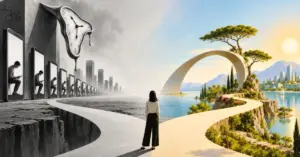
If we were to redesign the world to favor the creative spirit, perhaps we would see a different kind of game show. In a version of Family Feud designed for the divergent thinker, the objective would be to avoid the most popular answers entirely. The goal would be to identify the most novel, imaginative, or unexpected responses.
As a thought experiment to test this new paradigm, one might consider the question: "What items might be found in a national ballroom?" A convergent thinker might list "dancers" or "music." A divergent thinker, however, might picture the dust motes dancing in the light, the echo of a forgotten conversation, or the velvet texture of a discarded glove. In the pursuit of happiness, it is often those who look for the invisible, the unexpected, and the original who find the most meaningful rewards. By stepping into the "sandbox of creativity" and allowing ourselves to play without the fear of the red "X," we move closer to a fuller, more authentic way of living.