








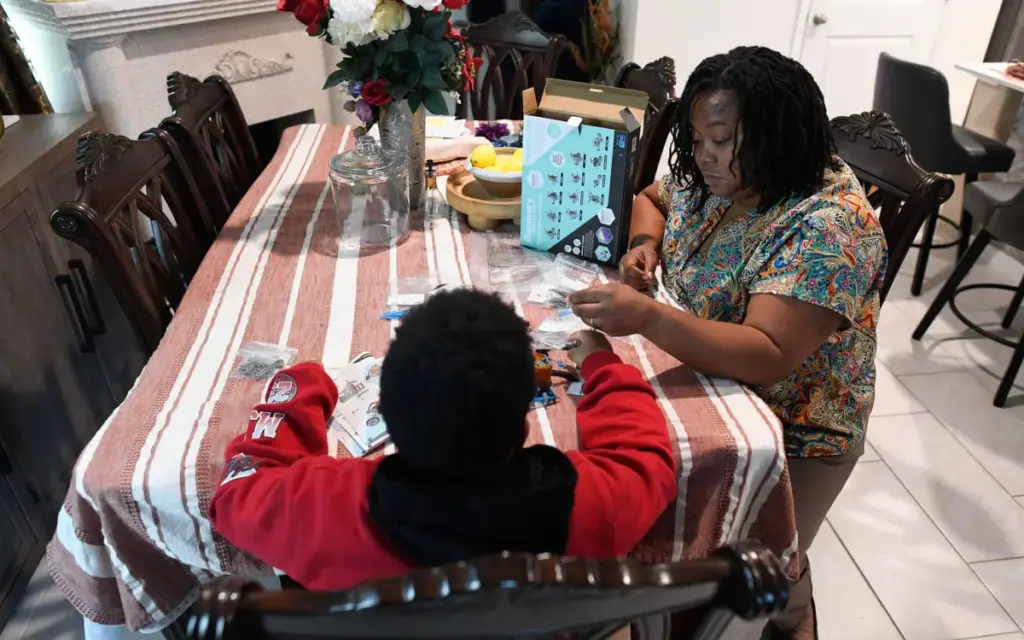
At Chain of Lakes Elementary School in Winter Haven, Florida, 9-year-old Ethan finds joy in the subjects he loves most: crafts, math, and science. But those moments of learning are frequently interrupted by the very system tasked with nurturing his education.
Ethan has autism and attention-deficit/hyperactivity disorder (ADHD). Diagnosed during his kindergarten year after displaying behaviors that initially concerned his family—such as pacing, hand-flapping, and an intense, hyper-focused interest in subjects like Martin Luther King Jr. and dachshunds—Ethan required specific accommodations to thrive in a traditional classroom setting.
According to administrative complaints filed by his mother, Josette Smith, a formal individualized education program (IEP) meeting was held with school and district officials. During this meeting, the team collectively agreed that Ethan required a trained paraprofessional to help him regulate his emotions and remain successfully integrated in his class. Yet, the complaints allege, school administrators ultimately refused to provide the dedicated aide. Rather than implementing the agreed-upon supports, the school repeatedly removed Ethan from classroom instruction, issued suspensions, and, by the time he reached the third grade, even called the police on him during behavioral episodes.

Smith, who works professionally as a seventh-grade science teacher, initially sought recourse through local channels, filing formal grievances with both the school district and the state education agency. When those efforts failed to yield solutions and the disruptions to her son’s education persisted, she turned to a higher authority: the U.S. Department of Education’s Office for Civil Rights, the federal entity historically responsible for investigating and resolving such discrimination claims. Smith’s federal complaint detailed the school’s failure to provide necessary accommodations and alleged that the institution discriminated against Ethan based on both his disability and his race, employing high-pressure tactics intended to push her Black son out of the public school system. In May, the federal office confirmed it would move forward with an investigation into several of her allegations.
For decades, families seeking justice when they believed their children’s civil rights had been violated in schools based on race, gender, or disability could turn to the federal government as a reliable recourse. However, the operational landscape has shifted dramatically. The White House has enacted sweeping cuts to regional civil rights offices, severely impairing the federal government’s capacity to investigate and resolve open cases. At the same time, funding has been slashed for ongoing research into the persistent disparities that people of color face when seeking timely disability diagnoses and vital community resources.
These systemic challenges unfold against a backdrop of rising autism rates. According to data from the Centers for Disease Control and Prevention, approximately 1 in 31 U.S. children by age 8 had been diagnosed with autism spectrum disorder as of 2022. While historical research examining demographic disparities in childhood autism diagnoses has yielded mixed conclusions, a recent study conducted by the Institute for Social and Health Equity at the State University of New York at Albany revealed that significant gaps driven by race, gender, and socioeconomic status remain stubbornly persistent.
Analyzing data from fourth graders between 2003 and 2022, researchers found that students of color, girls, low-income students, and multilingual learners were consistently less likely than their peers to be formally identified with autism within school environments, even as overall diagnosis rates ticked upward among historically marginalized populations. Furthermore, a large forthcoming study by the same research team discovered that these identification gaps widen exponentially among students with overlapping demographic identities, noting that Black and Hispanic girls were particularly unlikely to be identified by school systems.
Concurrently, the administration of President Donald Trump has brought autism and childhood health issues to the forefront of national discourse. In early August, President Trump signed an executive order aimed at reducing routine childhood immunizations, while falsely linking vaccines to autism. He has repeatedly framed the issue as a personal priority and one of the most alarming public health developments in history. Similarly, Health and Human Services Secretary Robert F. Kennedy Jr. characterized autism in April 2025 as a tragedy that destroys families, while lending credence to ungrounded claims regarding its origins—including thoroughly debunked assertions connecting the condition to childhood vaccines and the use of Tylenol during pregnancy.
Advocates argue that these policy directions are moving the country in the wrong direction. Camille Proctor, founder and executive director of The Color of Autism Foundation, voiced deep concern over the trajectory of federal initiatives, stating that the administration’s current approach is actively taking the nation backward.
In contrast, HHS spokesperson Emily Hilliard defended the administration’s focus in an email, stating that Secretary Kennedy’s prior remarks emphasized the urgent need for increased research into environmental factors contributing to the rise in autism diagnoses rather than seeking to stigmatize individuals or their families. Hilliard added that ongoing agency changes are designed to make federal support systems work more effectively for children and families. Representatives for the White House and the Department of Education did not respond to requests for comment.
The broad restructuring of federal agencies has directly impacted the apparatus dedicated to supporting students with disabilities. In March 2025, President Trump signed an executive order initiating the dismantling of the Department of Education and subsequently closing seven of the Office for Civil Rights’ 12 regional offices. By June of that year, the administration shifted special education oversight responsibilities largely to HHS, while reallocating portions of civil rights enforcement to the Department of Justice.
Legal experts warn that these administrative realignments create dangerous institutional gaps. Nancy Potter, a former supervising attorney at the Office for Civil Rights who now operates an independent education law firm, noted that while the changes may appear on paper to be a straightforward bureaucratic reorganization, they leave families dealing with intersectional discrimination—such as simultaneous bias based on both race and disability—caught in a void between agencies designed for entirely different mandates. The elements of these cases that are historically the most difficult to prove now lack an obvious home within the federal bureaucracy.
A congressional committee report released in April by Sen. Bernie Sanders (I-Vt.) concluded that the Office for Civil Rights had reached a 12-year low in resolving discrimination complaints, leaving behind a staggering backlog of nearly 12,000 active civil rights cases. An independent investigation by The Washington Post further revealed that the administration had indefinitely frozen a substantial portion of these pending matters.
In addition to these structural cutbacks, the White House vowed to halt federal equity investigations into areas such as school discipline practices. This policy shift persists despite extensive research demonstrating that students of color and low-income children already face disproportionate systemic barriers when attempting to secure autism identifications and access necessary neurodevelopmental resources.
Simultaneously, the administration significantly downsized the Institute of Education Sciences, the Department of Education’s primary research wing, canceling approximately $900 million in active research contracts, including long-standing data collection initiatives inside public schools. The administration also proposed ending federal data collection regarding racial disparities in school discipline. Parallel actions across the National Institutes of Health and the National Science Foundation have resulted in the cancellation of grants containing terms like "race" and "gender," effectively defunding research initiatives centered on diversity, equity, and inclusion.
Paul Morgan, director of the Institute for Social and Health Equity at SUNY-Albany and lead researcher on the autism disparity studies, warned that dismantling these data systems will only obscure the reality of the crisis. When data collection that helps illuminate the root of the problem is eliminated, the issue cannot be resolved, he noted, adding that current policy trends are actively exacerbating an already difficult situation.
Changes have also reached influential federal advisory bodies. The federal autism panel has been reconstituted in a manner that critics say leaves it lacking prominent scientists, Black members, and adequate representation from self-advocates compared to previous years. Proctor, who served on the panel prior to the current administration, noted the shift, while outside advocacy groups have raised alarms over the inclusion of known vaccine opponents on the roster.
HHS spokesperson Hilliard maintained that current panel members bring decades of vital experience in autism research and clinical care, remaining fully committed to aligning federal policy with rigorous scientific standards. However, disability advocates remain unconvinced, arguing that the administration’s overarching priorities are misplaced. Cameron Lynch, a former policy analyst for the Autistic Self Advocacy Network, characterized the sweeping changes as a source of unnecessary institutional chaos.
Disability rights advocates express grave concern that altering special education oversight weakens the fundamental federal safety net protecting students with disabilities, turning an already complex system into a confusing maze for families desperately trying to enforce educational rights. David Sitcovsky, vice president of advocacy for Autism Speaks, emphasized that access remains the central challenge across all these issues, questioning whether families—particularly those in marginalized communities—retain a clear and functional path to assistance when their children’s rights are violated.
As Smith awaits a decision on her federal civil rights complaint—a process she has been warned could extend beyond a year due to the massive federal backlog—Ethan has begun the fourth grade. Smith is actively seeking to transfer her son to a different educational environment better equipped to support his needs, while also requesting an expedited hearing for a due process complaint filed at the state level.
Compounding these educational struggles, the family has been forced to navigate criminal battery charges filed against Ethan, the first of which was initiated in March after the school contacted local law enforcement following an incident involving allegations that Ethan struck a staff member. According to a police report and email correspondence provided by Smith, police officers arrived at her home just hours after she formally notified the school district in writing that she had filed a federal discrimination complaint, a timeline she has highlighted in multiple subsequent grievances.
A spokesperson for Polk County Public Schools declined to comment, citing student privacy and confidentiality laws, while the Florida Department of Education did not respond to inquiries.
Reflecting on her experience as a mother and educator, Smith pointed to the heavy burden placed on families who speak out. As a Black mother, she expressed feeling that lodging any complaint carries immediate professional and personal retaliation, noting that once a parent begins actively advocating for their child, they immediately encounter institutional resistance. She emphasized that children do not choose to live with a disability.
Without timely diagnostic assessments and proactive early interventions, public health and legal studies indicate that children of color with disabilities face a severely elevated risk of being pushed out of public schools and funneled directly into the juvenile and criminal justice systems.
Catherine Lhamon, who directed the Education Department’s Office for Civil Rights during the Obama and Biden administrations and now serves as executive director of the Edley Center on Law & Democracy at the University of California-Berkeley School of Law, underscored the growing vulnerability of families under the current regulatory framework. Drawing an analogy to everyday behavior, Lhamon noted that people tend to speed when they do not see a police car present, warning that if local school systems believe no federal oversight is actively watching them, a measurable increase in discrimination will follow.