







In the evolving landscape of occupational therapy, practitioners are increasingly looking beyond immediate physical capabilities to evaluate the broader environments that shape a client’s daily life. While visualization tools like mind maps and genograms have long assisted clinicians in organizing clinical data, a growing movement within the profession is championing the use of eco maps. Traditionally rooted in social work, this graphical organizer is finding a critical new application in occupational therapy, offering a comprehensive snapshot of how interpersonal relationships and social environments directly impact a client’s functional performance.
Relationships influence nearly every facet of the human experience, acting as a foundational pillar for daily living. Surrounding individuals can offer emotional encouragement, foster opportunities for active participation, assist with essential daily tasks, or, conversely, introduce complex challenges that hinder engagement. According to occupational therapy experts, mapping these connections allows clinicians to understand the whole person rather than treating isolated symptoms. By visualizing an individual’s social network, therapists can better comprehend how external factors either facilitate success or create barriers to meaningful occupation.
The application of this visual tool aligns closely with professional guidelines, notably the Occupational Therapy Practice Framework, Fourth Edition (OTPF-4) published by the American Occupational Therapy Association. The framework explicitly identifies supports and relationships as critical environmental factors that significantly influence participation and performance. These factors encompass the physical, social, and attitudinal contexts in which people live and engage in their daily routines. Furthermore, the framework designates social participation as a core occupation, one that involves interactions with family members, friends, peers, coworkers, and wider community groups.
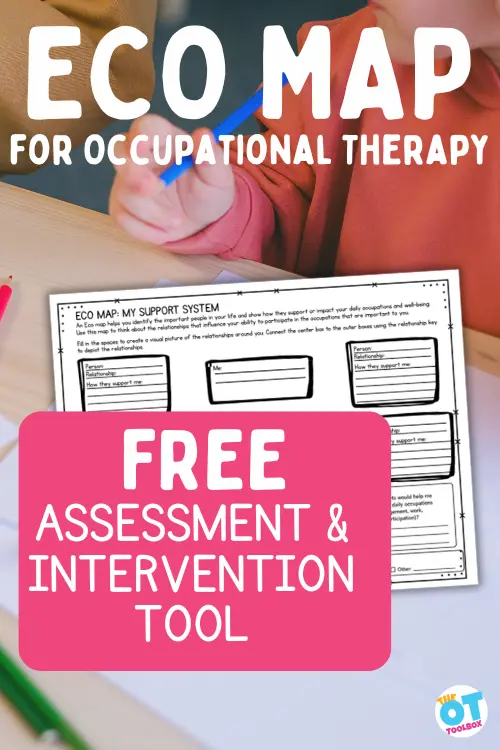
Despite the widespread acknowledgment of social contexts in theory, the active mapping of these relationships through specialized worksheets has not historically been a standard practice in occupational therapy. Practitioners are now bridging this gap by introducing tailored eco map worksheets designed specifically for clinical environments. These resources help individuals of all ages—from children and adolescents to adults and older populations—visually map out their support systems and identify areas where additional resources might be beneficial. Beyond client care, practitioners note that these mapping exercises can also be applied internally by therapists themselves to evaluate professional burnout and identify supportive relationships within their own careers.
The utility of an eco map spans multiple domains of occupational therapy, heavily influencing Activities of Daily Living (ADLs) and Instrumental Activities of Daily Living (IADLs). Many individuals rely extensively on personal support systems to successfully navigate everyday routines. For instance, an older adult may depend on adult children for transportation to necessary medical appointments, while a teenager often relies on family caregivers to establish stable routines that foster independence. Similarly, college students frequently lean on peer networks while adapting to the demands of independent living.
Beyond personal care and domestic routines, relationships play a profound role in work performance and educational participation. Success in professional and academic environments frequently hinges on effective social interaction, communication abilities, problem-solving, collaboration, and external support. When evaluating the occupational demands of work—a domain heavily scrutinized in discussions surrounding professional burnout among healthcare providers—understanding these relational dynamics becomes essential. An eco map helps uncover the relational strengths and vulnerabilities that directly impact job satisfaction and productivity.
As a screening and discussion tool, the eco map provides clinicians with rapid insight into a client’s social landscape. While it functions as a qualitative exploration rather than a standardized assessment, clear patterns frequently emerge during the mapping process. Some clients may demonstrate robust family backing paired with minimal community involvement, while others maintain extensive social connections yet lack the practical support required for day-to-day functioning. These insights guide clinicians in refining intervention plans and setting meaningful, targeted goals.
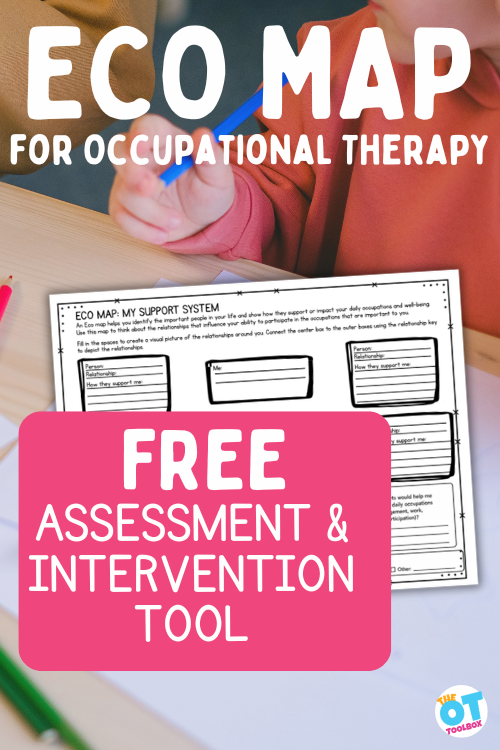
Implementing the tool begins simply, with the client’s name placed at the center of a diagram. From there, the individual maps out significant relationships across various categories, including immediate and extended family, friends and peers, academic and workplace supports, healthcare providers, community organizations, and online networks. By analyzing the nature of these connections—distinguishing between supportive, stressful, or neutral ties—both the therapist and the client gain a clearer understanding of the social machinery driving everyday occupational performance.
Ultimately, occupational therapy recognizes that human engagement does not occur in isolation. People execute their daily routines within complex ecosystems defined by expectations, social systems, and interpersonal relationships. By integrating tools like the eco map into regular practice, clinicians and their clients can systematically identify barriers, leverage existing strengths, and cultivate stronger pathways toward participation in meaningful, purposeful occupations.