
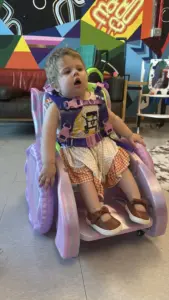









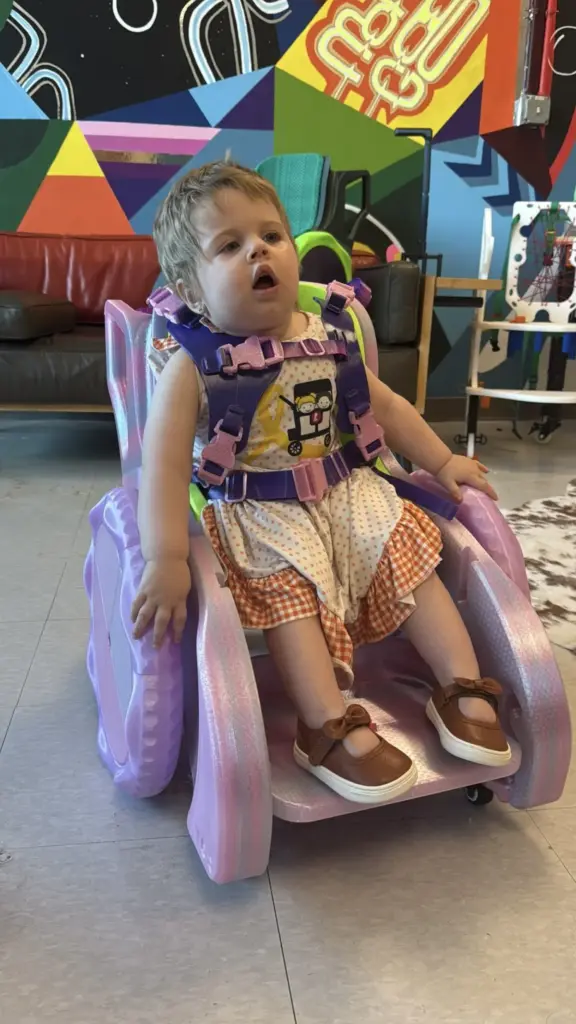
At the Monroe Carell Jr. Children’s Hospital in Nashville, the newest piece of mobility equipment is a 3D-printed wheelchair—built layer by layer by a gaming and technology specialist who had never originally set out to design a wheelchair at all.
That detail matters. It serves as a small sign of a much bigger shift happening across contemporary pediatric care, where hospitals, schools, and individual families are starting to manufacture the assistive technology that the traditional medical supply chain has struggled to deliver affordably, quickly, or in a way that feels genuinely tailored for an actual child instead of a generic patient.
What Is Actually Happening at Monroe Carell
The story centers on Graden Knapp, whose day job involves making hospital stays more bearable for young patients through toys, video games, and other interactive entertainment tools. While working at Monroe Carell, Knapp noticed something more fundamental than entertainment was missing from the clinical environment: the hospital simply did not have enough specialized wheelchairs suited to the specific, evolving needs of its youngest patients.

Determined to bridge this gap, Knapp taught himself a new set of technological skills. He came across open-source design concepts provided by "MakeGood," a New Orleans-based disability design nonprofit, and spent two to three months printing components and assembling what is now the hospital’s first nearly complete 3D-printed wheelchair.
The strategy behind the project extends far beyond keeping a temporary chair parked in a hospital storage closet. Knapp’s ultimate intent is for young patients to take the custom wheelchairs home with them upon discharge, effectively transforming a piece of institutional medical equipment into a personalized asset that a child can keep, customize, and physically grow into over time.
Although it began as a grassroots project on a single hospital floor, it points toward a broader horizon where pediatric assistive technology could be produced directly on-site, perfectly tailored to the individual child, and built around the core philosophy that a mobility device can be both highly functional and something a kid is genuinely excited to use.
The Design and Philosophy Behind Modern Open-Source Mobility
While specific institutional details regarding the exact model built by Knapp highlight the ingenuity taking place in Nashville, the wider movement relies heavily on collaborative, open-source engineering. Nonprofit organizations like MakeGood—often working alongside industrial design firms and global advocacy groups—have pioneered fully 3D-printable mobility devices aimed at early childhood development.
These designs are intentionally optimized for consumer-grade manufacturing machines widely available to the public. Nearly every major component of these innovative chairs—including the structural frame, wheels, tires, seating elements, and even safety straps—can be printed using standard desktop hardware. The modular pieces are engineered to snap together securely without requiring specialized tools, complex screws, or chemical adhesives, utilizing a seamless, puzzle-piece assembly style. If a specific part undergoes wear and tear or breaks entirely, a caregiver or technician can simply reprint that individual component rather than discarding or replacing the entire mobility unit.
By releasing these blueprints as open-source files on digital manufacturing platforms, creators ensure that anyone with access to a standard 3D printer and common filament materials—whether a parent, a school librarian, or a hospital technologist like Knapp—can produce a device locally. This approach has allowed numerous grassroots initiatives to distribute thousands of free or low-cost assistive devices globally, signaling a fundamental decentralization of medical equipment manufacturing.
The Real Story: Cost and Economic Barriers
This is precisely where the project evolves from a feel-good local news feature into a genuine, systemic accessibility milestone.

A traditional pediatric wheelchair in the United States typically carries a retail price ranging from $1,200 to $5,000. Custom or specialized powered pediatric models can easily run well past $12,000 once advanced seating systems, specialized materials, and electronic components are factored into the total. This heavy financial burden is compounded by the reality that growing children naturally outgrow standard wheelchairs every couple of years, exponentially multiplying the lifetime cost of mobility care. Furthermore, families frequently face strict insurance denials or only partial coverage claims for these essential medical devices.
In sharp contrast, open-source alternatives can be produced for a fraction of the cost in raw materials alone. Standard builds typically require only a handful of spools of durable thermoplastic filaments and a minimal amount of standard hardware like basic bolts, nuts, and casters. Hospital staff and project estimates suggest that producing a chair through this method can be up to ten times cheaper than acquiring a conventional commercial equivalent.
The primary driver behind these dramatic savings is not merely the use of inexpensive materials, but the total elimination of an entire layered apparatus of industrial manufacturing, wholesale distribution, and retail markup that conventional durable medical equipment traditionally carries. A traditional wheelchair must be engineered, tooled for mass production in a factory, shipped internationally, stocked by a specialized supplier, and marked up at each transitional step. Conversely, a 3D-printed version bypasses nearly all of those intermediate stages, allowing the design to exist purely as a digital file while the manufacturing "factory" becomes whatever printer happens to sit in a hospital office, a school workshop, or a family’s spare room.
Implications for Global Accessibility and Healthcare Equity
While the initial spotlight rests on a single hospital in Nashville utilizing one printer and a dedicated staff member, the underlying technology carries profound implications that extend far beyond Tennessee. This is particularly true for low- and middle-income countries, where reliable access to specialized mobility devices is dramatically more restricted than in wealthy, industrialized nations.
The scale of the global accessibility gap remains stark. Comprehensive reports from international health organizations reveal that more than 2.5 billion people worldwide require at least one form of assistive product—such as wheelchairs, hearing aids, or communication devices—yet nearly one billion individuals are consistently denied access. In resource-limited settings, assistive product availability can drop to critically low percentages, whereas wealthy nations report near-universal coverage. Independent studies on global wheelchair service provision indicate that tens of millions of people who clinically require a wheelchair do not have access to one, largely because commercial supply chains are thinnest and import costs are highest in developing regions.
This systemic void is precisely what low-cost, open-source 3D-printed designs are positioned to address. Because the production model relies on decentralized digital files rather than centralized import logistics, communities can manufacture, repair, and adapt mobility devices locally using readily available materials. This drastically reduces shipping delays, circumvents high import tariffs, and empowers local technicians to maintain equipment without depending on fragile international supply chains.
Why Hospitals and Institutions Are Taking Notice
The growing momentum behind on-site additive manufacturing in healthcare highlights several distinct advantages for hospitals, schools, and disability-focused nonprofits. Chief among them is the ability to drastically reduce acquisition costs while simultaneously empowering institutional staff to solve immediate, localized supply chain failures. By fostering a culture of internal innovation, facilities can deliver customized solutions to patients precisely when they are needed, removing weeks or months of administrative delays typically associated with specialized medical equipment procurement.
Admittedly, experts note that 3D-printed devices are not yet positioned to fully replace clinically prescribed, highly complex insurance-covered wheelchairs for every medical profile. Long-term clinical validation, stringent weight limits, and rigorous material durability testing remain active areas of ongoing research and refinement.
However, for the specific, immediate use case demonstrated at Monroe Carell—successfully placing a functional, well-fitted mobility device into the hands of a young child quickly, affordably, and with personal agency—the technology is already proving its viability in real-world clinical environments today. For other medical centers, educational institutions, and global health organizations, the central question is no longer whether on-site digital manufacturing works, but rather when they will choose to integrate these innovative methods into their own patient care strategies.