









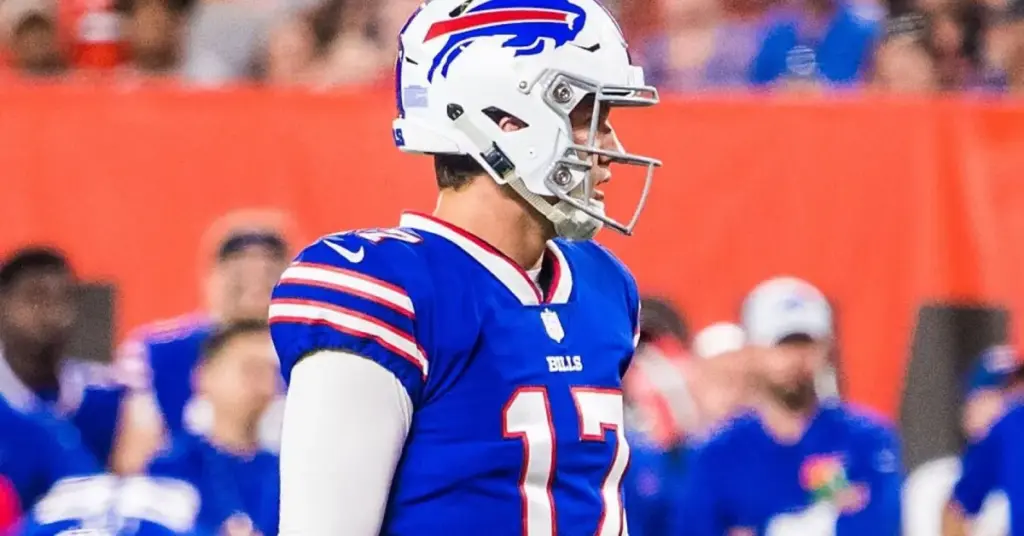
In many communities, there is a clear distinction between the sacred and the profane. At a wedding or a funeral, for instance, you are unlikely to encounter a guest sporting a blue jersey with the number 17 sewn across the chest. There is a time and a place for everything, and formal social rituals usually demand a departure from the rowdy, exuberant aesthetic of the gridiron. Yet, step outside those specific settings, and the landscape changes entirely.
Walk through a local supermarket, navigate the aisles of a suburban neighborhood, or step into a corporate office on a "casual Friday," and you will find that Buffalo Bills quarterback Josh Allen has become a pervasive cultural touchstone. Fans are not merely watching his games; they are wearing his name, drinking from his branded coffee mugs, and wrapping themselves in the identity of the team. As the current NFL season unfolds with a series of spectacular victories, a collective euphoria has taken hold. It is common to hear the phrase, "We are winning," echoing from the bleachers to the breakroom.
The "We" Phenomenon
The use of that first-person plural pronoun—"we"—is a fascinating linguistic habit that speaks to a deeper psychological reality. Fifty years ago, psychologist Robert B. Cialdini and his colleagues began to examine the intense emotional connection between spectators and their teams. Their research uncovered a phenomenon where individuals tether their own sense of self-worth to the performance of a group they have no active role in managing or assisting.

While a "home-field advantage" might suggest that the "13th Man"—the crowd—can influence the game by drowning out an opposing quarterback’s snap count, the reality remains that no fan in the stands is tasked with throwing a touchdown pass or making a game-changing interception. Spectators do not step onto the turf to engage in the physical chess match of an NFL game. Yet, through the firing of mirror neurons and the deep, sympathetic resonance of being a fan, spectators experience a vicarious thrill that feels profoundly personal. When the team succeeds, the fans succeed. When the team struggles, the fans feel the sting.
This tendency to associate with success was dubbed "BIRG-ing" by sports psychologists: "Basking in Reflected Glory." Much like lying in the sun to absorb its warmth, BIRG-ing is a passive but highly rewarding psychological state. It allows an individual to internalize the triumph of others, making the team’s victory feel like a personal achievement.
Testing the Limits of Basking
Cialdini’s original research utilized a series of field experiments to quantify this behavior. The first observation was straightforward: researchers tracked the prevalence of university-branded apparel on campus. Unsurprisingly, students were far more likely to don school sweatshirts on the Monday following a football victory than they were after a loss. The clothing served as a badge of honor, a public declaration of association with a winner.
However, the second and third experiments revealed more complex layers of social psychology. Researchers found that when a team was victorious, students were significantly more likely to use "we" when describing the game. When a student remarked, "We played well," they were effectively using the team’s success to bolster their own public image. By aligning themselves with the winners, they were subtly claiming a portion of that prestige for themselves.
The researchers concluded that a simple affiliation was sufficient to encourage fans to "trumpet" success and broadcast their pride. This explains the proliferation of team-themed bumper stickers, yard signs, and even elaborate inflatable mascots that illuminate front lawns at night. The fans are not just cheering for a team; they are announcing their membership in a winning culture.
The Communal Value of Sport
Despite the potential for pride to tip into the realm of gloating, there is a genuine utility to these shared emotions. Common admiration acts as a social adhesive, drawing a community together in a shared, non-partisan devotion. In a world often fractured by political and social isolation, the stadium provides a space where people can gather under a single banner, bolstered by a common spirit.
This phenomenon extends beyond the stadium walls. Families separated by geography often find themselves tethered together by the game, using halftime FaceTime calls to maintain a connection that might otherwise fray. Furthermore, the sport itself offers a masterclass in resilience and persistence. For fans in regions defined by tough climates and economic challenges, the team’s ability to "hang in there" becomes a metaphor for their own lives. When a fan says, "Go Bills!" they are often expressing a quiet, collective determination to weather whatever storm—be it a lake-effect blizzard or a difficult season—comes their way.
Sociologist and play theorist Thomas Henricks describes this state of equalizing togetherness as communitas. By finding a central shared passion, individuals can move past their own identities and find a sense of belonging. This de-individualization is not a loss of self, but rather a way to define where one belongs within a larger structure. These events are temporary and event-driven, yet they are not fleeting, as the recurring nature of the season ensures that the celebrants will gather time and time again, fostering a consistently generous mood among the fan base.
The Shift from "We" to "They"
While some fan bases remain remarkably patient—such as the "Dog Pound" in Cleveland or the steadfast supporters who stayed with the Buffalo Bills through 17 years of playoff droughts—loyalty is not always unconditional. In cities like Los Angeles, Miami, or Phoenix, sub-.500 seasons often lead to empty seats and a sudden decline in local enthusiasm.
When the glory fades, the psychological mechanism shifts from BIRG-ing to its opposite: CORF-ing, or "Cutting Off Reflected Failure." When a team begins to lose, the psychological distance between the fan and the team widens. The yard signs are taken down, the jerseys are relegated to the back of the closet, and the team buttons are tossed into junk drawers.
Most tellingly, this shift is mirrored in the language fans use. The pronoun "we" is quietly replaced by "they." When the team fails to convert a crucial third down or gives up a big play, the narrative changes. It is no longer "our" loss; it is "their" failure. Fans will criticize "their" inability to defend against the pass rush, "their" poor clock management, or "their" costly penalties.
This linguistic distancing is a defensive maneuver. Because self-esteem is so deeply intertwined with the team’s identity, a losing season can feel like a personal insult. In the minds of many fans, the opposite of pride is not humility, but shame. By distancing themselves from the team, fans protect their own self-image from the sting of defeat. Ultimately, the way we speak about our teams—whether we claim them as "we" or discard them as "they"—reveals less about the players on the field and more about the fragile, human need to be part of something that succeeds.