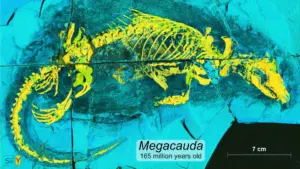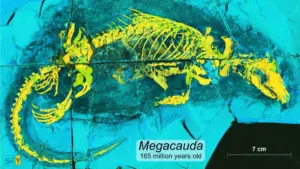









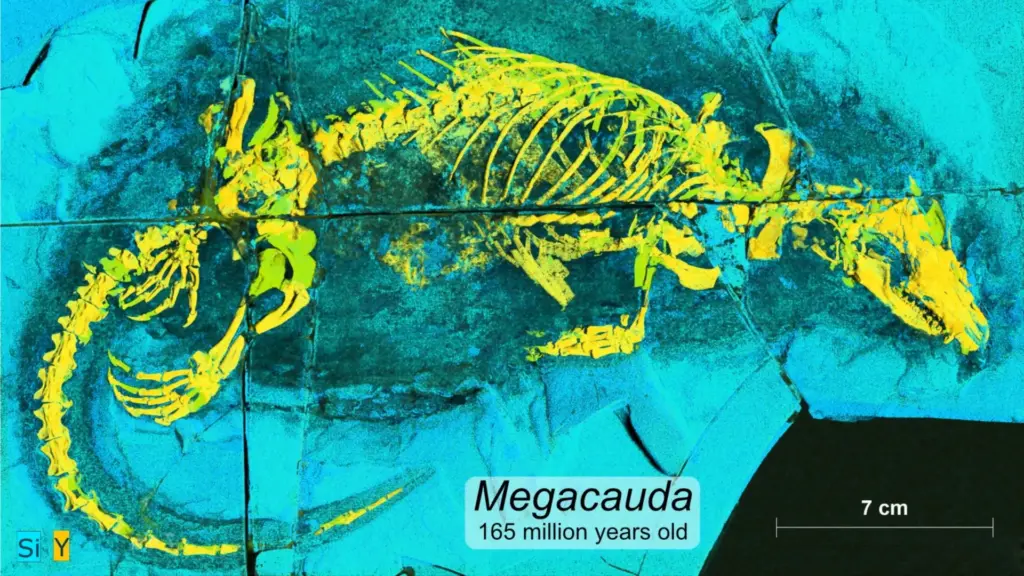
In the shadow of the gargantuan dinosaurs that dominated the Jurassic period, a small, fur-covered creature was quietly pioneering biological innovations that would eventually define the future of mammalian life. Paleontologists have recently unveiled the discovery of Megacauda sungei, a 165-million-year-old predator that provides a startlingly clear window into the evolutionary history of mammals. Measuring approximately half a meter—about 20 inches—from nose to tail, this ancient hunter was a heavyweight among its contemporaries, challenging long-held assumptions about the size and capability of early mammaliaforms.
The findings, the result of a multi-year international collaboration between researchers in Shenyang, Chicago, and Bonn, have been published in the journal Nature. While the creature’s size and specialized aquatic lifestyle are remarkable, the most significant revelation lies within its anatomy: the earliest evidence of a sophisticated soft palate. This structural development, which separates the mouth from the pharynx, served as the biological precursor to modern mammalian swallowing, enabling these creatures to nurse their young and breathe simultaneously—an adaptation that ultimately paved the way for the complex brain development seen in mammals today.
How an Ancient Predator Reveals the Evolution of Swallowing
The mechanics of swallowing may seem mundane, but in the history of vertebrate evolution, it represents a profound divide. Many non-mammalian animals lack a soft palate, relying instead on a relatively simple arrangement of hyoid bones in the throat. Without the complex mechanism found in mammals, feeding requires an entirely different set of physical movements.

Crocodiles offer a clear contemporary comparison. Because they lack the soft palate anatomy required for modern swallowing, they must lift their heads and engage in sudden, jerky motions to force unchewed food down their throats. As Professor Thomas Martin, a paleontologist at the University of Bonn, explains, this process is achieved primarily through the aid of gravity. In contrast, mammals possess a more elaborate hyoid structure and a sophisticated oral cavity that allows them to swallow effectively, regardless of gravitational orientation. Humans, for example, can drink through a straw while hanging upside down because the throat’s anatomy ensures that liquids and air can be managed independently.
This physiological leap was not merely a matter of convenience; it was a survival imperative. The ability to swallow while breathing allowed young mammals to consume nutrient-rich milk safely, preventing liquid from entering the nasal passages during nursing. By supporting effective and safe nourishment, this adaptation provided a vital survival advantage that allowed early mammals to thrive in a world otherwise dominated by reptiles.
"It was this adaptation that made brain development, eventually leading to humans, possible," Professor Martin stresses. The refinement of the soft palate and the precise shaping of the oral cavity and pharynx are directly linked to the broader evolution of mammals. The discovery of Megacauda sungei is particularly significant because it confirms that this critical anatomical development was already present millions of years before the rise of modern mammals, demonstrating that the building blocks of mammalian success were established early in the Jurassic.
A 165-Million-Year-Old Predator Built for Swimming
With its short fur, broad, flattened tail, and specialized limbs, Megacauda sungei would have resembled a prehistoric fusion of a modern otter, beaver, or platypus. Its anatomy was clearly optimized for a life spent in the water, a habitat choice that distinguishes it from many of its land-dwelling relatives.
To understand how the animal navigated its environment, the research team utilized high-resolution computed tomography (CT) scans of the fossil. By creating detailed three-dimensional reconstructions of its skeletal structure, the scientists could infer how the animal moved. The models suggest that Megacauda sungei propelled itself through the water primarily by paddling with its front legs, while its tail—a feature reflected in its name "Megacauda," meaning "large tail"—provided an undulating motion for movement. Its hind legs were likely used for steering, allowing the creature to maneuver through the water with agility.
"It is the earliest evidence of an aquatic lifestyle in mammals," notes Professor Martin. This discovery forces a re-evaluation of the ecological diversity of mammaliaforms during the Mesozoic Era.
The animal’s dental structure provided further clues about its life as a predator. It possessed backward-curving cusps on its teeth, which were perfectly adapted for gripping slippery aquatic prey. Perhaps most surprising to the researchers were the specialized canine teeth, which featured three roots—a distinct and complex dental feature that highlighted the animal’s evolutionary sophistication. By comparing the fossil with other prehistoric specimens and living animals, the team identified Megacauda sungei as a member of the docodonts, a group of extinct, early mammal relatives that were widespread during the Jurassic period. The fossil was recovered from Xiayingzi, in Inner Mongolia, a region known for its rich paleontological history.
A Tiny Giant in the Age of Dinosaurs
In the popular imagination, the Mesozoic Era, which spanned from approximately 230 million to 66 million years ago, is characterized by the sheer scale of dinosaurs. During this time, early mammal relatives were often dismissed as small, insignificant creatures, with many species weighing only a few grams.
Against this backdrop, Megacauda sungei stands out as an anomaly. Weighing in at approximately two kilograms—about 4.4 pounds—it was a true heavyweight among its peers. While it would seem minuscule compared to modern megafauna like elephants or whales, for a Jurassic mammaliaform, Megacauda sungei was an apex predator. It serves as a reminder that size is relative, and that even in an era of giants, small creatures were carving out specialized niches and pushing the boundaries of what was biologically possible for mammals.
An Extraordinary Fossil Discovery in Inner Mongolia
The story of Megacauda sungei is as much about the persistence of modern science as it is about the ancient creature itself. The discovery might have remained buried in obscurity had it not been for a fortunate series of events. Years ago, the Paleontological Museum of Liaoning in Shenyang acquired the fossil as part of a collection of specimens unearthed in Inner Mongolia. It remained part of the museum’s archives until a collaborative effort brought together three world-renowned experts: Professor Chang-Fu Zhou of Shandong University, Professor Zhe-Xi Luo of the University of Chicago, and Professor Thomas Martin of the University of Bonn.
Upon closer inspection, the trio realized that the specimen represented a previously unknown species. To honor the institutional history of the find, they named the creature Megacauda sungei—a combination of the Latin for "large tail" and a designation honoring Professor Sun Ge, the Honorary Director of the Paleontological Museum of Liaoning.
Establishing the identity of the creature required years of painstaking labor, including detailed anatomical comparisons, taxonomic classification, and rigorous documentation. "It is the result of a long period of teamwork," says Professor Martin. The effort has paid dividends for the field of paleontology, providing a new, high-resolution perspective on the early history of mammals and the surprising speed at which their ancestors developed specialized bodies and diverse lifestyles.
Other fossils from the docodont group suggest that these animals were remarkably adaptable. Evidence exists of members of the group that lived in trees, others that burrowed underground like modern moles, and now, with the study of Megacauda sungei, clear evidence of those that conquered the water. "This shows how widespread docodonts were in the Northern Hemisphere and that this diverse group of animals developed very different lifestyles at an incredibly early stage," summarizes Martin.
The discovery of Megacauda sungei serves as a powerful testament to the resilience and ingenuity of early mammals. It proves that long before the extinction of the dinosaurs allowed modern mammals to rise to global dominance, their ancient relatives were already experimenting with an impressive range of evolutionary strategies, setting the stage for the complexity of life that followed.