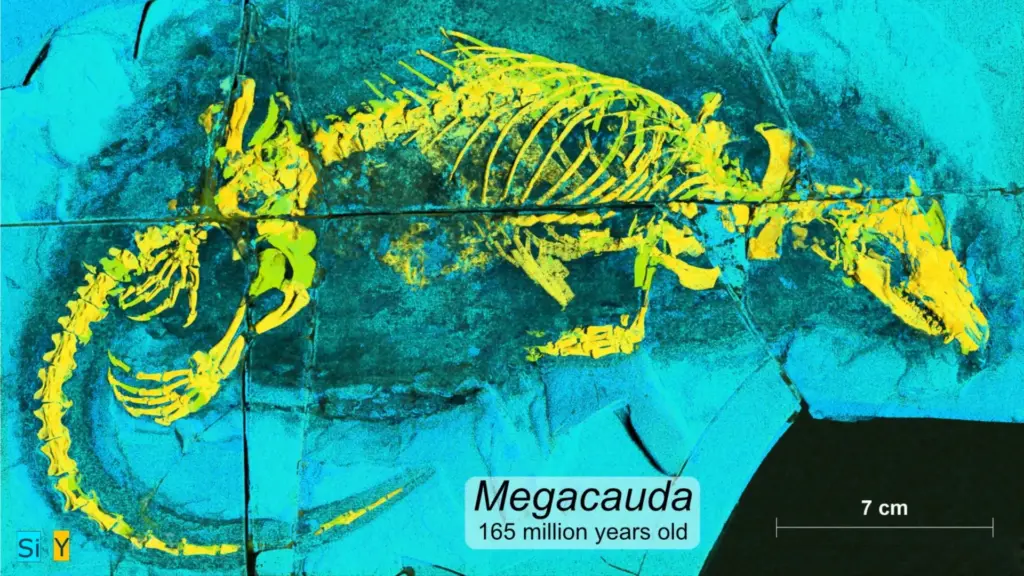
In the shadowed, dinosaur-dominated landscape of the Jurassic Period, a small, furry hunter was busy perfecting an evolutionary breakthrough that would eventually pave the way for human intelligence. A newly described species, Megacauda sungei, has provided paleontologists with an unprecedented look into the early development of mammals, offering evidence that key anatomical traits—often thought to be later innovations—were present 165 million years ago.
Measuring approximately half a meter from its nose to the tip of its broad, flattened tail, Megacauda sungei was a "giant" among its contemporaries. While modern mammals have grown to colossal sizes, their ancestors during the Mesozoic Era were typically diminutive, often weighing only a few grams. Against this backdrop of tiny, scurrying creatures, the two-kilogram (4.4-pound) Megacauda was a formidable top predator. The findings, resulting from a collaborative international study by researchers in Shenyang, Chicago, and Bonn, have been published in the prestigious journal Nature, shedding light on how these early mammaliaforms navigated their environment.
How an Ancient Predator Reveals the Evolution of Swallowing
While its size and aquatic lifestyle are significant, the most profound discovery regarding Megacauda sungei lies within its skull. Researchers utilized advanced computed tomography (CT) scans to create highly detailed, three-dimensional reconstructions of the fossil’s anatomy. These digital models revealed the existence of a sophisticated soft palate, a muscular structure that separates the oral cavity from the pharynx—the passage connecting the mouth to the throat.
The presence of this soft palate is a transformative anatomical development. In many modern reptiles, such as crocodiles, the absence of a soft palate necessitates a complex and often cumbersome method of feeding. Crocodiles must lift their heads and utilize sudden, gravity-assisted jerking motions to force unchewed food down their throats. According to Prof. Dr. Thomas Martin, a paleontologist from the University of Bonn and a key member of the research team, this reliance on gravity is a stark contrast to the mechanics found in mammals.
Mammals possess a more elaborate hyoid structure, a collection of bones in the throat that works in concert with the soft palate. This allows mammals to swallow effectively even when gravity is working against them. A human, for instance, can drink through a straw while hanging upside down without the liquid entering the windpipe. This ability is not merely a convenience; it was a critical evolutionary adaptation for nursing. By preventing liquid from entering the nasal passages, the soft palate allowed young mammals to consume nutrient-rich milk safely and efficiently.
This mechanism provided a massive survival advantage. As Prof. Martin explains, this adaptation was foundational to the trajectory of mammalian evolution. "It was this adaptation that made brain development, eventually leading to humans, possible," Martin stresses. "The soft palate and the shaping of the oral cavity and pharynx are directly linked to the evolution of mammals." Finding evidence of this structure in Megacauda sungei—a creature that lived millions of years before the rise of modern mammals—suggests that the biological machinery required for complex feeding and nursing emerged much earlier than previously realized.
A 165-Million-Year-Old Predator Built for Swimming
With its short, dense fur and a broad, flattened tail, Megacauda sungei would have resembled a modern otter, beaver, or platypus. Its physical build was explicitly designed for a life spent moving through water. The high-resolution CT reconstructions provided scientists with clear insights into how the animal maneuvered in its prehistoric riverine habitats.
The model suggests that Megacauda propelled itself by paddling with its front limbs while moving its tail in a rhythmic, undulating motion. Its hind legs, meanwhile, functioned like rudders, allowing the creature to change direction with precision as it tracked slippery, aquatic prey. "It is the earliest evidence of an aquatic lifestyle in mammals," says Prof. Martin.
This hunting strategy was supported by a specialized dental arrangement. In addition to backward-curving cusps on its teeth—which functioned like hooks to grip elusive prey—the creature possessed unusual three-rooted canine teeth. This feature came as a surprise to the research team, as it highlights a level of dental specialization that was remarkably advanced for the Jurassic period.
By comparing the fossil with other prehistoric specimens and living species, the team identified the animal as a member of the docodonts. The docodonts were a widespread group of early mammal relatives, or mammaliaforms, that flourished during the Jurassic. The fossil itself was unearthed in the Xiayingzi region of Inner Mongolia, a site that has proven to be a treasure trove for paleontological research.
A Tiny Giant in the Age of Dinosaurs
To understand the scale of Megacauda sungei, one must consider the world it inhabited. The Mesozoic Era, stretching from roughly 230 million to 66 million years ago, was the age of the dinosaur. While massive reptiles dominated the landscape, early mammals were forced into the margins, generally occupying small niches and remaining largely nocturnal or hidden.
Most of these early creatures weighed only a few grams, making them virtually insignificant in the eyes of the gargantuan predators of the time. In this context, Megacauda sungei was an outlier. At half a meter in length and weighing two kilograms, it was a "heavyweight" among its peers. While it would be dwarfed by modern megafauna like whales or elephants, it was a apex hunter in its specific ecosystem, demonstrating that early mammaliaforms were far more capable of occupying diverse ecological roles than once thought.
An Extraordinary Fossil Discovery in Inner Mongolia
The journey of Megacauda sungei from a forgotten rock in Inner Mongolia to a landmark scientific discovery is a testament to the power of international collaboration. The fossil was acquired years ago by the Paleontological Museum of Liaoning in Shenyang as part of a general collection of specimens. Its true value remained hidden until it was examined by a powerhouse team of researchers: Prof. Dr. Chang-Fu Zhou of Shandong University, Prof. Dr. Zhe-Xi Luo of the University of Chicago, and Prof. Dr. Thomas Martin of the University of Bonn.
Upon realizing that the specimen represented a previously unknown species, the researchers sought to honor Prof. Sun Ge, the Honorary Director of the Paleontological Museum of Liaoning. They combined the Latin for "large tail" (Megacauda) with the species name sungei to create the taxonomic designation Megacauda sungei.
Establishing the identity and significance of this animal was a laborious process that spanned years of meticulous analysis, comparative anatomy, and documentation. "It is the result of a long period of teamwork," says Prof. Martin. This effort has provided scientists with a new, nuanced understanding of the early history of mammals and the speed at which their ancestors diversified.
The discovery of Megacauda sungei is part of a larger, ongoing shift in how paleontologists view the docodont group. Other fossils in the same lineage have revealed that these creatures were already adapting to a staggering array of environments. Some species were adapted for climbing in trees, others were specialized to burrow underground like modern moles, and Megacauda perfected the art of aquatic hunting.
"This shows how widespread docodonts were in the Northern Hemisphere and that this diverse group of animals developed very different lifestyles at an incredibly early stage," summarizes Martin. These findings illustrate that long before the extinction of the dinosaurs allowed modern mammals to rise to global dominance, their ancient ancestors were already experimenting with a remarkable variety of evolutionary paths, demonstrating the same adaptability and complexity that would eventually characterize the mammalian lineage.