






The role of an occupational therapist (OT) within a multidisciplinary healthcare team is often misunderstood, yet it is arguably one of the most transformative elements in a patient’s journey toward recovery and quality of life. Following a recent reflection on the structure and efficacy of modern healthcare teams, it has become increasingly clear that the profession of occupational therapy struggles not with a lack of value, but with a persistent difficulty in communicating that value to colleagues, administrators, and the public. To bridge this gap, perhaps it is time for the profession to adopt a new identity: the definitive "difference maker" on the healthcare team.
In a clinical environment often dominated by diagnostic metrics and pharmaceutical interventions, the unique perspective of an OT—focusing on the functional, psychological, and environmental needs of the individual—often goes unnoticed. However, when we analyze the tangible impact OTs have on the daily lives of patients, a clear narrative emerges. By meeting patients exactly where they are in their unique health journeys, OTs provide solutions that are often overlooked by other members of the care team. These interventions are not merely supplementary; they are essential for restoring agency, dignity, and joy to patients facing profound life challenges.
To truly understand this role, one must look at the specific, lived experiences of patients whose trajectories were altered by the creative, patient-centered approach of an occupational therapist. These stories are not just anecdotes; they are evidence of the specialized, human-centric care that only an OT is uniquely positioned to provide.

Terminal Cancer and the Power of Play
Consider the case of "Paul," a ten-year-old patient diagnosed with terminal cancer. By the time he was under the care of his medical team, Paul was largely wheelchair-bound, having withdrawn from the world as his health declined. Despite the best efforts of a robust multidisciplinary team, the weight of his illness appeared to be winning. During daily occupational therapy sessions, the atmosphere remained heavy, and each hour would conclude with the same somber tone with which it began. The medical interventions were managing his physical condition, but his spirit was clearly failing.
One afternoon, the approach changed. Armed with a simple assistive device—a grabber—the therapist seized a moment of opportunity. As Paul’s mother stepped into the kitchen to wash dishes, leaving the room momentarily empty, the therapist handed the grabber to Paul and whispered a simple, conspiratorial instruction: "Hide it under the table." The shift in Paul’s demeanor was instantaneous. His eyes lit up, replaced by a sense of purpose and mischief. When his mother returned and began searching for her missing dish towel, the tension in the room dissipated. Paul, clutching the towel and waving it in the air, broke into genuine, uninhibited laughter.
The grabber remained with Paul for the remainder of his life, serving as a tool for play, connection, and even a bit of healthy mischief with his siblings and parents. When his parents eventually contacted the therapist following Paul’s passing two weeks later, their message was one of deep gratitude. They did not thank the team for the clinical management of his disease, but rather for the moments of joy and normalcy that the therapist had introduced into the final days of their son’s life. This intervention highlighted a critical truth: the role of the OT is often to treat the person, not just the diagnosis.
Restoring Dignity Through Functional Innovation
In other instances, the value of an OT lies in addressing the subtle, deeply personal functional losses that patients are often too embarrassed to mention to their doctors or nurses. "Jack," a patient suffering from severe and uncontrolled diabetes, had undergone multiple surgeries that left him with only his thumbs and half of his dominant index finger. As the OT worked with him on general activities of daily living (ADLs), it became clear that Jack was struggling with a specific, private hurdle. He was hesitant to speak up, fearing that asking for help with yet another task would be a burden, but eventually, he confessed. The latest surgery had compromised his ability to perform the very basic human task of cleaning his own nose.
In a high-stakes clinical setting, such a request might be dismissed as trivial, but for an occupational therapist, it was a significant matter of independence and self-esteem. After assessing the sensation, skin integrity, and circulation of Jack’s remaining finger, the therapist consulted with the nursing and medical staff to ensure safety. From there, they constructed a custom device using Velcro and splinting material. Through a process of trial and adjustment, the device was perfected, allowing Jack to regain control over this specific occupation. For Jack, this was not a minor technical fix; it was the restoration of a basic, private independence that allowed him to maintain his dignity throughout a challenging recovery.
The Architect of Personal Environment
The impact of an OT often extends beyond the clinical room and into the physical environment where the patient lives. "Dorothy," a 75-year-old patient living with severe rheumatoid arthritis, had become a prisoner in her own home. When the OT arrived for an evaluation, Dorothy called out from inside that the door was unlocked, as she was unable to open it herself. Upon questioning, it was revealed that for ten years, Dorothy had lived in her apartment unable to operate the front door. She had relied on the kindness of neighbors to open it for her, leaving it unlocked so she could receive visitors.
A professional looking at the door through the lens of a traditional medical model might have simply suggested moving Dorothy to an assisted living facility. However, the OT looked at the environment as a set of mechanical obstacles. A quick inspection revealed that the magnetic seal on the door was unnecessarily strong. By applying masking tape to cover half of the surface, the suction was reduced to a level that allowed Dorothy to open the door independently for the first time in a decade. Before departing, the therapist ensured that the apartment manager and the local fire department verified the door still met all necessary safety and fire protection standards.
This intervention—a simple, elegant solution—transformed Dorothy’s daily existence. She was no longer a prisoner in her home; she had reclaimed her mobility and autonomy.
Moving Forward: Defining the Difference
These stories underscore a vital reality: none of these needs—the need for play in a dying child, the need for private hygiene in a post-surgical patient, or the need for access in an elderly woman—would have been addressed by the traditional medical team. These are the "small" things that make a world of difference.
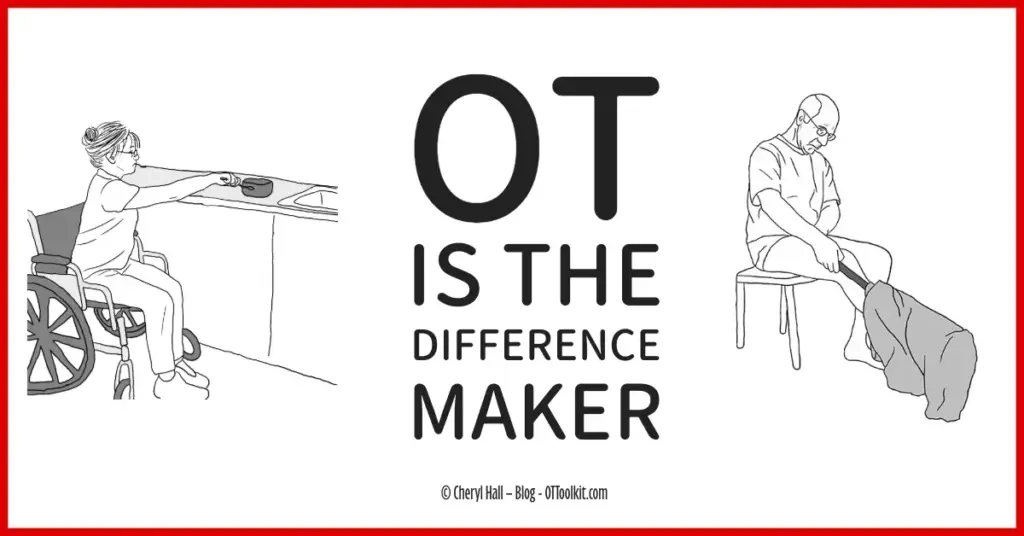
For the profession of occupational therapy, the path forward is clear. It is time to lean into the identity of the "difference maker." When members of the healthcare team are asked what occupational therapy brings to the table, the answer should not be a complex clinical definition, but a series of stories that demonstrate how the profession identifies the gaps in patient care and fills them with functional, creative, and life-changing solutions. OTs are uniquely trained to look at the intersection of a patient’s health, their environment, and their aspirations.
As healthcare systems continue to evolve, the demand for this perspective will only grow. It is incumbent upon the profession to share these experiences, not just as a means of professional advocacy, but as a way of reminding the broader medical community that patient care is not just about the survival of the body, but the quality of the life being lived. The next time a healthcare team requires a reminder of the value of occupational therapy, the best evidence will be the stories of the patients who, because of an OT, were able to laugh, function, and live with renewed independence.