







“I’ve never chopped celery before,” said Sebastian Baez, a 20-year-old student with autism, as he expertly guided a stainless-steel chef’s knife across a wooden cutting board to slice fresh vegetables. “I love using the knife.”
Sebastian is one of 16 participants enrolled at Quest Kids Academy, a specialized school located in Central Florida dedicated to children and young adults with intellectual and developmental disabilities. The high-stakes, hands-on cooking project was designed to look far beyond the traditional classroom setting, merging culinary arts with crucial life skills. The primary objective of the Friendsgiving gathering was to teach students how to follow multi-step recipes, while simultaneously mastering foundational economic concepts such as drafting grocery shopping lists, managing cash, and sticking to strict budgetary limits—all essential tools required to live more independently as adults.
“We’re looking at, how do we get them to understand the value and benefit of money and what that means for them,” explained Lauren Nelson, Quest’s vice president of philanthropy.
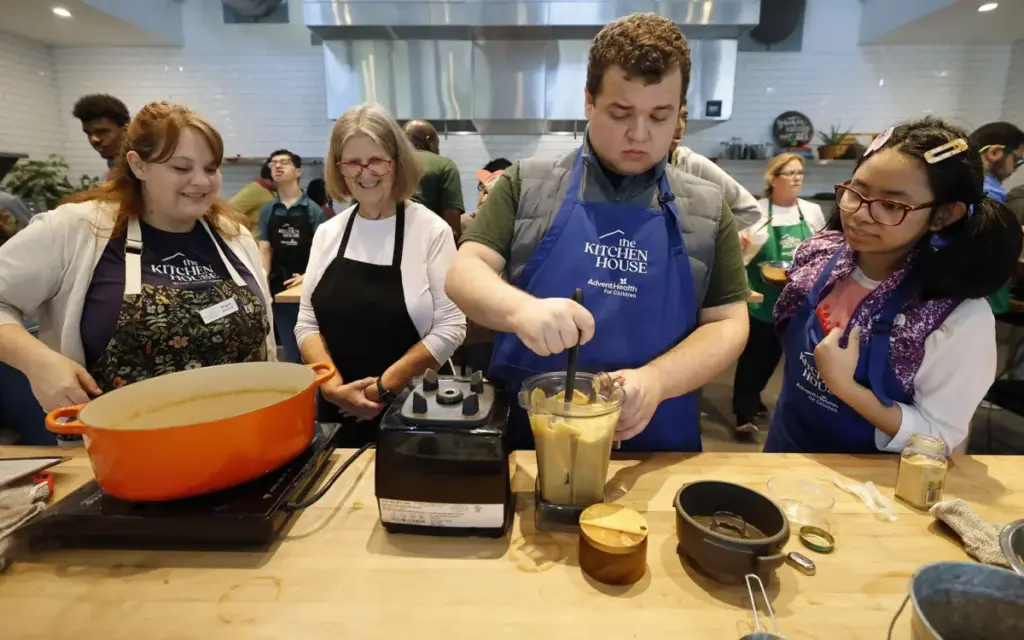
The ambitious program was made possible through a $2,500 grant provided by the FAIRWINDS Foundation, a philanthropic organization focused on helping local families achieve long-term financial stability. The venue for the culinary exercise was the Kitchen House, a specialized community home featuring an industrial-grade kitchen and an expansive teaching garden, which was originally established by the Emeril Lagasse Foundation to promote healthy, plant-forward eating habits among young people.
“We’re really trying to teach people to put more plants on their plate,” noted Sara Elliott, co-executive director of the Kitchen House, pointing to the philosophy behind the facility.
The menu for the afternoon celebration reflected that wholesome approach, featuring a comforting spread of macaroni and cheese made with a creative twist of cauliflower and squash, traditional holiday stuffing, green bean casserole, and freshly baked pumpkin bars topped with a rich, handmade cream.
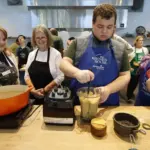
Kristy Chadwich, who leads the culinary curriculum at Quest Kids Academy, organized the students into four distinct working groups to manage the preparation of the four-course meal. To ensure safety and individualized support, each table was assigned a dedicated Kitchen House staff member or volunteer. More advanced students, like Sebastian, tackled tasks requiring precise knife skills, while participants with different comfort levels or physical needs were assigned equally vital roles that did not involve sharp utensils.
Among them was 19-year-old Jeremiah Feliciano, who lives with a physical disability that generally prevents him from standing for extended periods of time. Determined to contribute to the feast, Jeremiah spent a grueling yet rewarding 30 minutes entirely on his feet, vigorously whipping fresh cream to create the final topping for the pumpkin bars.
“After I was done, I couldn’t feel my arm,” Jeremiah said afterward, a wide smile reflecting his immense pride in the achievement. “It makes me feel great.”
Chadwich, who normally carries a portable lawn chair wherever she goes to ensure Jeremiah always has a readily available place to sit, literally jumped with joy as she watched him work. She noted that it was by far the longest she had ever witnessed him remain standing.
“Just knowing what he’s capable of, and that he is able to achieve that, and stand for long periods of time in the kitchen is so great,” Chadwich said, visibly moved by his perseverance.
The practical kitchen experience was the culmination of weeks of preparation. In the weeks leading up to the Friendsgiving event, the students participated in immersive, real-world lessons focused on personal finance and budgeting. Armed with small amounts of cash, they embarked on supervised shopping excursions and trips out to local eateries, where they practiced calculating costs, counting out money, and determining how much they could afford to spend in real time.
The day of the feast actually began with an applied math lesson. Faced with a recipe originally written to serve 100 people, the students sat down together to work out the mathematical equations required to scale the ingredients down for their much smaller group. Before stepping foot into the kitchen workspace, they also took an educational tour of the Kitchen House’s sprawling garden, allowing them to see firsthand where some of the fresh produce they would soon be cooking with was grown.
Madison Seminio, a 17-year-old student with autism, appeared thoroughly absorbed and thrilled while cutting up cauliflower for the holiday macaroni and cheese dish.
“I’m doing good,” Madison said with a wide, bright smile as she focused on the task at hand.
While Madison worked her knife steadily across the cutting board, Erin Hennessy, a youth employment specialist at Quest, observed closely. Hennessy pointed out that the cooking session was imparting lessons that reached far beyond basic culinary arts. The students were actively practicing how to follow complex, multi-step instructions, how to see a task through to its completion, and the critical workplace habit of remaining at their designated station ready to work when it was time to start.
“All the things that you and I do for employment every single day, sometimes these guys need that explicit training on how to start or when to wait,” Hennessy explained, watching the room operate with remarkable autonomy. “Just the fact that they’re all listening to the instructor, and I’m not doing anything is big.”
For 20-year-old Luke Krantz, who lives with autism, the culinary class represents a favorite part of the school week. Luke is naturally quiet and does not speak often, but he possesses a strong grasp of kitchen safety and knife handling. During the meal preparation, he took charge of chopping onions for the holiday stuffing. When his freshly chopped onions hit the hot pot along with sizzling carrots and celery, the rich, savory aroma immediately filled the air. Overcome with joy at the sensory result of his labor, Luke jumped up and down, clapping his hands in celebration.
Once all the dishes were prepared, the students, teachers, volunteers, and staff gathered together around a long, rustic table set up in the garden to share the fruits of their collective labor.
In keeping with the traditions of the holiday, the feast included a moment of reflection where each participant was asked to share one thing they felt deeply grateful for. Along with expressing appreciation for the delicious food they had prepared, the students spoke up to voice their thanks for a diverse array of personal blessings: local Chipotle restaurants, an alligator farm, robots, a beloved stepbrother, swimming pools, their families, and, true to the spirit of Friendsgiving, the strong bonds they share with one another.