









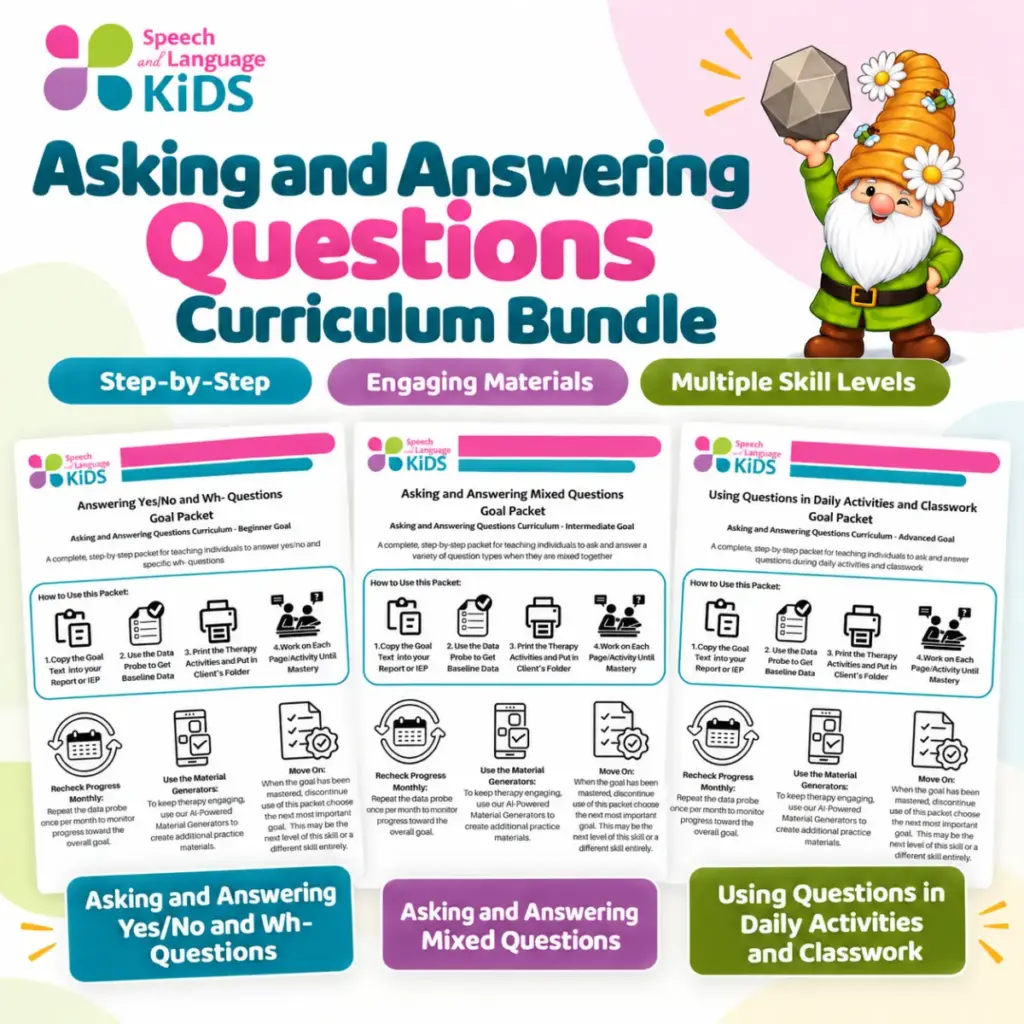
For many children and adolescents, the seemingly simple act of asking and answering questions can become a significant hurdle in their social and academic development. While verbal communication is often viewed as an intuitive process, the cognitive machinery required to parse a question and extract the necessary information is complex. Educators and speech-language professionals are increasingly focusing on a foundational strategy to address this: breaking down the linguistic components of inquiry to build more robust communication skills. By teaching question forms—who, what, where, when, and why—in isolation, therapists and teachers are finding that students can transition from confusion to confidence in both their personal lives and their classroom performance.
The struggle to navigate questions often manifests as a breakdown in the reciprocal nature of conversation. When a child or teen cannot accurately identify what a question is asking for, they may respond with irrelevant information, become frustrated, or withdraw from social interactions altogether. This is not merely a social inconvenience; it can have cascading effects on academic progress. In a classroom setting, a student’s ability to participate is tethered to their capacity to understand the teacher’s inquiries and to pose their own questions when they encounter a deficit in their own understanding.
The prevailing methodology in addressing these challenges centers on the philosophy that communication is a skill set that can be dissected into manageable parts. Rather than overwhelming a student with the entirety of the English interrogative system, the current therapeutic approach advocates for a slow, deliberate focus on individual question forms. By introducing these words one at a time, practitioners help the learner establish a mental framework where specific question words are tethered to specific categories of information.
For instance, when a student is taught that the word "who" is a signal to search for a person, or that "where" is a cue to look for a location, the abstract nature of language becomes more concrete. This foundational work is essential because it shifts the burden of communication from a guessing game to a systematic process of categorization. When the student understands the underlying structure of a question, they are no longer just listening for sounds; they are actively searching for a specific type of data that the question requires.
This process of compartmentalization serves as a scaffolding mechanism. Once the student has achieved a degree of proficiency with one question type, they can then integrate another. This incremental expansion allows the student to build a repertoire of communication tools without becoming bogged down by the cognitive load of trying to master multiple linguistic functions at once. As the student gains clarity on what each question word signifies, the anxiety often associated with being "put on the spot" in a classroom or social environment begins to dissipate.
The impact of this approach extends well beyond the therapy room. In daily interactions, children and teens who have mastered these foundational concepts are better equipped to advocate for their needs and participate in meaningful dialogue. Whether it is asking a peer for clarification on a game or responding to a parent’s inquiry about their day, the ability to decode and formulate questions is the bedrock of social competence. The goal is to move the student from a state of passive listening to active, purposeful engagement.
In the academic sphere, the benefits are equally profound. Teachers often report that students who struggle with question-asking are also those who find it most difficult to follow complex instructions or participate in critical discussions. By mastering the ability to identify the information being requested, students become more effective learners. They are better able to navigate the demands of written tests, class discussions, and individual projects, as they are no longer misinterpreting the core of the questions presented to them.
Therapeutic sessions designed around this strategy are characterized by a focus on functional application. A therapist working with a child or teen in this capacity will typically create an environment where these question forms can be practiced in a safe, controlled setting before they are applied in more challenging, real-world contexts. The walkthrough of such a session often highlights the importance of consistency and repetition. By modeling how to listen for the question word, identify the requested information, and formulate a relevant answer, the practitioner provides a blueprint that the student can mirror.
The process of guiding a student through this development requires patience and keen observation. The professional must be able to gauge when a student has mastered one form and is ready to progress to the next. If a student is introduced to "who" and "where" simultaneously, the lines may blur, leading to the very confusion the intervention aims to eliminate. Therefore, the pace is dictated by the student’s success in recognizing the distinct function of each word.
As the intervention progresses, the therapy often shifts from teacher-led prompts to student-initiated questioning. This is a critical milestone, as it indicates that the student is beginning to use these tools independently to navigate their environment. When a child starts asking "where" to find an item or "why" something is happening, they are demonstrating a move toward autonomy. They have transitioned from being a responder to a participant in the exchange of information.
The nuance of this work lies in recognizing that not every student learns in the same way. While the systematic approach of teaching one form at a time is the core, the execution must be tailored to the individual’s developmental level and communication style. For a younger child, this might involve the use of visual aids or play-based scenarios, while an adolescent might benefit from more abstract discussions or role-playing realistic social or academic situations. The common thread remains the dedication to the principle that once the individual understands the relationship between the question word and the information requested, the barrier to communication is significantly lowered.
Ultimately, the goal of this therapeutic strategy is to foster an environment where children and teens can express their thoughts and curiosity without the constraints imposed by a lack of clarity in questioning. By breaking down the complex structure of language into its most basic, identifiable components, professionals are helping students to bridge the gap between their internal understanding and their ability to externalize that knowledge. As these students gain a firmer grasp on the mechanics of asking and answering, they are better prepared to handle the multifaceted demands of communication, ultimately leading to greater success in both their personal development and their future academic and social endeavors. The methodology serves as a reminder that the most sophisticated communication skills are built upon the most basic foundations, and that with the right approach, even the most challenging obstacles to interaction can be overcome.