








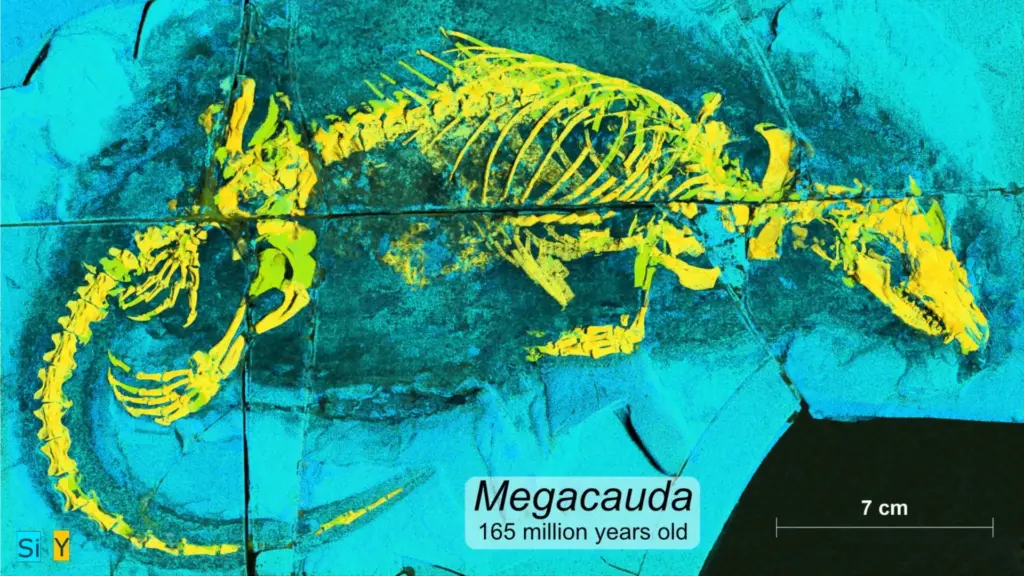
A remarkable fossil discovery from the heart of Inner Mongolia is providing scientists with a rare, transformative glimpse into the origins of mammalian physiology. The creature, a 165-million-year-old predator known as Megacauda sungei, was a furry, water-dwelling hunter that lived alongside the dinosaurs of the Jurassic Period. Measuring approximately half a meter—or 20 inches—from its nose to the tip of its broad, flattened tail, Megacauda was a "giant" among its contemporaries, most of which were tiny, shrew-like creatures weighing only a few grams.
The findings, published in the prestigious journal Nature, are the result of an extensive international collaboration between paleontologists from the Paleontological Museum of Liaoning in Shenyang, the University of Chicago, and the University of Bonn. While the animal’s aquatic adaptations are a significant discovery in their own right, the true scientific breakthrough lies in its internal anatomy. Researchers have uncovered evidence of a sophisticated soft palate—a structure that separates the mouth from the pharynx—dating back millions of years earlier than previously thought in the mammalian lineage.
How an Ancient Predator Reveals the Evolution of Swallowing
The development of the soft palate is not merely a anatomical curiosity; it is a fundamental evolutionary milestone that defines the success of modern mammals. Most non-mammalian vertebrates lack this complex soft tissue structure, relying instead on a relatively simple arrangement of hyoid bones in the throat to manage the passage of food. Without a soft palate, these animals often face significant mechanical challenges when it comes to eating and breathing.

To visualize the difference, one need only look at the crocodile. When a crocodile captures prey, it must often manipulate the food using gravity, tilting its head back and utilizing sudden, jerking motions to force unchewed chunks down its throat. "This is achieved with the aid of gravity," explains Prof. Dr. Thomas Martin, a leading paleontologist from the University of Bonn. In contrast, the mammalian throat is a marvel of biological engineering. Our more elaborate hyoid structure, combined with the soft palate, decouples the respiratory tract from the digestive tract. This allows mammals to swallow—or even drink through a straw—while their heads are positioned in any orientation, even upside down, without the risk of choking or inhaling fluid.
This physiological innovation was not just about convenience; it was a prerequisite for the survival of the mammalian line. By preventing liquids from entering the nasal passages during feeding, the soft palate allowed young mammals to nurse effectively. Access to nutrient-rich milk provided a survival advantage that allowed for rapid growth and, eventually, the sustained energy required for the development of larger, more complex brains. As Professor Martin notes, "It was this adaptation that made brain development, eventually leading to humans, possible. The soft palate and the shaping of the oral cavity and pharynx are directly linked to the evolution of mammals." Finding this complex structure in Megacauda sungei reveals that these foundational traits were already in place long before the rise of modern mammals, forcing researchers to recalibrate the timeline of evolutionary development.
A 165-Million-Year-Old Predator Built for Swimming
Beyond its internal anatomy, Megacauda sungei was an evolutionary pioneer in terms of its lifestyle. With its dense fur, streamlined body, and a broad, flattened tail, the creature would have borne a striking resemblance to a modern-day otter, beaver, or platypus. To understand exactly how it moved through the Jurassic waterways, the research team utilized high-resolution computed tomography (CT) scans. By building detailed three-dimensional reconstructions of the skeleton, scientists were able to model the animal’s range of motion and muscle attachments.
The models suggest that Megacauda was a highly efficient swimmer. It likely propelled itself through the water by paddling with its muscular front legs, while its powerful, flattened tail provided both thrust and stability through an undulating, side-to-side motion. Its hind legs were likely used for steering and maneuvering in the water, allowing it to navigate the complex environments of the Jurassic landscape. "It is the earliest evidence of an aquatic lifestyle in mammals," says Professor Martin, highlighting the significance of this adaptation.
The creature’s dentition further confirms its role as a specialized aquatic predator. Its teeth featured backward-curving cusps, a classic evolutionary design for gripping slippery, aquatic prey like fish or amphibians. Perhaps most surprisingly, the team discovered that Megacauda possessed specialized canine teeth with three roots—a distinct feature that caught the researchers off guard and provided a critical clue to its taxonomic placement. Through rigorous comparison with other prehistoric specimens and living species, the team concluded that Megacauda belonged to the docodonts, an extinct group of mammaliaforms that were widespread during the Jurassic Period.
A Tiny Giant in the Age of Dinosaurs
In the shadow of the colossal dinosaurs that dominated the Mesozoic Era, the "mammaliaforms"—the group that includes the ancestors of modern mammals—are often portrayed as small, timid creatures that occupied only the margins of the ecosystem. Megacauda sungei challenges this narrative. Weighing approximately two kilograms (about 4.4 pounds), it was a formidable presence compared to its peers.
The Mesozoic Era, spanning from 230 million to 66 million years ago, was undoubtedly the age of the dinosaur. However, the discovery of Megacauda serves as a reminder that the early ancestors of mammals were already experimenting with diverse survival strategies. While many of their cousins remained small, scurrying through the underbrush, Megacauda had already claimed a specialized niche as an aquatic top predator. It was a heavyweight in a world of miniatures, demonstrating that early mammals were far more ecologically diverse than once assumed.
An Extraordinary Fossil Discovery in Inner Mongolia
The story of how this fossil came to light is one of patience and collaboration. The specimen was unearthed in Xiayingzi, Inner Mongolia, and eventually found its way into the collection of the Paleontological Museum of Liaoning in Shenyang. For years, the fossil sat in the museum’s archives until the combined expertise of Prof. Dr. Chang-Fu Zhou of Shandong University, Prof. Dr. Zhe-Xi Luo of the University of Chicago, and Prof. Dr. Thomas Martin of the University of Bonn brought it to the light of modern science.
Recognizing the specimen as a previously unknown species, the team decided to honor Prof. Sun Ge, the Honorary Director of the Paleontological Museum of Liaoning, by naming the species sungei. Combined with Megacauda, which translates to "large tail," the scientific name serves as a permanent tribute to both the anatomy of the animal and the researchers who facilitated its discovery.
Years of painstaking work went into the classification and analysis of the fossil. The process involved more than just visual inspection; it required the careful, multi-year documentation of bone structure, dental patterns, and comparative studies across global fossil databases. "It is the result of a long period of teamwork," Professor Martin emphasizes.
This research has significantly altered our understanding of how early mammals adapted to their environments. Other fossils from the docodont group have shown that these animals were incredibly versatile; some were specialized for tree-dwelling, while others were expert burrowers, similar to modern moles. Megacauda sungei adds the aquatic dimension to this list. Collectively, these discoveries reveal that long before the extinction of the dinosaurs allowed mammals to diversify into the modern forms we recognize today, their ancient relatives were already testing the limits of biology, successfully occupying land, air, and water through innovative anatomical adaptations. The story of Megacauda sungei is not just the story of one animal, but a testament to the early, rapid evolution of the mammalian lineage.