


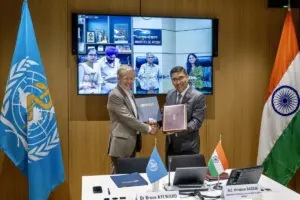



Ahead of the Seventy-seventh World Health Assembly, a pivotal gathering of global health leaders, the Qatar Fund for Development (QFFD) and the World Health Organization (WHO) have formalized a new strategic partnership. The two organizations have signed a Core Contribution Agreement, marking a significant financial and collaborative commitment to support the implementation of the WHO’s extended Thirteenth General Programme of Work (GPW13). This agreement, which involves a contribution of US$ 4 million from the State of Qatar through QFFD, is designed to bolster the Organization’s capacity to address the most pressing health challenges currently facing the international community.
The timing of this announcement is deliberate, arriving as the global health community prepares for the Seventy-seventh World Health Assembly. This annual assembly serves as the supreme decision-making body for the WHO, where delegations from member states convene to set policy, review progress, and address the evolving landscape of public health. By securing this funding, the WHO gains critical resources that will allow it to operate with greater agility as it tackles the complex, multifaceted health crises that continue to emerge across various regions.
For the State of Qatar, this contribution is the latest in a series of international efforts aimed at strengthening global healthcare infrastructure. The partnership highlights Qatar’s long-standing dedication to improving health outcomes and fostering sustainable development, reflecting a broader foreign policy strategy that prioritizes humanitarian aid and global stability. Through the QFFD, Qatar has consistently sought to provide essential resources to regions where healthcare systems are fragile, and this latest agreement with the WHO serves to amplify those efforts on a global scale.
“Our partnership with WHO is a testament to our dedication to leaving no one behind in the pursuit of health equity worldwide,” stated Mr. Sultan Ahmed Al-Aseeri, Acting Director-General of QFFD. “By supporting WHO, we aim to empower communities, enhance healthcare access, and contribute to a healthier future for all.”
Mr. Al-Aseeri’s comments underscore a core pillar of the QFFD’s mission: the belief that health is a fundamental human right that transcends borders. By channeling funds through the WHO, the QFFD ensures that its contributions are leveraged within a global framework that is equipped to deploy resources where they are most urgently needed. This collaborative model is particularly significant given the current state of global health, where inequalities in healthcare access continue to exacerbate the vulnerability of marginalized populations.
The flexibility of these funds is a major component of the agreement, a point that WHO Director-General Dr. Tedros Adhanom Ghebreyesus emphasized during the signing. In the context of humanitarian aid, “flexible funding” refers to contributions that are not earmarked for specific, narrow projects, but are instead available for the WHO to allocate according to shifting global priorities. This flexibility is essential for responding to sudden disease outbreaks, natural disasters, or the collapse of healthcare systems in conflict zones, where the ability to mobilize resources quickly can be the difference between life and death.
“Flexible funds are critical for WHO’s life-saving work,” said Dr. Tedros. “With thanks to long-standing partners like the Qatar Fund for Development, WHO can use these funds to swiftly respond to global health needs as they arise. I am grateful to the State of Qatar for their support and for allowing us the flexibility we need to carry out our mission and mandate.”
The financial support is directly tied to the WHO’s Thirteenth General Programme of Work (GPW13), which serves as the organization’s strategic roadmap. The programme is intentionally broad, encompassing a wide spectrum of health issues including the prevention and management of both communicable and non-communicable diseases. Furthermore, it focuses on the fundamental strengthening of national health systems, ensuring that countries have the institutional capacity to manage their own healthcare challenges over the long term.
A key aspect of this extended programme is its focus on the "life course" approach. This perspective acknowledges that health needs change as individuals move from childhood to adolescence, adulthood, and old age. By integrating this perspective into its strategic planning, the WHO aims to create resilient health systems that can provide continuous, high-quality care throughout every stage of human life. This is particularly important in resource-limited settings, where the absence of comprehensive health services often results in poor outcomes for vulnerable groups, such as mothers, children, and the elderly.
Furthermore, the collaboration will place a specific emphasis on supporting nations currently grappling with crisis and post-crisis situations. Whether due to armed conflict, political instability, or environmental disasters, countries in these situations often see their healthcare infrastructure decimated. The QFFD’s contribution will enable the WHO to intervene in these high-risk areas, providing the necessary support to rebuild services, manage outbreaks, and maintain the continuity of essential medical care. This focus aligns perfectly with the QFFD’s organizational mission, which prioritizes providing aid in regions where human suffering is most acute and the need for external intervention is most pressing.
The broader implications of this partnership extend beyond the immediate $4 million contribution. By demonstrating a model of sustained cooperation between a national development agency and a multilateral health organization, QFFD and the WHO are setting a standard for how international actors can collaborate to solve complex problems. In an era where geopolitical tensions can often hinder international cooperation, this agreement serves as a reminder of the potential for shared goals—specifically, the goal of achieving universal health coverage—to bring nations and organizations together.
As the international community looks toward the future, the challenges of global health are becoming increasingly interconnected. Climate change, the risk of future pandemics, and the rise of non-communicable diseases like diabetes and cardiovascular conditions require a coordinated global response that no single nation can manage on its own. Partnerships like the one between the Qatar Fund for Development and the WHO represent a beacon of hope in this context. They provide not just the financial fuel required to run operations, but also the diplomatic and strategic momentum needed to keep health high on the global political agenda.
The agreement also serves as a reflection of the evolving role of the QFFD on the world stage. Over the past decade, the organization has moved from a primarily regional actor to a significant player in international development. By aligning itself with the technical expertise and global reach of the WHO, the QFFD is ensuring that its contributions are backed by evidence-based policies and rigorous implementation standards. This ensures that every dollar contributed is used to maximum effect, whether that involves vaccinating children in a remote village, training healthcare workers in a post-conflict zone, or strengthening the disease surveillance systems of a developing nation.
Ultimately, the partnership between the Qatar Fund for Development and the World Health Organization is a strategic investment in global stability. Health is not merely a matter of medicine; it is an economic and social driver that determines the stability of communities and nations. By investing in the WHO’s GPW13, the State of Qatar is investing in the collective health of the global population, recognizing that in an interconnected world, the health of one is inextricably linked to the health of all. As the Seventy-seventh World Health Assembly convenes, this agreement stands as a clear signal of the importance of solidarity, agility, and shared commitment in the ongoing pursuit of a healthier, more resilient world.