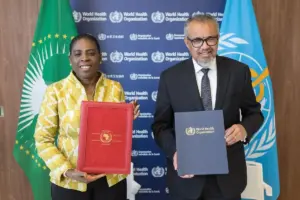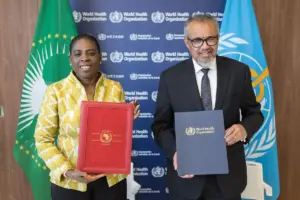




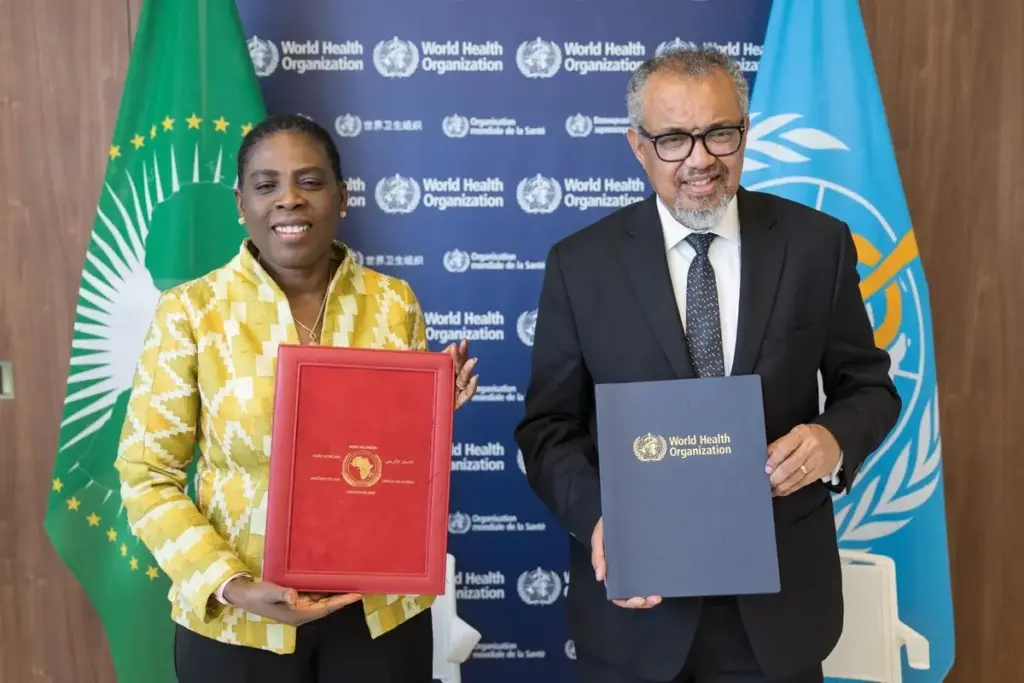
GENEVA — In a decisive move to fortify the continent’s health architecture against unprecedented financial headwinds, the World Health Organization (WHO) and the African Union (AU) Commission have officially renewed their longstanding strategic partnership. The formal signing of an updated Memorandum of Understanding (MoU) took place against the backdrop of the 78th World Health Assembly in Geneva, marking a pivotal moment for bilateral cooperation in global health governance.
This renewed agreement powerfully reaffirms a joint, unwavering commitment to advancing health security, universal health coverage (UHC), and sustainable development across the entire African continent. At a time when the global health landscape faces severe financial challenges, the pact underscores the critical leadership of the African Union in fostering collective action, driving inclusive partnerships, and building enduring regional resilience. Furthermore, the agreement firmly positions the Department of Health, Humanitarian Affairs, and Social Development of the AU Commission at the absolute heart of the continent’s health policy implementation efforts.
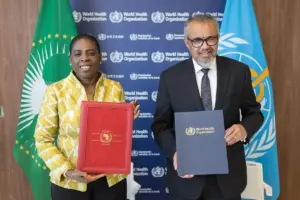
The landmark agreement was formally signed by Her Excellency Ambassador Amma Adomaa Twum-Amoah, Commissioner for Health, Humanitarian Affairs and Social Development, acting on behalf of His Excellency Mahmoud Ali Youssouf, Chairperson of the African Union Commission. Signing on behalf of the global health body was Dr Tedros Adhanom Ghebreyesus, Director-General of the World Health Organization. Together, their signatures cement a defining moment dedicated to bolstering primary health care and expanding universal health coverage for millions of citizens across Africa.
During the signing ceremony, Commissioner Twum-Amoah spoke extensively about the profound strategic importance of the renewed agreement and the indispensable leadership role the African Union continues to play in shaping the trajectory of Africa’s health landscape. She observed that the updated pact establishes a brand-new chapter in the ongoing cooperation between the continental body and the global health agency, noting that closer collaboration will dramatically enhance their collective ability to respond swiftly and effectively to the evolving health needs of diverse populations while ensuring that no vulnerable community is left behind.
The Commissioner stressed that the African Union deeply values the central and leading role that the WHO plays within the broader sphere of global health. She expressed eager anticipation for deepening this strategic partnership to successfully achieve their mutually shared goals. Emphasizing the urgent need for a fundamental paradigm shift in how continental health systems are financed, Commissioner Twum-Amoah delivered a powerful message regarding long-term financial independence, asserting that leaders must move away from simply budgeting for immediate survival and instead begin aggressively planning for true health sovereignty.
Building directly upon the solid foundation established by the previous 2019 Memorandum of Understanding, this newly updated agreement significantly streamlines and strengthens coordination across all relevant AU entities. It meticulously aligns disparate efforts to fully support Africa’s paramount health priorities, thereby setting the stage for an unprecedented level of enhanced cooperation between the WHO and the African Union. Crucially, the agreement also reaffirms the WHO’s vital central technical and normative leadership role in both global and regional health arenas, while solidifying the organization’s steadfast commitment to supporting the AU and its specialized institutions in successfully realizing the health-related Sustainable Development Goals.
The timing of this renewed diplomatic and operational accord could not be more critical, arriving as traditional funding models experience severe strain. Dr Tedros Adhanom Ghebreyesus highlighted the urgency of the moment, pointing out that recent cuts to bilateral aid have directly imperiled the health and well-being of millions of people across Africa. He noted that the renewed agreement clearly reflects a shared, unwavering determination to translate high-level diplomatic partnerships into tangible, life-changing results for the people of Africa, actively supporting individual nations as they leave behind an era of historical aid dependency and transition securely toward sustainable self-reliance. Expressing profound pride in the alliance, the WHO Director-General affirmed that the organization stands shoulder-to-shoulder with the African Union to drive forward the critical health priorities of the continent.
The comprehensive Memorandum outlines five key areas of collaboration designed to address systemic vulnerabilities and foster robust, self-sustaining health infrastructures across member states. This framework arrives at a time of heightened geopolitical and economic significance for the continent. The timing of the renewed agreement closely mirrors the African Union’s recently elevated voice in global health governance—a diplomatic standing significantly bolstered by its historic G20 membership—and serves to highlight the WHO’s ongoing, indispensable role as a trusted technical and operational partner to governments throughout the region.
Ultimately, the renewed MoU introduces fresh momentum for regional and multilateral cooperation aimed directly at tackling Africa’s most pressing and complex health challenges. By uniting institutional strengths and resources, the WHO and the AU Commission are uniquely positioned to deliver meaningful, lasting results that will reverberate across the African continent for generations to come.
For further information regarding the renewed partnership and ongoing collaborative initiatives, media and interested stakeholders may contact Professor Julio Rakotonirina, Director of the Department of Health, Humanitarian Affairs and Social Development at the African Union Commission via email at [email protected], or Ms Stéphanie Seydoux, Director and Director-General Envoy for Multilateral Affairs at the World Health Organization via email at [email protected]. Additional media inquiries can also be directed to the WHO Media Team or Mr King David Cartey of the African Union Commission.