








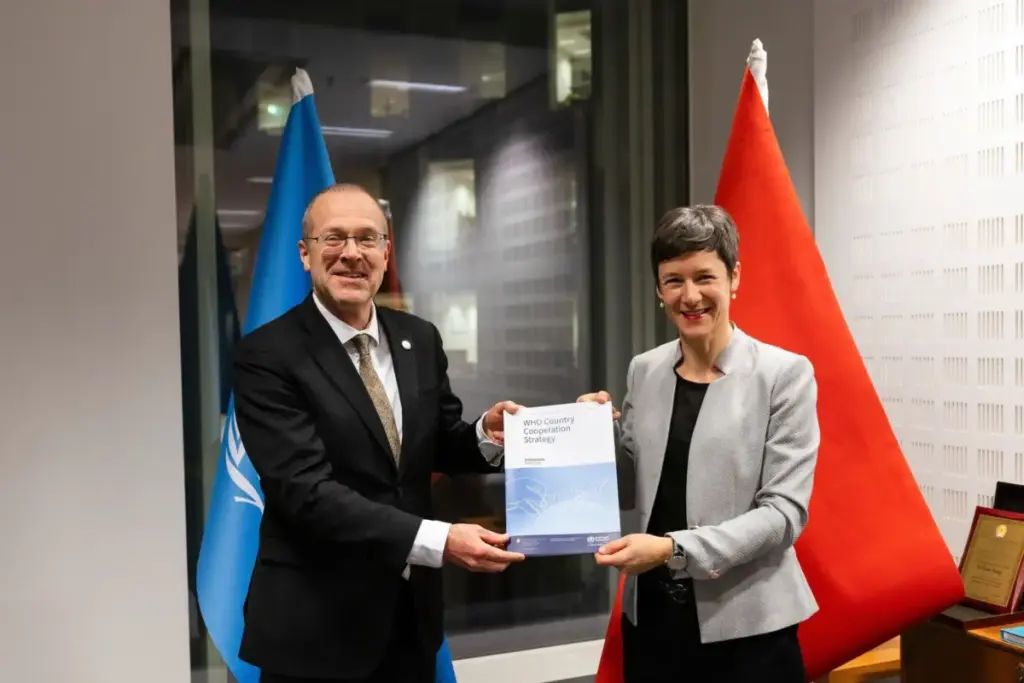
COPENHAGEN, Denmark — In a significant reaffirmation of their enduring alliance in public health, the World Health Organization (WHO) and Switzerland have officially announced the renewal of their strategic cooperation framework. The updated agreement, covering the period from 2024 to 2028, was formally finalized and signed during a high-level meeting held on March 4, 2025, at the Regional Office of the WHO in Copenhagen, Denmark.
This latest development builds upon a pioneering history of collaboration between the global health body and the Swiss Confederation. More than a decade ago, in 2013, Switzerland made history by becoming the very first high-income country within the WHO European Region to pilot a structured country cooperation strategy with the organization. That initial framework laid the groundwork for a robust, dynamic partnership designed to address complex health challenges both domestically within Switzerland and across the wider European region and beyond.
Recognizing the evolving landscape of global public health—particularly in the wake of unprecedented global health emergencies and systemic shifts over recent years—WHO and Switzerland jointly decided in 2022 to update, modernize, and renew their strategic agreement. The culmination of this thorough review process led to the official signing ceremony in Copenhagen, where key leaders from both institutions met to chart the course for the remainder of the 2024–2028 strategic cycle.

The formalization of the renewed strategy was underscored by a meeting between prominent leaders representing both parties. Barbara Schedler, Ambassador for Global Health at the Swiss Federal Office of Public Health, and Dr. Hans Henri P. Kluge, WHO Regional Director for Europe, came together in the Danish capital to formally agree on the strategic priorities and the way forward for closer, more effective collaboration. Their discussions focused on aligning Swiss expertise and resources with the strategic objectives of the WHO European Region, ensuring that both entities can respond dynamically to emerging health threats, strengthen health systems, and promote universal health coverage.

The newly minted WHO–Switzerland Country Cooperation Strategy for 2024–2028 serves as a comprehensive roadmap guiding joint initiatives, technical cooperation, and policy dialogue over the four-year period. Stakeholders, public health professionals, and interested members of the public are encouraged to visit the official WHO/Europe website to read the full news release and access the complete publication detailing the strategic priorities, milestones, and operational mechanisms outlined in the cooperation document.
Beyond the broad framework of the country cooperation strategy, the partnership between Switzerland and the WHO encompasses several critical, high-impact initiatives of global significance. Among these is the ongoing collaboration centered on the global BioHub system. In mid-2024, specifically on June 13, WHO and Switzerland took notable steps to further strengthen their partnership regarding this vital global infrastructure. The global BioHub system plays a crucial role in enhancing global health security by facilitating the rapid, safe, and transparent sharing of biological materials, including novel pathogens with epidemic and pandemic potential, among Member States and a network of qualified laboratories worldwide. This collaboration underscores Switzerland’s steadfast commitment to multilateralism and global health preparedness, leveraging Swiss scientific and infrastructural capabilities to support the WHO’s mission of protecting populations from infectious disease threats.
The relationship between Switzerland and the WHO has long been characterized by a deep-seated commitment to international solidarity and technical excellence. As host to WHO headquarters in Geneva, Switzerland maintains a unique and pivotal position within the global health architecture. The ongoing refinement of bilateral strategies, such as the 2024–2028 cooperation framework, demonstrates a shared vision for addressing contemporary public health priorities, ranging from non-communicable diseases and health workforce strengthening to emergency preparedness and digital health innovation.
With the 2024–2028 strategy now formally in effect following the March 2025 signing in Copenhagen, both organizations are poised to deepen their operational synergy. The implementation of the strategy will be closely monitored by representatives from the WHO Regional Office for Europe and the Swiss Federal Office of Public Health, ensuring that joint efforts yield measurable improvements in health outcomes and contribute significantly to the health and well-being of populations across the European region and globally.