



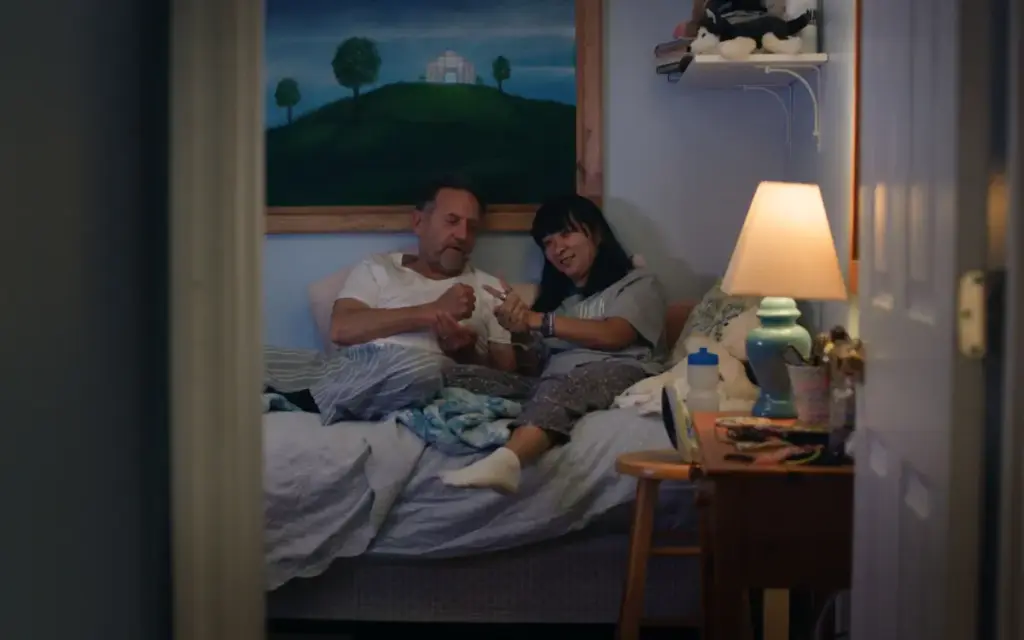
ORLANDO, Fla. — Many cinematic works draw inspiration from a filmmaker’s personal life, but few offer a glimpse quite as intimate, unvarnished, and deeply lived-in as Liz Sargent’s feature debut, “Take Me Home.”
For Sargent, who grew up as one of seven children adopted by her parents alongside four biological children, the narrative feature-length film presents a poignant, deeply personal look at the realities of caregiving, developmental disabilities, the systemic complexities of the American medical framework, and the intricate dynamics of family life in suburban Florida.
What makes the project uniquely striking is its grounding in undeniable truth. The movie is set directly in the family’s real East Orlando home and stars the filmmaker’s own sister, 37-year-old Anna Sargent, who has cognitive disabilities. While professional actors step into the roles of Liz’s parents, Bob (portrayed by Victor Slezak) and Joan (portrayed by Marceline Hugot), as well as her sister Emily (portrayed by Ali Ahn), the fictionalized narrative remains intimately tethered to the genuine lived experiences Liz shared with her sister while growing up.

Reflecting on the emotional catalysts that drove her to write the story, Liz Sargent recalls a specific period in her early adulthood when the weight of the future became overwhelming.
“There was a time in my 20s where I just felt this extreme anxiety about what the future held for my family, for my parents, and for my youngest sister — but also where I belonged with my own hopes and dreams and goals,” Liz Sargent said. “I was drowning in the medical system trying to fight for my sister who has mental illness and getting her health care, and finding guardianship for Anna, and thinking about my parents aging out of their role as caregivers… It became this film of capturing that moment and talking about how we make those decisions and what’s available in this country.”
The decision to film in Florida was far from arbitrary; it was an intentional choice born of a desire to capture the exact environment that forged the family’s identity and resilience. Shooting in the peak of summer added logistical hurdles, but it also provided the precise aesthetic and atmospheric texture the director wanted.
“We shot in August. It’s the worst. It’s the hottest. But the downpours are sort of magical in a way,” Liz Sargent said. “Suddenly it disappears, and there’s this beautiful light that shines through, and everything’s glowing around it from the water. I feel like there’s something about that Florida that I wanted to capture, like this is the American dream. There’s also the harshness of the environment and these people trying to survive within it.”
The journey of “Take Me Home” from a localized vision to an acclaimed cinematic release has been swift and remarkable. The project began as a 16-minute short film that earned a coveted premiere at the prestigious Sundance Film Festival in 2023. Following screenings at dozens of film festivals across the country, including the Florida Film Festival, Sargent secured a major milestone when she was awarded a $1 million production grant through the Tribeca Film Festival and AT&T Untold Stories.
Within a single year, the short film blossomed into a fully realized, 90-minute feature-length story. It made its triumphant return to the Sundance Film Festival in January, earning Sargent a screenwriting award. From there, the film embarked on a high-profile festival run, securing an international premiere at the Berlin Film Festival and a New York premiere at Tribeca. The theatrical rollout is now well underway, with “Take Me Home” opening in theaters in New York City on a Wednesday and slated for a Los Angeles release on September 30.
In the feature-length film, the plot follows Anna as she is forced to learn how to navigate the world independently, manage her evolving relationship with her sister, and cope with her father’s advancing memory loss, all set against the profound grief of losing her mother.
Achieving this authentic portrayal on screen required a specialized, supportive production environment. On set, the filmmakers integrated a disability producer, a dedicated acting coach, and an improvisational approach tailored to help Anna Sargent thrive. This crucial infrastructure was supported in part by Caring Across Generations, a national advocacy organization dedicated to shifting cultural narratives and public policies around caregiving to make vital support systems more accessible to families.
“We were able to provide some grant funding to the film in order to make sure she had a caregiver, an accessibility producer that trained everybody else to work with Anna in the way that she needed to be worked with, and also an acting coach to really work in a personalized way to help Anna prepare for all of her scenes,” said Lydia Storie, an executive producer on the film and director of culture change for Caring Across Generations. “Having that in place allowed for her to deliver an award-winning performance.”
As “Take Me Home” continues to expand its reach and connect with wider audiences, Sargent has discovered just how universal its underlying themes truly are. Her story resonates deeply with the estimated 130 million people across the United States who currently find themselves navigating the demands of caregiving roles. This resonance was acutely felt during a special screening at Bonnet Springs Park in Lakeland—the very location where the film’s moving final scenes are set—where Sargent’s parents viewed the completed film for the very first time.
“I think it was very moving for them to get to be in an audience with people and understand that their personal struggles, like the intimate details that I’m sharing about our lives, are normalized. There’s a vulnerability that we all have,” Liz Sargent said. “It was beautiful to see people come up to them afterward and talk to them about their own care stories.”
While the middle section of the film confronts the heavy tensions born of financial instability and deep uncertainty about the future, its final act pivots toward hope, illustrating what life could realistically look like for individuals who require care and a secure place to belong.
“It is possible to create a world where we can all thrive and have our needs met. What I want is for people to identify and fall in love with Anna. I think that kind of love and protection is what’s going to change the way we vote and interact in this world,” Liz Sargent said.
Storie echoed that sentiment, emphasizing the broader societal implications of the film’s message.
“When I watch this film through to the end, I see this vision of what can be when we recognize that all of us deserve better,” Storie said. “A more supportive and inclusive future will be better for all of us.”