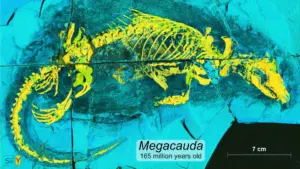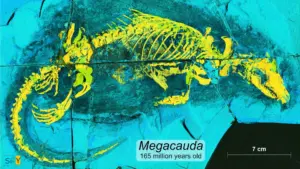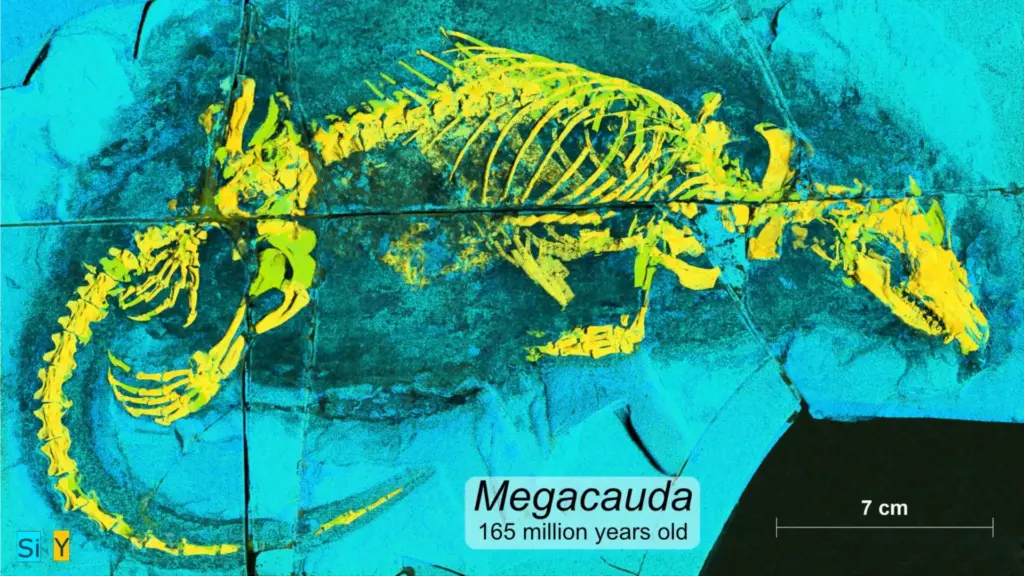
A 165-million-year-old fossil unearthed in the remote regions of Inner Mongolia is providing scientists with a profound look into the deep evolutionary history of mammals. The creature, a furry, otter-like predator named Megacauda sungei, has emerged as a centerpiece for understanding how early mammalian ancestors successfully navigated a world dominated by dinosaurs. Despite measuring only half a meter (20 inches) from nose to tail, this ancient hunter was a heavyweight among its Jurassic contemporaries, offering researchers an unprecedented look at the anatomical innovations that would eventually pave the way for modern mammals.
The discovery, detailed in the journal Nature, is the result of a collaborative international effort involving researchers from the Paleontological Museum of Liaoning in Shenyang, the University of Chicago, and the University of Bonn. By utilizing advanced computed tomography (CT) scans to create high-resolution three-dimensional reconstructions of the fossil, the team was able to peer inside the creature’s anatomy, revealing a sophisticated physiological trait that suggests mammals were evolving toward complex life functions far earlier than previously assumed.
An Anatomical Breakthrough in the Age of Dinosaurs
The most striking feature of Megacauda sungei is not its size, but the presence of a well-developed soft palate. In evolutionary biology, the soft palate acts as a crucial muscular partition that separates the oral cavity from the pharynx—the passage that connects the mouth to the throat. This anatomical milestone is far more than a mere structural detail; it is the fundamental mechanism that allows an animal to swallow food while simultaneously breathing.

For many non-mammalian vertebrates, this is a significant challenge. Crocodiles, for instance, lack a soft palate and must rely on gravity and awkward, jerking head motions to force unchewed prey down their throats. As Prof. Dr. Thomas Martin of the University of Bonn explains, this reliance on gravity creates a rigid constraint on how and where an animal can feed. In contrast, the mammalian hyoid structure, supported by the soft palate, allows for complex muscle coordination. Humans, for example, can drink through a straw while hanging upside down—a feat made possible by the very evolutionary architecture found in this Jurassic predator.
The implications of this discovery are far-reaching. The ability to swallow without interrupting airflow is an essential adaptation for nursing. By preventing liquid from entering the nasal passages during feeding, the soft palate allowed for the efficient consumption of nutrient-rich milk, providing a massive survival advantage for the young of the species. Prof. Martin emphasizes that this specific adaptation was a cornerstone for future biological progress: "It was this adaptation that made brain development, eventually leading to humans, possible. The soft palate and the shaping of the oral cavity and pharynx are directly linked to the evolution of mammals." Finding evidence of this feature in Megacauda sungei—a creature that lived millions of years before the modern mammal radiation—indicates that these complex traits were being "tested" by evolution much earlier than experts had hypothesized.
A Predator Built for Aquatic Life
With its short, dense fur and a broad, flattened tail, Megacauda sungei would have been an unmistakable presence in the Jurassic wetlands, bearing a striking resemblance to a modern otter, beaver, or platypus. Its physical build, confirmed by the team’s three-dimensional reconstructions, suggests a lifestyle perfectly calibrated for an aquatic environment.
The fossil analysis indicates that Megacauda sungei likely propelled itself through the water using a rhythmic, undulating motion of its tail, supplemented by paddling with its front legs. Its hind legs, meanwhile, functioned as steering mechanisms, allowing for the precise maneuvering required to hunt elusive, slippery prey. This makes the species the earliest known example of an aquatic lifestyle in the mammaliaform lineage.
Further evidence of its specialized diet is written in its teeth. The predator was equipped with backward-curving cusps designed specifically to grip aquatic prey. Perhaps most surprising to the researchers were the canine teeth, which featured three roots—a distinct, complex configuration that separates this species from many of its contemporaries. By comparing the fossil to both prehistoric specimens and modern living animals, the research team identified the creature as a member of the docodonts, a group of mammaliaforms that were widespread across the Northern Hemisphere during the Jurassic period.
A Heavyweight in a World of Dinosaurs
While the term "top predator" might conjure images of massive theropods, Megacauda sungei must be viewed through the lens of the Mesozoic era. Weighing approximately two kilograms (4.4 pounds) and measuring half a meter in length, this creature was indeed a "tiny giant." In a world dominated by dinosaurs, where the vast majority of mammal relatives were small, mouse-sized creatures weighing only a few grams, Megacauda sungei was an outlier.
For the Jurassic ecosystem, this size was significant. The Mesozoic Era, spanning from 230 million to 66 million years ago, was a time of intense competition. Against the backdrop of towering dinosaurs, the success of a two-kilogram predator highlights the remarkable niche-filling capabilities of the docodonts. These animals were not merely surviving; they were actively diversifying. Other fossils of the docodont group suggest that while some were evolving into aquatic hunters like Megacauda, others were taking to the trees or burrowing into the earth like modern moles. This early diversification speaks to an evolutionary plasticity that allowed these early mammal relatives to thrive in diverse, often harsh environments.
The Story Behind the Discovery
The scientific importance of Megacauda sungei might have remained hidden in a museum drawer were it not for a fortuitous series of events. The fossil was originally unearthed in the Xiayingzi region of Inner Mongolia and eventually became part of the collection at the Paleontological Museum of Liaoning in Shenyang. It was only when three world-renowned experts—Prof. Dr. Chang-Fu Zhou of Shandong University, Prof. Dr. Zhe-Xi Luo of the University of Chicago, and Prof. Dr. Thomas Martin of the University of Bonn—examined the specimen together that its true nature began to emerge.
The name Megacauda sungei was chosen to reflect both the animal’s physical characteristics and the contribution of the scientific community. "Megacauda" translates to "large tail," a nod to the feature that likely powered its swimming, while "sungei" honors Prof. Sun Ge, the Honorary Director of the Paleontological Museum of Liaoning, in recognition of his contributions to the study of the region’s fossils.
The formal classification and description of the species required years of painstaking labor. The team conducted detailed comparative analyses, documentation, and classification to ensure that their findings would hold up to the rigors of scientific scrutiny. "It is the result of a long period of teamwork," Prof. Martin notes, highlighting that the discovery is a testament to the power of international collaboration in paleontology.
Ultimately, the study of Megacauda sungei does more than just document a single extinct animal; it reshapes the narrative of mammalian history. It demonstrates that long before the extinction of the dinosaurs allowed mammals to ascend to global dominance, the ancestors of the mammalian lineage were already experimenting with complex anatomy, specialized hunting techniques, and diverse environmental adaptations. These ancient relatives of ours were not merely waiting in the shadows; they were active, evolving participants in a vibrant and rapidly changing world.