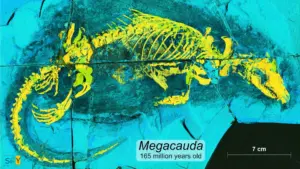

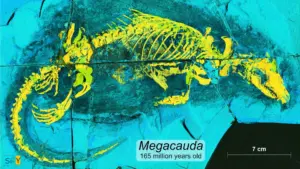






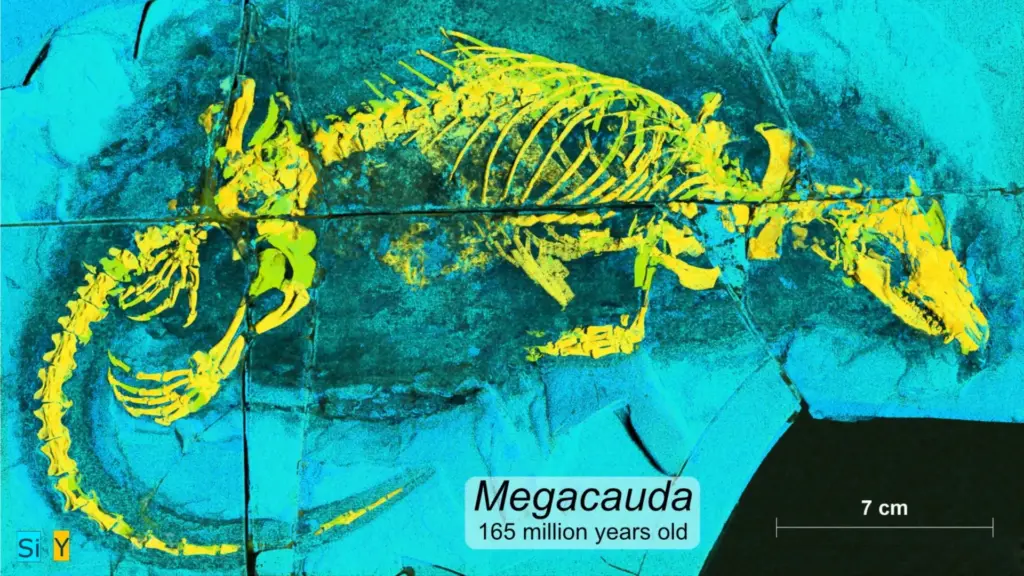
A remarkable fossil discovery from the heart of Inner Mongolia is challenging long-held assumptions about the evolutionary timeline of mammals. Scientists have identified a 165-million-year-old predator, Megacauda sungei, whose sophisticated anatomy offers an unprecedented window into how early mammal relatives navigated the dangerous, dinosaur-dominated landscape of the Jurassic Period. Measuring approximately half a meter—or 20 inches—from its nose to the tip of its broad, flattened tail, this creature was a heavyweight among its contemporaries. While it may seem small by modern standards, its biological complexity suggests that the foundational traits defining mammals today were established far earlier than previously believed.
The findings, the result of a multi-year collaborative effort between researchers from the Paleontological Museum of Liaoning in Shenyang, the University of Chicago, and the University of Bonn, have been published in the journal Nature. Through rigorous analysis, the international team has revealed that Megacauda sungei was not merely a survivor, but a highly specialized aquatic hunter that possessed anatomical features once thought to be exclusive to much later mammalian lineages.
How an Ancient Predator Reveals the Evolution of Swallowing
The most significant discovery regarding Megacauda sungei lies not in its size or its predatory prowess, but in the internal architecture of its skull. High-resolution computed tomography (CT) scans performed on the fossil revealed the presence of a sophisticated soft palate. This anatomical feature acts as a partition between the mouth and the pharynx—the critical passage connecting the oral cavity to the throat.

In many modern non-mammalian vertebrates, the absence of a soft palate dictates a very different approach to feeding. Animals such as crocodiles, for instance, lack this complex structure and rely on a simpler arrangement of hyoid bones in the throat. To move unchewed food down their gullets, crocodiles must rely on gravity, often lifting their heads and performing sudden, jerking motions to force prey into the esophagus. As Professor Thomas Martin of the University of Bonn explains, this reliance on external physics is a far cry from the internal physiological control seen in mammals.
The evolution of the soft palate in mammals represents a monumental shift in vertebrate biology. By separating the air passage from the food passage, it allows for the simultaneous processes of breathing and swallowing. This is a feat that humans perform effortlessly—one can drink from a straw while standing on their head, completely unfazed by the gravitational pull that would otherwise cause a crocodile to struggle.
This development was a cornerstone of mammalian success. Beyond the convenience of eating and breathing at once, the soft palate is essential for the mechanics of nursing. It allows young mammals to consume nutrient-rich milk safely, preventing the liquid from entering the nasal passages or the lungs. This efficiency in feeding provided an immediate survival advantage for offspring, laying the groundwork for the high-metabolic lifestyle that characterizes the class Mammalia.
"It was this adaptation that made brain development, eventually leading to humans, possible," Professor Martin notes. "The soft palate and the shaping of the oral cavity and pharynx are directly linked to the evolution of mammals." Finding evidence of this structure in Megacauda sungei—a creature that thrived tens of millions of years before the rise of modern mammals—suggests that the physiological "machinery" for our own existence was being forged in the murky waters of the Jurassic.
A 165-Million-Year-Old Predator Built for Swimming
Visually, Megacauda sungei would have been an intriguing sight. With its short fur and a broad, flattened tail, it likely bore a striking resemblance to modern semiaquatic mammals like otters, beavers, or the platypus. Its body was clearly optimized for a life spent navigating the water, a habitat that offered both refuge and a bounty of prey.
By constructing detailed three-dimensional models from their CT scans, the researchers were able to simulate how the animal moved. It appears that Megacauda sungei propelled itself through the water primarily by paddling with its front limbs, while its tail provided a rhythmic, undulating motion to increase speed. Its hind legs, meanwhile, likely functioned as rudders, allowing for agile changes in direction as it pursued prey through the water column. According to Professor Martin, this represents the earliest definitive evidence of an aquatic lifestyle in the evolutionary history of mammals.
The animal’s teeth provided further evidence of its predatory nature. It possessed backward-curving cusps, a classic evolutionary design for gripping slippery aquatic prey. However, the researchers were particularly surprised to discover that the creature also possessed specialized canine teeth with three roots. Such dental complexity is a distinctive marker that helped the team classify the animal as a member of the docodonts, an extinct group of mammaliaforms that were widespread during the Jurassic Period.
A Tiny Giant in the Age of Dinosaurs
In the popular imagination, the Mesozoic Era is synonymous with the reign of gargantuan dinosaurs. For roughly 165 million years, the planet was dominated by reptiles, while early mammal relatives were typically relegated to the shadows, often weighing only a few grams and living under constant threat.
In this context, Megacauda sungei was an anomaly. Weighing in at approximately two kilograms—about 4.4 pounds—it was a true heavyweight. While it would be dwarfed by a modern elephant or even a domestic cat, it was a "top predator" in its local ecosystem. Its size, relative to the small, insectivorous mammals that were common at the time, highlights the rapid diversification that took place within the mammaliaform lineage.
An Extraordinary Fossil Discovery in Inner Mongolia
The journey of Megacauda sungei from the sedimentary rocks of Inner Mongolia to the pages of a scientific journal is a testament to the power of international collaboration. The fossil was originally unearthed in the Xiayingzi region and eventually found its way into the collection of the Paleontological Museum of Liaoning. For years, the specimen sat in the archives, its true significance obscured by its appearance among other Jurassic treasures.
It was only when a team of three distinguished paleontologists—Professor Chang-Fu Zhou of Shandong University, Professor Zhe-Xi Luo of the University of Chicago, and Professor Thomas Martin of the University of Bonn—examined the fossil collectively that its potential became clear. Recognizing that they were looking at a previously unknown species, the researchers decided to name it in honor of Professor Sun Ge, the Honorary Director of the Paleontological Museum of Liaoning. They combined "Megacauda," referring to its distinctively large tail, with "sungei," the Latinized patronymic for Sun Ge.
The process of formally identifying and documenting the specimen was an arduous one, involving years of meticulous comparative analysis. The team had to weigh the fossil against both other prehistoric specimens and modern living counterparts to ensure their classification was accurate. "It is the result of a long period of teamwork," Professor Martin remarked.
Ultimately, Megacauda sungei serves as a crucial piece of the puzzle regarding early mammalian diversity. Other fossils from the docodont group have shown that these early relatives were experimenting with a variety of survival strategies: some took to the trees, others burrowed underground in a manner similar to modern moles, and Megacauda sungei successfully exploited the aquatic niche. This wide range of adaptations across the Northern Hemisphere proves that long before the extinction of the dinosaurs paved the way for the age of mammals, our ancient ancestors were already pushing the boundaries of what it meant to be a mammal, setting the stage for the diverse life forms that would eventually inherit the earth.