






Occupational therapy has long recognized that human beings do not function in a vacuum. Every individual operates within a complex web of environmental, physical, and social factors that either facilitate or hinder daily performance. Recently, practitioners in the field have begun adopting a specialized visual graphic organizer traditionally common in social work—the eco map—to better evaluate how interpersonal relationships directly impact a client’s functional performance and overall well-being.
Rooted in the core tenets of the profession, this approach allows therapists to gain a holistic view of a patient’s social environment. Relationships influence nearly every aspect of daily life, from offering emotional encouragement and practical assistance to creating barriers that make routine participation difficult. By utilizing an eco map, occupational therapists can visually chart these dynamics, offering both practitioners and clients a clear snapshot of the support systems surrounding an individual.
The implementation of this tool aligns closely with professional guidelines. According to the Occupational Therapy Practice Framework, Fourth Edition (OTPF-4), supports and relationships are formally classified as vital environmental factors. These factors significantly influence participation and performance across various domains, encompassing the physical, social, and attitudinal surroundings in which people live and engage in occupations. While traditionally emphasized in social work, integrating eco maps into occupational therapy sessions provides a structured mechanism to target broader environmental impacts on health, including the management of professional burnout among therapists themselves.

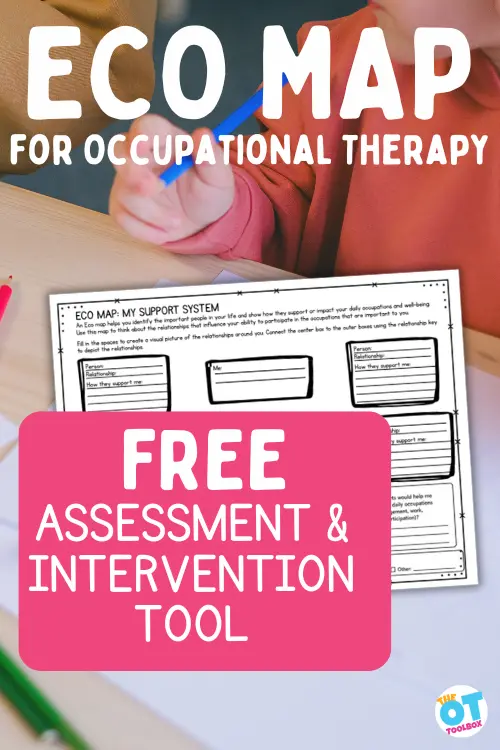
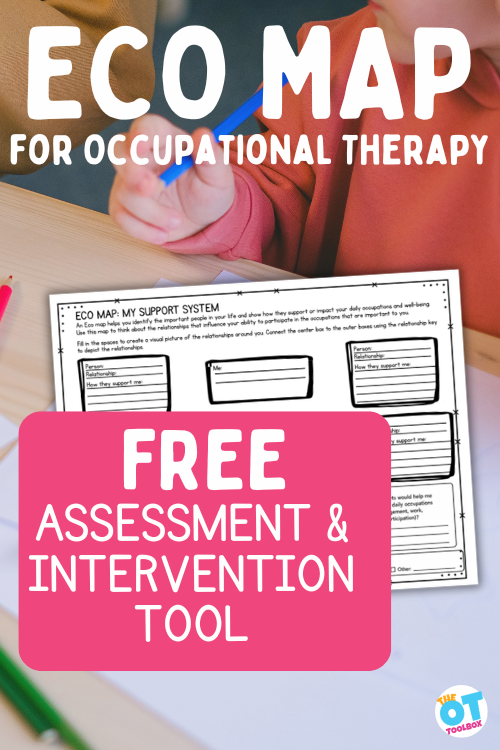
To understand the utility of the tool, it helps to examine what an eco map entails. Much like a mind map, an ecomap requires an individual to place themselves in the center of a visual diagram and identify the people, groups, organizations, and support systems that play an active role in their daily routine. Unlike a traditional family tree or genogram, an ecomap focuses exclusively on current relationships and how those connections affect active participation, personal well-being, and overall functioning. It explicitly illustrates supportive versus stressful connections, thereby highlighting resources that can be mobilized to strengthen occupational engagement.
Within the framework of occupational therapy, social participation is recognized as a fundamental occupation in its own right. This encompasses all activities involving interactions with family members, friends, peers, coworkers, community members, and various social groups. These interactive occupations play a critical role in overall health and quality of life, yet they are frequently overlooked during standard functional evaluations. The ability to establish, maintain, and navigate relationships directly affects educational participation, work performance, leisure activities, routine self-care, and emotional well-being.
Furthermore, many individuals rely heavily on their support systems to successfully complete Activities of Daily Living, commonly known as ADLs, and Instrumental Activities of Daily Living, or IADLs. Supportive relationships frequently assist with fundamental self-care tasks as well as more complex community living skills. For instance, an older adult may depend entirely on adult children for transportation to necessary medical appointments, while a teenager might rely on caregivers to establish structured routines that promote independence. Similarly, a college student may lean heavily on peer support networks while learning to navigate independent living. The ecomap serves to pinpoint these exact relationships and maps out the specific ways they sustain daily participation.
Relationships also exert a profound influence on occupational participation within work environments. When examining the broad category of work, occupational therapists evaluate the various components that impact performance and job satisfaction. Success in these settings often depends heavily on interpersonal communication abilities, social interaction skills, problem-solving, collaboration, and external support systems. By deploying an ecomap, individuals and their therapists can clearly identify critical workplace relationships, communication breakdowns, and areas of professional isolation that may significantly impair job performance or contribute to occupational burnout.
As a screening and discussion tool, the ecomap offers substantial clinical value. While it does not function as a standardized assessment, it provides deep qualitative insight into a client’s social environment and existing support networks. As clients map out their connections, practitioners can readily observe patterns. Some individuals demonstrate robust family support systems coupled with a total lack of community involvement, whereas others maintain extensive social circles while lacking practical, everyday functional support. These observations subsequently guide individualized intervention planning and goal development.
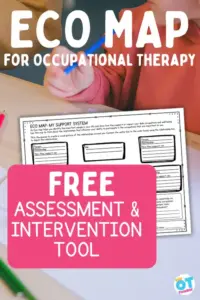
The practical application of the eco map worksheet begins by placing the client’s name in a central focal point. From there, the individual systematically identifies important people and supports across multiple categories, including immediate and extended family, friends and peers, school and work supports, healthcare and service providers, community organizations, and online support networks. For each identified relationship, the client can record the nature, frequency, and quality of the interaction, distinguishing whether the connection acts as a facilitator of independence or a barrier to engagement.
Although eco maps have a long history in social work, their intentional adaptation for functional occupational therapy outcomes represents an evolving practice. By pairing the visual mapping exercise with targeted reflection questions, practitioners can deepen client self-awareness and unearth intervention opportunities that might otherwise remain hidden during standard evaluations. These guided discussions often reveal crucial insights regarding how social circles either promote or detract from independence.
Ultimately, occupational therapy operates on the principle that meaningful participation requires looking beyond the individual to the surrounding social and environmental context. The eco map provides a practical, adaptable method for exploring these connections, enabling therapists and clients to collaborate effectively on building stronger pathways toward enhanced daily functioning, improved social participation, and greater overall quality of life.