








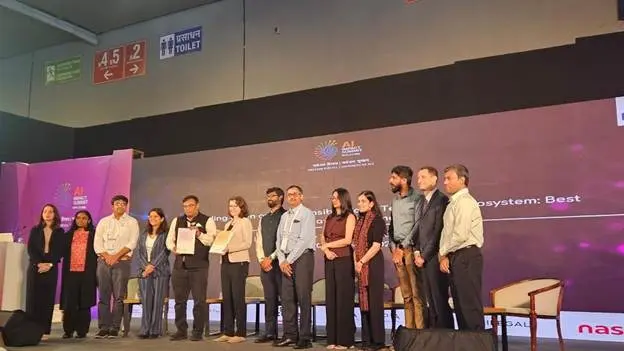
NEW DELHI — In a landmark move for the global assistive technology community, India’s Ministry of Electronics and Information Technology recently unveiled a comprehensive strategy to transform the country from a text-heavy digital landscape into a dynamic, voice-first ecosystem. Launched on the global stage at the India AI Summit Expo, this ambitious initiative is anchored by two monumental documents: a comprehensive policy report focused on building responsible voice ecosystems and a practical developers’ toolkit designed to empower creators of accessible software.
For those working within the accessibility space, this policy shift represents far more than a mere technical upgrade. Instead, it marks a fundamental change in how millions of people with limited literacy, visual impairments, or physical disabilities will interact with the digital world. For generations, the evolution of the internet has favored those who can comfortably read and write in dominant languages, leaving vast segments of the global population behind. By redefining how technology communicates with its users, India’s new roadmap aims to dismantle these long-standing barriers at their root.
The announcement comes at a time when governments worldwide are grappling with the digital divide, a phenomenon that has evolved far beyond mere internet connectivity. For over a billion people globally, the digital divide is fundamentally about a lack of quality of use. Most contemporary digital interfaces are engineered specifically for literate, English-speaking users, creating an invisible wall for populations that communicate primarily through spoken regional dialects or struggle with reading and writing. India’s new strategy addresses this imbalance by treating voice recognition and speech technology not as luxury features, but as essential Digital Public Infrastructure.

By integrating voice capabilities deeply into the civic and commercial fabric of the nation, the government hopes to ensure that accessing government services, digital banking, healthcare portals, and educational resources becomes as simple as speaking naturally in one’s native tongue. This paradigm shift holds profound implications for individuals who have historically been disenfranchised by text-centric applications, effectively democratizing access to the modern digital economy.
To bridge the gap between high-level policy and grassroots implementation, the newly released developers’ toolkit provides a practical, hands-on guide for creators of assistive technologies. Historically, ethical considerations, security safeguards, and accessibility compliance have been treated as afterthoughts in the fast-paced software development lifecycle. The new toolkit moves these critical elements from the periphery to a foundational requirement. It outlines clear pathways for developers to integrate robust speech recognition technologies that can accurately process diverse accents, dialects, and regional speech patterns without compromising user privacy or data security.
Furthermore, the guidelines emphasize the importance of inclusive design principles, ensuring that software developers build applications that are inherently intuitive for users with varying physical and cognitive capabilities. By equipping engineers with the necessary frameworks, standards, and technical resources, the toolkit lowers the barrier to entry for local startups and major tech firms alike, fostering an environment where inclusive innovation can thrive organically.

However, transitioning an entire nation of over 1.4 billion people—with dozens of major languages and hundreds of dialects—to a voice-first ecosystem is a monumental undertaking. The accompanying policy report is refreshingly candid about the massive hurdles that lie ahead. Building and maintaining a truly inclusive digital ecosystem requires far more than initial technological innovation; it demands long-term financial stamina, sustained public-private partnerships, and continuous investment in linguistic research.
Funding remains the elephant in the room for initiatives of this scale. Developing highly accurate speech models for low-resource languages requires vast amounts of localized training data, specialized computing infrastructure, and ongoing linguistic curation. Ensuring the financial sustainability of these public infrastructure projects will require coordinated efforts between government bodies, philanthropic organizations, and private sector technology leaders. The policy report openly discusses the economic frameworks needed to secure this funding, emphasizing that the long-term socioeconomic benefits of a fully included populace far outweigh the initial capital expenditure.
While India’s linguistic diversity presents a unique technical challenge, the underlying issues are far from unique. Many nations across Africa, Southeast Asia, and Latin America face remarkably similar hurdles regarding linguistic fragmentation, varying levels of digital literacy, and the dominance of foreign languages in digital spaces. Countries such as Nigeria, which boasts over 500 distinct languages including Hausa, Yoruba, and Igbo; South Africa, with its eleven official languages; as well as Ethiopia and Kenya, could benefit immensely from the frameworks and methodologies established in India’s new roadmap.
By demonstrating how a complex, multilingual society can successfully harness voice artificial intelligence to bridge the digital divide, India is effectively creating a global blueprint for digital inclusion. The strategies outlined in the policy report and developers’ toolkit offer a scalable model for other developing nations striving to make their digital economies accessible to all citizens, regardless of their linguistic background or reading proficiency.
The launch of these comprehensive reports marks a definitive turning point for the international accessibility community. India is showing the world through concrete policy actions that voice technology is not merely a matter of convenience or modern luxury, but a fundamental human right in the digital age. By tackling the difficult, systemic questions surrounding sustainable funding, legal frameworks, and technical standards, this initiative provides a clear roadmap for achieving global digital inclusion.
If developers and policymakers can successfully master voice AI within the complex and diverse linguistic landscape of India, the precedent demonstrates that similar solutions can be implemented anywhere in the world. This initiative serves as a powerful call to action for technologists, lawmakers, and accessibility advocates globally to examine these newly established documents, adapt them to their unique regional contexts, and commit to building a future where the internet listens to every voice.